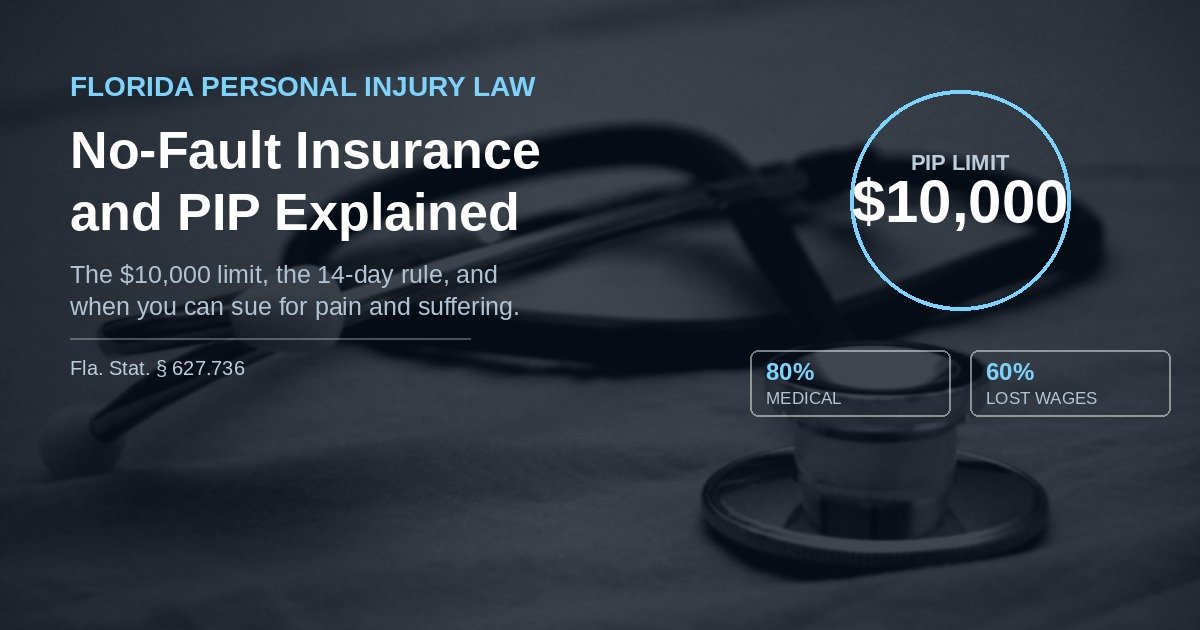
Florida requires every driver to carry at least $10,000 in Personal Injury Protection (PIP) coverage, which pays 80% of your medical bills and 60% of your lost wages after a crash, regardless of who caused it. What PIP does not cover is pain and suffering, and the $10,000 limit runs out fast in a serious accident, which is exactly why understanding this system matters even though your own insurance is paying first.
What “No-Fault” Actually Means in Florida
No-fault doesn’t mean fault stops mattering. It means that for your initial medical bills and lost income, your own PIP coverage pays out regardless of who caused the crash, instead of you having to first prove the other driver was at fault. Fault still determines who pays for vehicle damage, and once your injuries clear a certain threshold (more on that below), fault comes back into play for a full injury claim against the at-fault driver.
Under Florida Statute § 627.736, PIP pays:
- 80% of reasonable, necessary medical expenses
- 60% of lost wages
- A $5,000 death benefit
- All of it drawn from the same $10,000 aggregate limit
The 14-Day Rule – Miss This and You May Lose PIP Entirely
To access PIP medical benefits at all, you generally have to receive initial medical services within 14 days of the accident. This is separate from, and much stricter than, the two-year deadline to file a lawsuit covered in our guide to Florida’s car accident statute of limitations. Waiting two weeks to “see if it gets better on its own” isn’t just a health risk – it can disqualify you from PIP coverage regardless of how legitimate your injury turns out to be.
The $2,500 vs. $10,000 Split: The EMC Determination
Here’s a detail that catches a lot of people off guard. The full $10,000 PIP medical benefit isn’t automatic – it only unlocks if a qualified provider determines you have an “Emergency Medical Condition” (EMC) under the statute, meaning a condition where the absence of immediate care could reasonably be expected to result in serious jeopardy to your health. Without that determination, PIP medical coverage is capped at $2,500.
The providers allowed to make an EMC determination are limited by statute to a physician (MD or DO), dentist, physician assistant, or advanced practice registered nurse. A chiropractor, who many people see first after a minor-feeling accident, generally cannot make this determination. If a chiropractor is the only provider you’ve seen, you may be stuck at the $2,500 cap even with a real injury – one more reason seeing a medical doctor early matters, not just for your health but for what your PIP coverage will actually pay.
PIP Doesn’t Cover Pain and Suffering – Here’s When You Can Sue For It
PIP is strictly economic: medical bills and lost wages, up to the limit. It never pays for pain and suffering, emotional distress, or loss of enjoyment of life. To pursue those damages from the at-fault driver, your injury has to clear Florida’s serious injury threshold under Florida Statute § 627.737, meaning it involves, at least in part:
- Significant and permanent loss of an important bodily function
- Permanent injury, within a reasonable degree of medical probability
- Significant and permanent scarring or disfigurement
- Death
The word doing the most work here is permanent. Temporary soreness or bruising, even if genuinely painful for weeks, generally won’t clear this bar on its own. A herniated disc, a surgery, documented nerve damage, or lasting scarring often will. This is also where thorough, prompt medical documentation stops being just a health matter and becomes the evidence your entire claim beyond PIP depends on.
Is Florida Getting Rid of No-Fault?
You may have seen headlines suggesting Florida was about to eliminate PIP. During the 2025 legislative session, HB 1181 and SB 1256 proposed repealing the no-fault system entirely and replacing it with mandatory bodily injury liability coverage of $25,000 per person and $50,000 per accident, which would have eliminated the serious injury threshold altogether since injured drivers could sue directly for any damages. Neither bill passed. As of 2026, Florida remains a no-fault state, PIP is still mandatory, and the serious injury threshold described above still applies. If you’re getting information that says otherwise, it’s either outdated or describing a proposal that never became law – worth double-checking directly with the Florida Senate or House before acting on it.
Why Uninsured/Underinsured Motorist Coverage Matters More Here
Unlike PIP, uninsured/underinsured motorist (UM/UIM) coverage is optional in Florida, not mandatory. That makes it one of the more consequential decisions a Florida driver makes, since it’s what steps in when the at-fault driver has no insurance, not enough insurance, or flees the scene entirely. Given that PIP alone rarely covers a serious accident’s real cost, and that a driver without adequate liability coverage can leave you with nowhere else to turn, UM/UIM is worth carrying even though Florida law doesn’t require it. Once PIP is exhausted and a claim moves toward the at-fault driver, the factors that determine what a case is actually worth are covered in our guide to average car accident settlements in Florida.
Frequently Asked Questions
Do I still need to call the police if my own PIP is going to pay for my medical bills?
Yes. A police report still matters for establishing what happened, for any vehicle damage claim, and for a future injury claim against the at-fault driver if your case ends up clearing the serious injury threshold. PIP paying first doesn’t remove the value of documentation.
What happens if my medical bills exceed my $10,000 PIP limit?
Once PIP is exhausted, you’re responsible for the remainder unless you have additional coverage like MedPay, health insurance, or your injury clears the serious injury threshold and you pursue a claim against the at-fault driver.
Can I choose not to carry PIP in Florida?
No. PIP is legally required for any vehicle registered in Florida, alongside Property Damage Liability coverage. It’s one of the few truly mandatory coverages in the state.
Does PIP pay if I caused the accident myself?
Yes, that’s the core feature of no-fault coverage. Your PIP pays your own medical bills and lost wages regardless of who caused the crash, within the policy limits and the rules described above.
If my injury doesn’t meet the serious injury threshold, am I out of options?
You’re limited to your PIP and any other coverage you carry (health insurance, MedPay) for that specific accident’s economic costs – you generally can’t pursue the at-fault driver for pain and suffering. This is exactly why understanding the threshold before treatment decisions get made, not after, matters.
This article is for general informational purposes and does not constitute legal advice. Insurance rules and legislative proposals can change. Consult a licensed Florida attorney or your insurance provider to confirm current requirements for your situation.