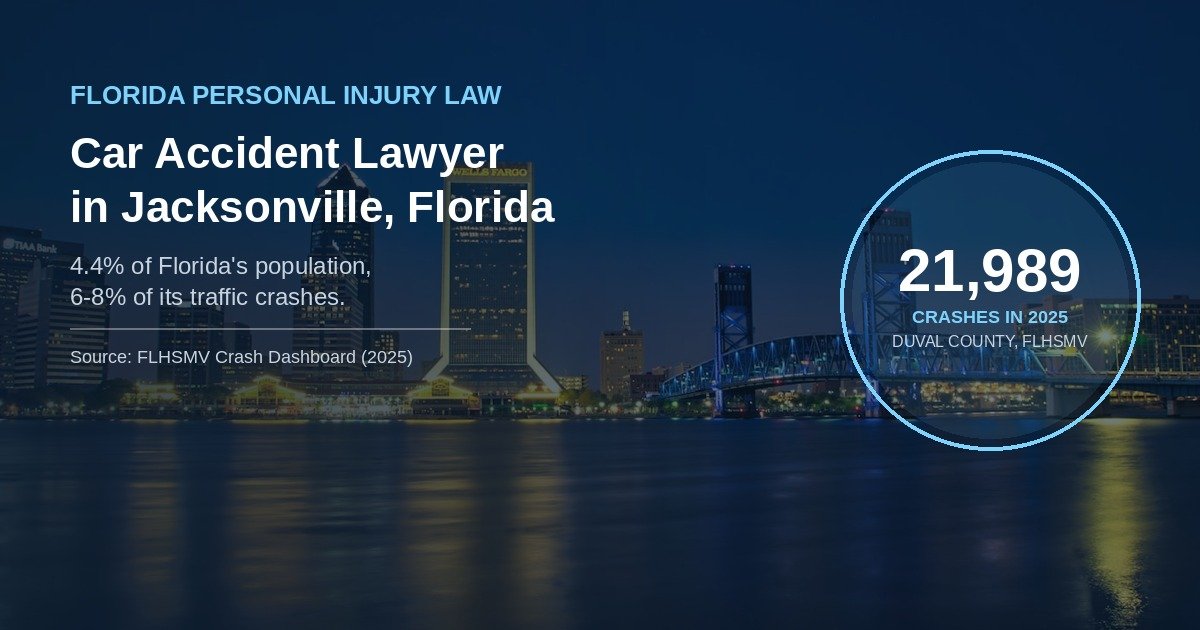
Jacksonville makes up roughly 4.4% of Florida’s population but accounts for 6-8% of the state’s annual traffic crashes, according to FLHSMV Crash Dashboard data – a disproportion that shows up consistently year over year. Duval County recorded 21,989 crashes in 2025, resulting in 172 fatalities and more than 15,000 injuries. If you were hurt in a Jacksonville crash, the Florida legal deadlines, no-fault insurance rules, and settlement factors covered elsewhere on this site apply exactly the same way statewide – what’s useful locally is understanding why Jacksonville’s numbers run so far ahead of its population share.
Why Jacksonville’s Crash Rate Runs So High
A few factors specific to Jacksonville show up repeatedly in local crash data and city safety reports:
- Duval County’s size and highway network. Jacksonville is geographically enormous for its population, meaning residents drive more miles on average, much of it on interstate corridors rather than short local trips.
- I-95 through Jacksonville has documented crash clusters from FL-117/Norwood Avenue to the St. Johns River, and where FL-13, FL-10, and I-95 merge on the south side of the river – both flagged repeatedly in crash-pattern analyses as high-risk stretches.
- I-10 has several notable interchange clusters along its length through the county, particularly where it meets other major highways.
- Older road design. Many of Jacksonville’s arterial roads, including stretches of Blanding Boulevard, were built for far lower traffic volumes than they now carry, with confusing lane configurations and aging signal timing frequently cited as contributing factors.
- Dangerous intersections identified in local crash data include SR 312 and US 1, Atlantic Boulevard and Southside Boulevard, Beach Boulevard and Hodges Boulevard, and St. Johns Bluff Road and Central Parkway.
Jacksonville Has a Serious Hit-and-Run and DUI Problem
Duval County records more than 6,360 hit-and-run crashes a year – a striking share of the county’s total crash volume. If you’re involved in a hit-and-run, Florida’s PIP coverage still pays your initial medical bills and lost wages regardless of whether the other driver is identified, which is exactly why understanding the no-fault system matters, and why optional uninsured motorist coverage is worth serious consideration in Jacksonville specifically.
DUI-related crashes are also a significant local concern – a 2023 study ranked Jacksonville among the deadliest U.S. cities for DUI fatalities, and the city saw deadly DUI crashes more than double between 2019 and 2020. This pattern has continued to show up in more recent crash data as a persistent, not one-time, problem.
Pedestrians and Cyclists Face Elevated Risk
Jacksonville has ranked among the more dangerous U.S. metro areas for pedestrians in national safety rankings. Duval County sees roughly 481 pedestrian crashes (39 fatalities) and 383 bicycle crashes (11 fatalities) a year – both disproportionate to the county’s population, and concentrated in neighborhoods like Riverside, San Marco, Arlington, and areas near downtown where foot traffic and congestion overlap.
What This Means for Your Claim
The legal mechanics don’t change based on which Florida city you’re in – the same PIP-first, no-fault system, the same serious injury threshold for pursuing damages beyond PIP, and the same 51% comparative fault rule apply in Jacksonville exactly as they do anywhere else in Florida. Where Jacksonville’s crash data becomes useful is in cases involving I-95, I-10, or one of the intersections above – a documented history of crashes at a specific location can support your account of how the accident happened, particularly when fault is disputed.
Jacksonville-area claims are typically handled in Duval County. Given how much of the area’s crash activity ties to hit-and-run incidents and DUI-related crashes specifically, if either was a factor in your accident, that context is worth raising early with whoever handles your claim.
Frequently Asked Questions
Why does Jacksonville have so many more crashes than its population would suggest?
Jacksonville’s large geographic size relative to its population means residents drive more highway miles on average, combined with aging road infrastructure and several documented high-crash interstate corridors, particularly along I-95 and I-10.
What should I do if I’m in a hit-and-run accident in Jacksonville?
Report it to police immediately and seek medical treatment within Florida’s 14-day PIP window regardless of whether the other driver is identified – your own PIP coverage still applies, and uninsured motorist coverage, if you carry it, can help cover what PIP doesn’t.
Are DUI-related crashes a bigger problem in Jacksonville than elsewhere in Florida?
Data suggests yes – Jacksonville was ranked among the deadliest U.S. cities for DUI fatalities in a 2023 study, and deadly DUI crashes rose sharply in recent years, a trend distinct from typical statewide patterns.
Is a Jacksonville car accident claim handled differently than one elsewhere in Florida?
The underlying law is identical statewide. The practical difference is usually Duval County court scheduling and practices, along with the specific crash patterns tied to Jacksonville’s highway network and hit-and-run rate.
This article is for general informational purposes and does not constitute legal advice. Crash statistics are drawn from FLHSMV reporting and third-party analyses of that data; figures vary by source, year, and reporting scope. Consult a licensed Florida attorney regarding your specific case.