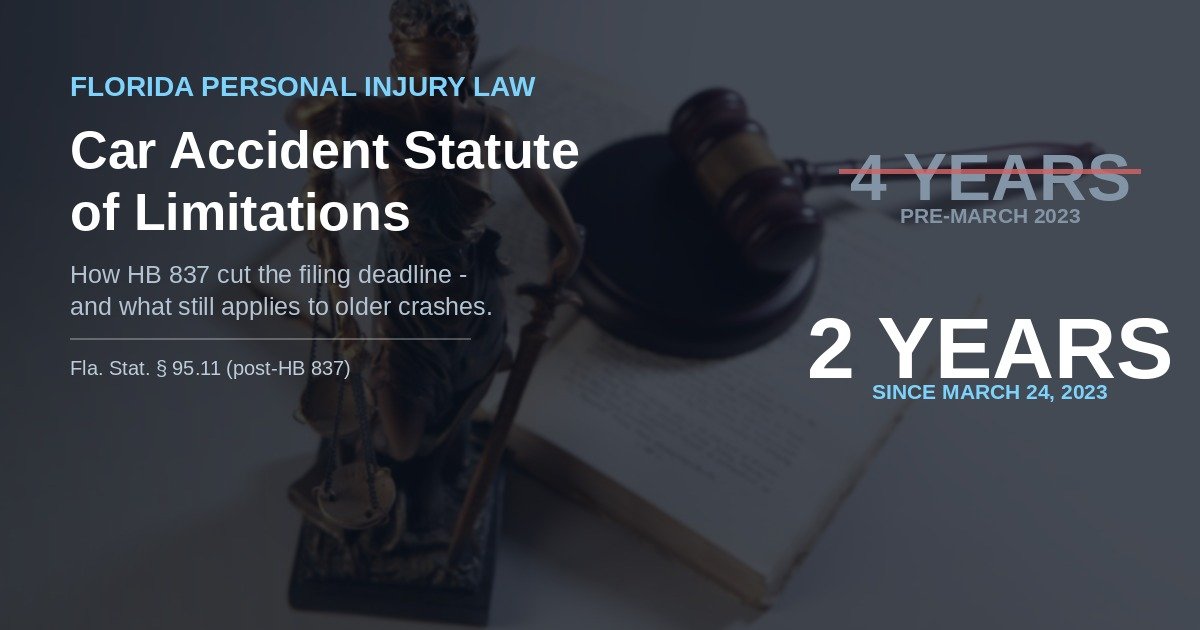
If your car accident happened on or after March 24, 2023, you have two years from the date of the crash to file a personal injury lawsuit in Florida. This is a relatively recent change – before that date, Florida gave injury victims four years. If your accident happened before March 24, 2023, the older four-year deadline still applies to your case.
Why the Deadline Changed
In March 2023, Florida enacted House Bill 837, a sweeping tort reform law that cut the general negligence statute of limitations in half, from four years down to two. Car accidents fall under this general negligence category, so the shorter deadline applies to the large majority of Florida crash claims. The change wasn’t retroactive: it only applies to accidents that happened on or after the law’s effective date. A crash from 2022 still gets the old four-year window; a crash from 2024 gets two years.
This is one of the areas where a lot of content online is simply out of date. Search this topic and you’ll still find pages citing the old four-year rule as current fact, and even the statute’s own citation has moved: it was previously codified at § 95.11(4)(a) and was renumbered to § 95.11(5)(a) after a 2024 reorganization of the statute. If a source you’re reading cites four years or the old subsection number, it’s describing pre-2023 law, not the rule that applies today.
When the Clock Starts
For most car accident claims, the two-year period starts on the date of the crash itself, not the date you finish treatment, not the date your insurance claim wraps up, and not the date you first talk to a lawyer. If your accident happened on June 1, 2024, your deadline to file suit is June 1, 2026, regardless of how your medical treatment or insurance negotiations are going at that point.
Exceptions That Can Change Your Deadline
Wrongful death. If a crash results in a death, the two-year deadline still applies, but it runs from the date of death rather than the date of the accident. This rule wasn’t changed by HB 837 – it was already two years beforehand. If someone survives for weeks or months after a crash before passing away, this can meaningfully shift the deadline later than the accident date alone would suggest.
Claims against government entities. If a government vehicle or a road defect maintained by a city, county, or state agency was involved, Florida’s sovereign immunity rules under § 768.28 require you to first submit written notice to the government entity, which then gets 180 days to investigate before a lawsuit can even be filed. This process runs on a different clock than the standard two-year deadline, so treat any government involvement as a reason to move faster, not slower.
Minors and legal incapacity. Special tolling rules can pause the clock when the injured person is a minor or otherwise legally incapacitated at the time of the crash, similar to how many states handle these situations.
Intentional acts. If the crash involved an intentional act rather than negligence (an intentional ramming, for example, rather than an accident), a different four-year deadline for intentional torts may apply instead of the two-year negligence rule.
A Second Clock: Your Own Insurance Claim
Separately from the lawsuit deadline, first-party insurance claims – meaning a claim against your own auto insurer, such as under your policy’s contract terms – generally follow Florida’s five-year statute of limitations for actions on a written contract, not the two-year negligence deadline. This distinction matters if a dispute develops with your own insurance company rather than the other driver, since you may have more time than the two-year lawsuit deadline would suggest. This is a nuance worth confirming with an attorney rather than assuming either deadline applies by default.
Florida’s No-Fault System Doesn’t Change This Deadline
Florida requires drivers to carry Personal Injury Protection (PIP) coverage, which pays your initial medical bills and lost wages after a crash regardless of who was at fault. This is a separate system from the negligence lawsuit described above, and it comes with its own tight timeline – Florida law generally requires seeking treatment within 14 days of a crash to qualify for PIP benefits at all. That 14-day rule is a completely different deadline from the two-year statute of limitations covered in this article, and missing it can cost you PIP benefits even if you’re nowhere near the lawsuit deadline. We cover the no-fault PIP system and its rules in more detail in our guide to Florida’s no-fault insurance law.
What Happens If You Miss the Two-Year Deadline
If you file even a single day after your deadline expires, the at-fault party can move to have your case dismissed, and Florida courts routinely grant that motion regardless of how strong the underlying claim is. Once dismissed on those grounds, you generally lose the ability to pursue compensation through the courts for that accident entirely.
What to Do If You’re Not Sure Which Deadline Applies
Given how recently this law changed, and how much outdated information is still circulating, don’t assume either the two-year or four-year rule applies to your situation without confirming your accident date against March 24, 2023. If your case involves a government entity, a minor, a wrongful death, or a dispute with your own insurer rather than the at-fault driver’s, the standard two-year rule may not be the deadline that actually controls your case.
Frequently Asked Questions
Does the two-year deadline apply to property damage claims too?
Property damage claims generally follow their own limitations period under Florida law, separate from the personal injury negligence deadline. If your accident involved both injury and vehicle damage, don’t assume both claims share an identical deadline without confirming.
What if I was hurt in Florida but I’m not a Florida resident?
Florida’s statute of limitations generally applies to lawsuits filed in Florida courts regardless of the injured person’s home state, though where you can or should file can get more complicated if multiple states are involved. This is worth discussing with an attorney rather than assuming.
Can insurance negotiations pause the two-year clock?
No. Ongoing settlement talks with an insurance company do not pause or extend the statute of limitations. If a fair settlement hasn’t been reached as your deadline approaches, a lawsuit generally needs to be filed to preserve your right to recover, even if negotiations are still technically open.
I was in an accident in 2022 – does the new two-year rule apply to me?
No. HB 837’s two-year deadline only applies to accidents on or after March 24, 2023. A 2022 accident falls under the older four-year rule that was in effect at the time.
Does the two-year deadline affect my PIP claim?
Not directly – PIP claims run on their own rules, including the 14-day treatment window to qualify for benefits at all, which is a much shorter and separate deadline from the two-year lawsuit statute of limitations described here.
This article is for general informational purposes and does not constitute legal advice. Deadlines and exceptions depend on the specific facts of your case, including your exact accident date. Consult a licensed Florida attorney to confirm which statute of limitations applies to your situation.