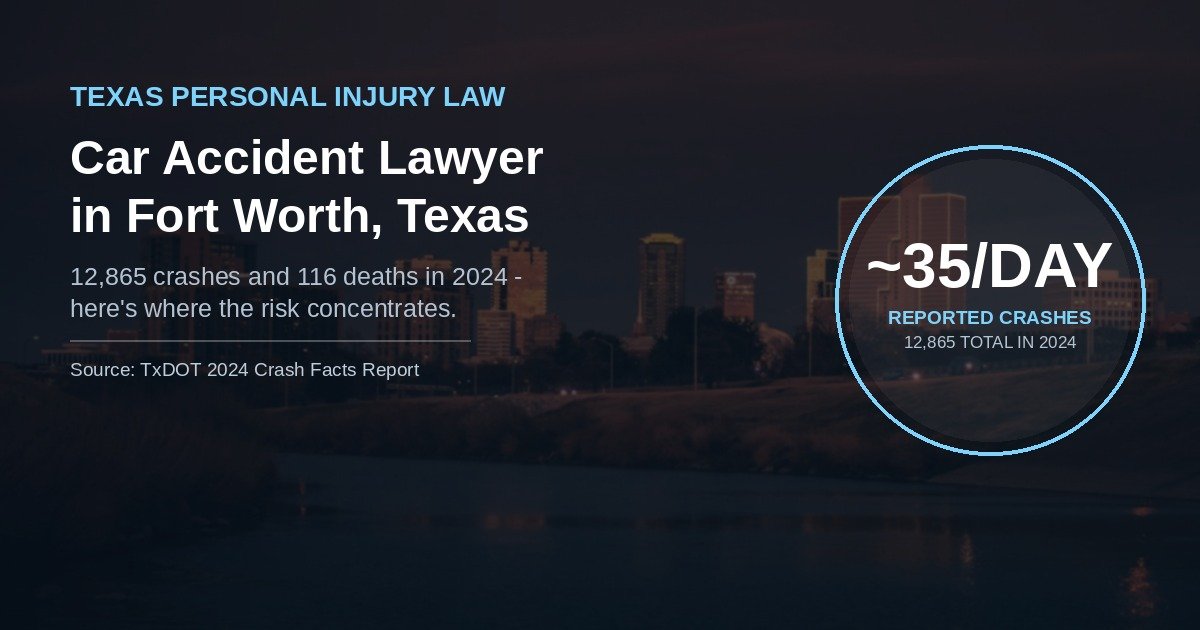
Fort Worth recorded 12,865 traffic crashes in 2024, resulting in 116 deaths and more than 6,600 injuries, according to TxDOT’s official Motor Vehicle Traffic Crash Facts report – roughly 35 collisions every single day in a city that recently crossed 1 million residents. If you were hurt in a Fort Worth crash, the Texas legal deadlines, fault rules, and settlement factors covered elsewhere on this site apply exactly the same way statewide – what’s useful locally is understanding where Fort Worth’s risk actually concentrates.
Where Fort Worth’s Crashes Concentrate
Fort Worth ranked fourth among major Texas cities for total crashes in 2024, behind Houston, Dallas, and El Paso. A handful of corridors and interchanges account for a disproportionate share of the city’s serious crashes:
- The I-30 and I-35W interchange, described by multiple crash-data analyses as a known engineering challenge where sudden slowdowns and merging conflicts regularly produce chain-reaction crashes.
- I-35W through downtown, one of the city’s most congested corridors even after a $1.4 billion expansion completed in 2018. This corridor was the site of a well-documented 133-vehicle pileup during a 2021 ice storm that killed six people – an extreme example, but one that illustrates how quickly conditions can turn dangerous on this specific stretch.
- The Loop 820 interchanges with I-30 and I-20, along with where US-287 feeder roads join the freeway system, all flagged for short acceleration lanes and closely spaced ramps that leave little margin for error.
- SH-183 (Airport Freeway) near DFW Airport, another corridor with a history of elevated crash volume tied to heavy commercial and commuter traffic.
Older intersection-level data has flagged specific high-crash locations like Riverside Drive at East Lancaster Avenue and I-35W at Meacham Boulevard, though these figures are less current – treat named intersections as directional rather than a precise current ranking, and rely on the corridor-level pattern above as the more reliable current signal.
Rear-end collisions account for the largest share of Fort Worth crashes overall, while DWI-related crashes make up a disproportionate share of fatalities – a pattern consistent with the rest of North Texas.
What This Means for Your Claim
The legal mechanics don’t change based on which Texas city you’re in – the same two-year statute of limitations, the same 51% comparative fault rule, and the same contingency fee structure apply in Fort Worth exactly as they do anywhere else in Texas. Where Fort Worth’s crash data becomes useful is in cases involving one of the corridors above – a documented pattern of merging conflicts or chain-reaction crashes at a specific interchange can support your account of how the accident happened, particularly when fault is disputed.
Fort Worth-area claims are typically handled in Tarrant County. Given how much of the city’s serious crash activity concentrates on a relatively small number of interchanges, if your accident happened at or near one of the locations above, that context is worth raising with whoever handles your claim.
Frequently Asked Questions
What is the most dangerous road for car accidents in Fort Worth?
The I-30 and I-35W interchange is consistently flagged as a high-risk merging area, and I-35W through downtown carries some of the city’s heaviest and most congestion-prone traffic, including the site of a fatal multi-vehicle pileup during a 2021 ice storm.
How does Fort Worth compare to other Texas cities for crash risk?
Fort Worth ranked fourth among major Texas cities for total crashes in 2024, behind Houston, Dallas, and El Paso, with roughly 35 reported collisions per day citywide.
What’s the most common cause of serious crashes in Fort Worth?
Rear-end collisions account for the largest share of overall crashes, while impaired driving is responsible for a disproportionate share of fatal ones.
Is a Fort Worth car accident claim handled differently than one elsewhere in Texas?
The underlying law is identical statewide. The practical difference is usually Tarrant County court scheduling and practices, along with the specific crash patterns unique to Fort Worth’s interchange-heavy road network.
This article is for general informational purposes and does not constitute legal advice. Crash statistics are drawn from TxDOT’s official crash reports and third-party analyses of that data; figures vary by source, year, and reporting scope. Consult a licensed Texas attorney regarding your specific case.