You’re on an F-1 visa, you have a real business idea, and you want to know exactly what you can and can’t do before you accidentally jeopardize your status. Here’s the specific answer for F-1 students, building on the general passive-versus-active principle covered in our main guide on owning an LLC on a visa.
F-1 Quick Reference
| Situation | General Rule |
| Passive ownership | Generally allowed without special authorization |
| Active work for your own LLC | Requires CPT or OPT authorization tied to your field of study |
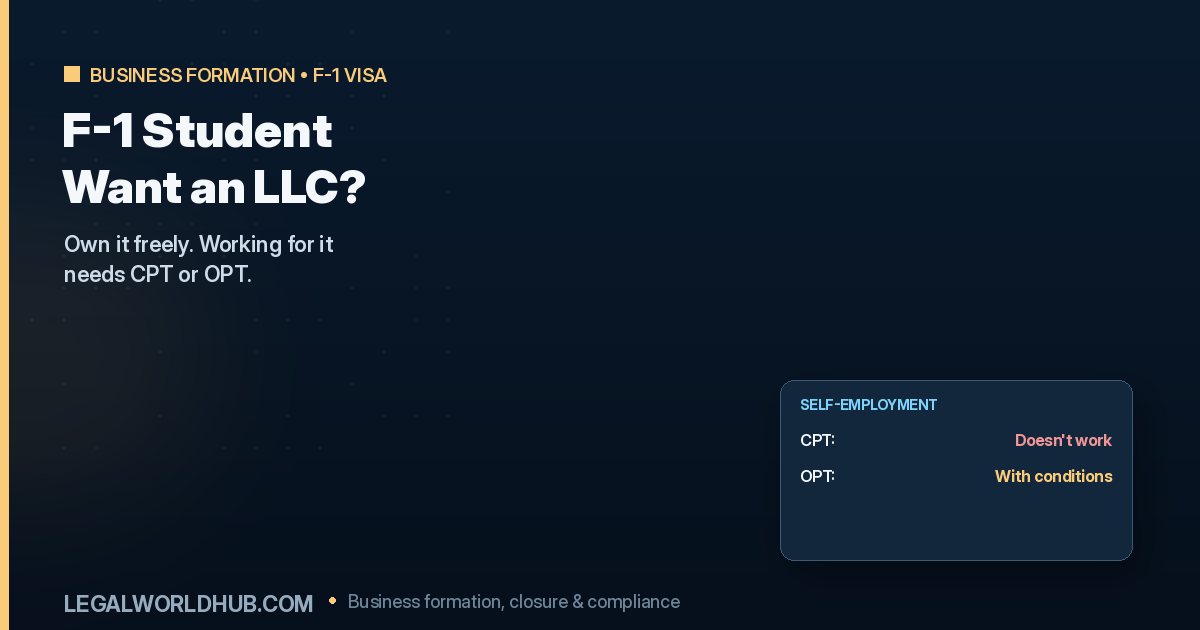
| Self-employment under CPT | Not possible; CPT requires an actual employer-employee relationship |
| Self-employment under standard OPT | Possible, but you must retain less than 50 percent control and work under genuine employer oversight |
| Raising investment capital | Generally considered passive, not employment |
Yes, You Can Own the LLC
Nothing about F-1 status prevents you from forming an LLC and holding ownership in it. You can register the business, be listed as a member, and receive your share of profits as passive income. This part is genuinely straightforward and doesn’t require any special authorization.
The Part That Actually Restricts You: Working for It
F-1 status authorizes you to study, not to work, with narrow, specific exceptions. Curricular Practical Training and Optional Practical Training are the two paths that allow F-1 students to work, and both come with real structural requirements that matter enormously if the employer in question is your own company.
CPT and Your Own LLC: Generally Doesn’t Work
CPT requires a genuine employer-employee relationship as part of an established curricular requirement, typically tied to an internship or practicum integrated into your academic program. Being self-employed through your own LLC generally cannot satisfy this requirement, since CPT is built around the idea of an external employer providing training and oversight, not you supervising yourself.
OPT and Your Own LLC: Possible, With Real Conditions
Standard OPT offers more room, and it is genuinely possible to work for your own company under OPT, but only within specific structural limits. You generally need to retain less than 50 percent control over the business, meaning majority control needs to sit elsewhere, with a co-founder, investor, or board structure, and the work needs to fit within a genuine employer-employee framework rather than you simply doing whatever you want as the founder. Talk to your school’s Designated School Official before structuring anything like this, since your specific school’s interpretation of these requirements can matter as much as the general federal rules do.
What Definitely Doesn’t Work: The Real Case That Went Wrong
An F-1 student used an LLC to buy distressed real estate, resell it for profit, and hired contractors to do the physical work. On paper, that might sound passive, hiring others to do the labor. In practice, the student personally coordinated the work and handled sales, and during a later OPT application review, USCIS flagged the associated tax filings and denied the application based on unauthorized employment. Coordination and active decision-making, even when you’re not personally swinging a hammer, is exactly the kind of involvement that crosses the line.
How to Structure This More Safely
- Use a US citizen, green card holder, or otherwise work-authorized person as the LLC’s actual operator or manager, with a properly documented management agreement
- Avoid transferring money out of the LLC to yourself for anything other than documented, genuinely passive investment returns
- If you want to actively build and run a company yourself rather than structure around this limitation, look into whether the E-2 treaty investor visa applies to your nationality, since it’s specifically designed to allow active business management in a way F-1 status is not
Raising Money Is Generally Fine
Meeting with investors, pitching your business idea, and negotiating funding terms is generally treated as a passive activity rather than day-to-day operational work, since it doesn’t involve performing the actual labor or services the business provides. This is worth knowing if your main concern is fundraising specifically rather than running daily operations.
Frequently Asked Questions
Can an F-1 student own an LLC?
Yes. F-1 status doesn’t prevent you from owning a business as a passive investor. The restriction is on working for it, not owning it.
Can I use CPT to work for my own company?
Generally no. CPT requires a genuine employer-employee relationship tied to your curriculum, and self-employment typically doesn’t satisfy that structure.
Can I use OPT to work for my own LLC?
Possibly, but only if you retain less than 50 percent control of the business and the arrangement reflects a genuine employer-employee relationship. Confirm the specifics with your Designated School Official before proceeding.
Is raising investment money for my startup considered unauthorized employment?
Generally no. Pitching investors and negotiating funding is typically treated as a passive activity rather than operational work.
What happens if I get this wrong as an F-1 student?
It can result in denial of a later immigration benefit, such as an OPT application, based on a finding of unauthorized employment, as has happened in real cases where students underestimated how much personal coordination counted as active involvement.
Bottom Line
F-1 status lets you own an LLC without issue, but working for it requires CPT or OPT authorization structured very specifically, and self-employment through CPT generally doesn’t work at all. If you genuinely want to actively run your own company rather than structure carefully around these limits, it’s worth discussing the E-2 visa or other entrepreneurship-focused options with an immigration attorney. For the general principle behind all of this, see our main guide on owning an LLC on a visa.
This article is general information, not legal or immigration advice. F-1 visa rules involve genuinely fact-specific determinations; consult your Designated School Official and a licensed immigration attorney before acting.