L-1 and TN visas follow the same passive-ownership principle covered in our main guide on owning an LLC on a visa, tied just as tightly to a specific employer as H-1B, with no CPT or OPT equivalent to work around it. But there’s a specific scheme some TN holders have actually tried, and it’s worth knowing about before you consider anything similar.
Quick Reference
| Situation | General Rule |
| Owning an LLC (L-1) | Allowed. Passive equity ownership is not employment |
| Owning an LLC (TN) | Allowed. Passive investment, including forming an LLC, is explicitly permitted |
| Working for your own LLC (either) | Not allowed without separate authorization; both visas are employer-specific with no self-employment path |
| Being listed as CEO or an officer of your LLC | Generally treated as active involvement, not passive ownership, under TN rules specifically |
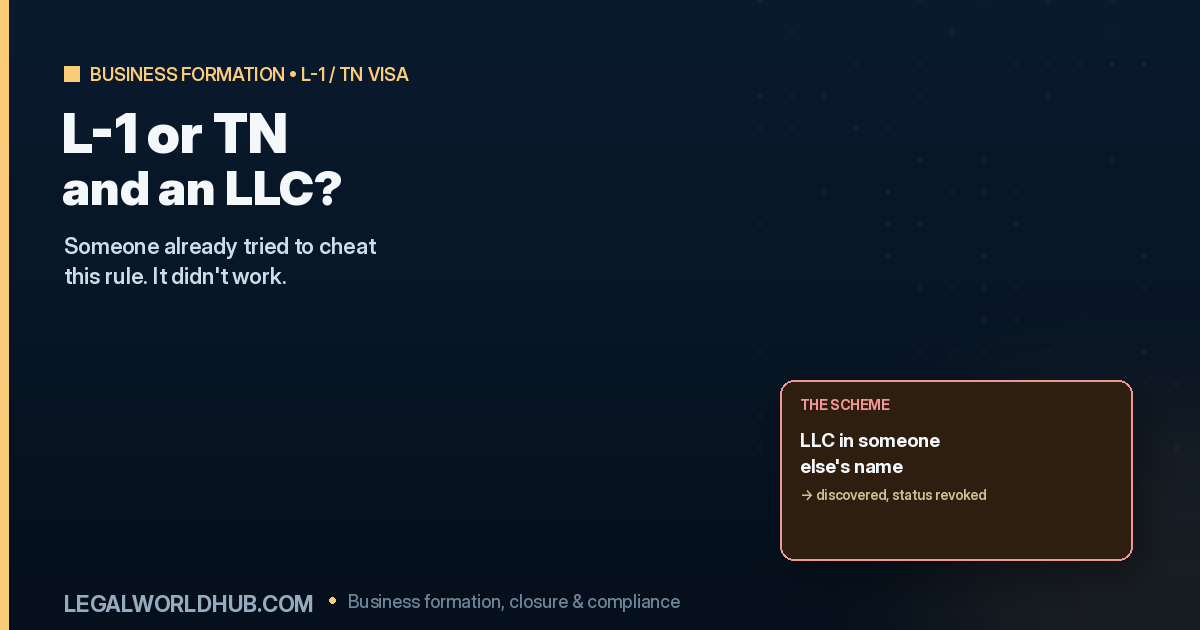
| Putting the LLC in someone else’s name to receive payment | A real scheme some TN holders have tried; it’s still a violation if discovered, and status gets revoked |
Same Underlying Rule as H-1B
Both L-1 and TN status authorize employment with a specific employer, in a specific role, and neither has anything resembling F-1’s CPT or OPT that would let you branch out and work elsewhere, including for your own company. The core distinction from our main guide applies identically here: owning equity in an LLC is not employment and doesn’t violate your status. Performing work or providing services for that LLC, regardless of compensation, generally does, unless the LLC itself is your visa sponsor or you have separate valid work authorization.
For L-1 holders specifically, one immigration law source puts it plainly: passive investment, owning shares without performing services, is generally acceptable, but the problem arises the moment ownership turns into active participation, managing staff, negotiating contracts, or performing core business functions. And here’s a detail worth sitting with: even when compensation isn’t immediate, involvement that provides value to the business or replaces work that would normally be paid can still be treated as unauthorized employment.
TN Specifically: No Self-Employment, Full Stop
TN status is built around a verified job offer from a US employer under the USMCA agreement, and it does not permit self-employment in any form. A TN holder cannot come to the US to work for a business they own or control, even their own LLC, regardless of how the paperwork is structured. Passive investment is explicitly fine: holding shares, being a silent partner, receiving dividends, even forming an LLC to hold real estate or securities someone else manages. What’s specifically not fine is functioning as the operator.
One detail worth being precise about: being listed as the CEO or an officer of your own LLC is generally treated as active involvement rather than passive ownership under TN rules specifically, even if you’re not drawing a salary. Title alone can be enough to signal the kind of operational role that crosses the line.
The Scheme That Doesn’t Work, and Why
This is worth stating directly because it’s a real pattern that comes up in actual immigration law consultations, not a hypothetical. Some TN holders have tried structuring their business by putting the LLC in someone else’s name, a friend, a relative, a partner, and then receiving payment from that LLC as if it were passive income. This does not work. If USCIS discovers the arrangement, and these structures do get discovered, it’s treated as exactly the unauthorized employment it’s designed to disguise, and TN status can be revoked as a result. Structuring around a rule by hiding who actually controls the money doesn’t change what the rule is actually evaluating; it just adds a layer that looks worse, not better, once uncovered.
If You Actually Want to Run a Business
If passive ownership genuinely isn’t enough for what you’re trying to build, the same alternatives that apply to H-1B holders apply here. The E-2 treaty investor visa allows active management of a business for eligible nationalities. Some L-1 holders may have a more direct path if the underlying company itself expands to sponsor a different, more suitable status. Employment-based green card categories that allow self-sponsorship, such as EB-2 National Interest Waiver or EB-1A for qualifying individuals, are worth discussing with an immigration attorney if active entrepreneurship is genuinely the goal rather than something to work around.
Frequently Asked Questions
Can a TN visa holder own an LLC?
Yes, as a passive investment. TN rules explicitly permit forming an LLC as long as the holder doesn’t participate in day-to-day operations, management, or decision-making.
Can an L-1 visa holder own an LLC?
Yes. Passive equity ownership is not considered employment. Active participation, managing staff, negotiating contracts, performing core business functions, is what creates risk.
Can I be the CEO of my own LLC on a TN visa?
Generally no, at least not in a way that stays passive. Holding an officer title like CEO is typically treated as active involvement under TN rules, regardless of whether you’re drawing a salary.
Can I put my LLC in someone else’s name to get around TN restrictions?
No. This is a real scheme some TN holders have attempted, and it’s still unauthorized employment if discovered, with TN status revocation as a real consequence. Disguising who benefits doesn’t change what’s actually happening.
What if I want to actively run my own company on L-1 or TN status?
Consider the E-2 treaty investor visa if eligible, or discuss employment-based green card categories that allow self-sponsorship with an immigration attorney. Passive ownership alone won’t support active entrepreneurship under either L-1 or TN.
Bottom Line
L-1 and TN visa holders can own an LLC exactly the way H-1B holders can, passively, without performing services or managing operations. Neither visa offers a legitimate workaround for active self-employment, and attempts to disguise active involvement, including putting ownership in someone else’s name, are a known pattern that gets discovered and revoked, not a clever solution. For the general principle behind all of this, see our main guide on owning an LLC on a visa.
This article is general information, not legal or immigration advice. L-1 and TN rules involve genuinely fact-specific determinations with serious consequences for your status; consult a licensed immigration attorney before acting.