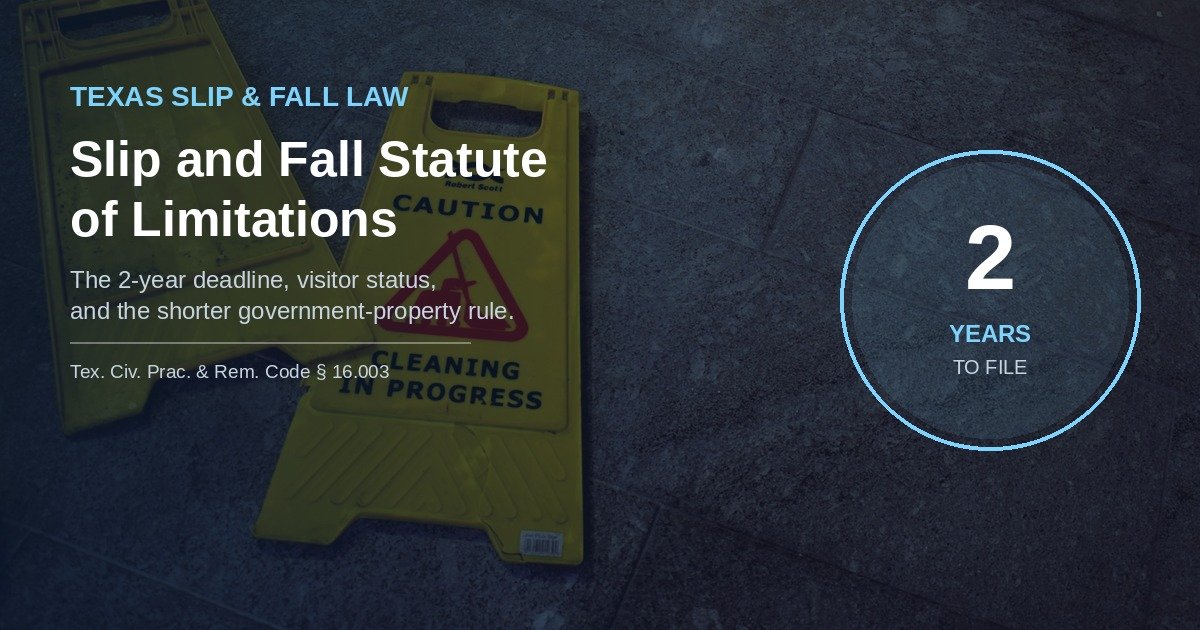
If you were hurt in a slip and fall on someone else’s property in Texas, you generally have two years from the date of the fall to file a lawsuit, the same deadline that applies to car accident claims under Texas Civil Practice and Remedies Code § 16.003. But slip-and-fall cases, formally called premises-liability claims, come with a wrinkle car accident cases don’t: your legal status on the property when you fell determines what you have to prove, and if a government entity owns the property, your window to act can shrink to a matter of months.
The Two-Year Deadline, and Why It’s Riskier Here
The statute of limitations itself is straightforward – two years from the date of the fall, same rule, same statute as any other personal injury claim in Texas. What makes slip-and-fall cases riskier than car accidents is how quickly the evidence disappears. A wet floor gets mopped up, a broken step gets repaired, security footage gets overwritten on a routine schedule, and the store or property manager typically has insurance and legal representation involved from the moment you fell. Waiting even a few weeks to start documenting your case can mean the difference between having real evidence and having only your own account of what happened.
Your Legal Status on the Property Changes Everything
Unlike a car accident, where fault is based on how the crash happened, a Texas premises-liability claim depends heavily on why you were on the property in the first place. Texas law sorts visitors into three categories, each owed a different duty of care:
- Invitees are on the property for the mutual benefit of both parties – customers in a store, tenants, hotel guests, meter readers. This is the strongest position to be in: property owners owe invitees the highest duty of care, including an obligation to actually inspect the premises for hazards, not just avoid creating them. An invitee can win a claim by showing the owner knew or reasonably should have known about a dangerous condition and failed to fix or warn about it.
- Licensees are on the property with permission, but for their own purposes rather than the owner’s benefit – typically social guests. Property owners only have to warn licensees about dangers they actually know about. Unlike with invitees, there’s no duty to inspect, and “should have known” isn’t enough – the owner has to have had real, actual knowledge of the hazard.
- Trespassers are on the property without permission. Texas law generally only requires owners to avoid willfully or wantonly injuring a trespasser – ordinary negligence isn’t enough to create liability. There’s a significant exception for children: under the “attractive nuisance” doctrine (Tex. Civ. Prac. & Rem. Code § 75.007(b)-(c)), a property owner who knows their property has something children are likely to be drawn to and hurt by – a pool, construction equipment – has to take reasonable steps to keep trespassing children safe.
Most slip-and-fall claims involve invitees, since most falls happen in stores, restaurants, and other commercial spaces open to customers – which is also the visitor category with the strongest legal protection.
What You Actually Have to Prove
Beyond the statute of limitations, a Texas premises-liability claim requires proving four elements:
- Duty – the property owner owed you a duty of care based on your visitor status above
- Breach – the owner failed to meet that duty, by creating a hazard, failing to fix a known one, or failing to warn about it
- Causation – the hazardous condition actually caused your fall and injury, not something unrelated
- Damages – you suffered real, documented harm as a result
The knowledge requirement is often where these cases are won or lost. For an invitee, showing the owner should have discovered the hazard through reasonable inspection is enough. For a licensee, you need to show the owner actually knew. This is exactly why documenting how long a hazard appears to have existed – a dried, tracked-through spill versus a fresh one, dust on a broken step – matters so much to a slip-and-fall claim specifically, and can meaningfully affect what your claim is ultimately worth.
Government Property Comes With a Much Shorter Deadline
If you fell on government-owned property – a city sidewalk, a public building, a state park – the two-year statute of limitations isn’t the deadline that controls your case. Texas’s governmental immunity rules require formal written notice to the government entity, and that notice deadline can be as short as six months from the date of the fall, dramatically shorter than the standard two-year window. If a fall happened on any kind of public property, treat your timeline as urgent from day one rather than assuming you have the standard two years.
Special Rules for Agricultural and Recreational Land
Texas also reduces the duty of care for landowners who open agricultural or recreational land to the public for activities like hunting, fishing, or hiking, under Tex. Civ. Prac. & Rem. Code § 75.002(b). If your fall happened on land being used for a recreational purpose rather than a typical commercial property, the standard invitee/licensee framework above may not apply the same way – this is a nuance worth flagging early if it applies to your situation.
What to Do After a Slip and Fall
Given how quickly evidence disappears in these cases, the immediate steps matter even more than in a car accident. For the full breakdown, see our guide to what to do after a slip and fall in Texas – in short:
- Report the fall to the property owner or manager immediately, and get it in writing if possible (an incident report)
- Photograph the hazard itself before it’s cleaned up or repaired, along with the surrounding area
- Identify any witnesses and get their contact information
- Seek medical attention promptly, both for your health and to document the injury’s connection to the fall
- Avoid giving a recorded statement to the property owner’s insurance company before understanding your position
Frequently Asked Questions
Does the two-year deadline apply if I fell at a friend’s house rather than a business?
Yes, the same two-year statute of limitations applies regardless of the type of property, though your visitor classification (likely licensee at a friend’s home) affects what you have to prove about the owner’s knowledge of the hazard.
What if I don’t know whether the property is government-owned?
Check with the property owner, a title search, or a licensed attorney as soon as possible after your fall. Given how much shorter government notice deadlines can be, confirming ownership early is worth prioritizing over almost anything else in a premises-liability case.
Can I still have a case if I was a trespasser when I fell?
Generally only if the property owner acted willfully or with gross negligence, or if you’re a child and the “attractive nuisance” exception applies. Ordinary hazards and ordinary negligence typically won’t support a claim if you were trespassing.
How is a slip-and-fall claim different from a car accident claim in terms of proof?
Car accident claims usually turn on how the crash happened. Slip-and-fall claims turn heavily on what the property owner knew (or should have known) about the hazard and your legal status on the property – two additional layers of proof that don’t exist in most car accident cases.
This article is for general informational purposes and does not constitute legal advice. Deadlines and legal duties can vary based on the specific facts of your case, including property ownership and your reason for being there. Consult a licensed Texas attorney to confirm which rules apply to your situation.