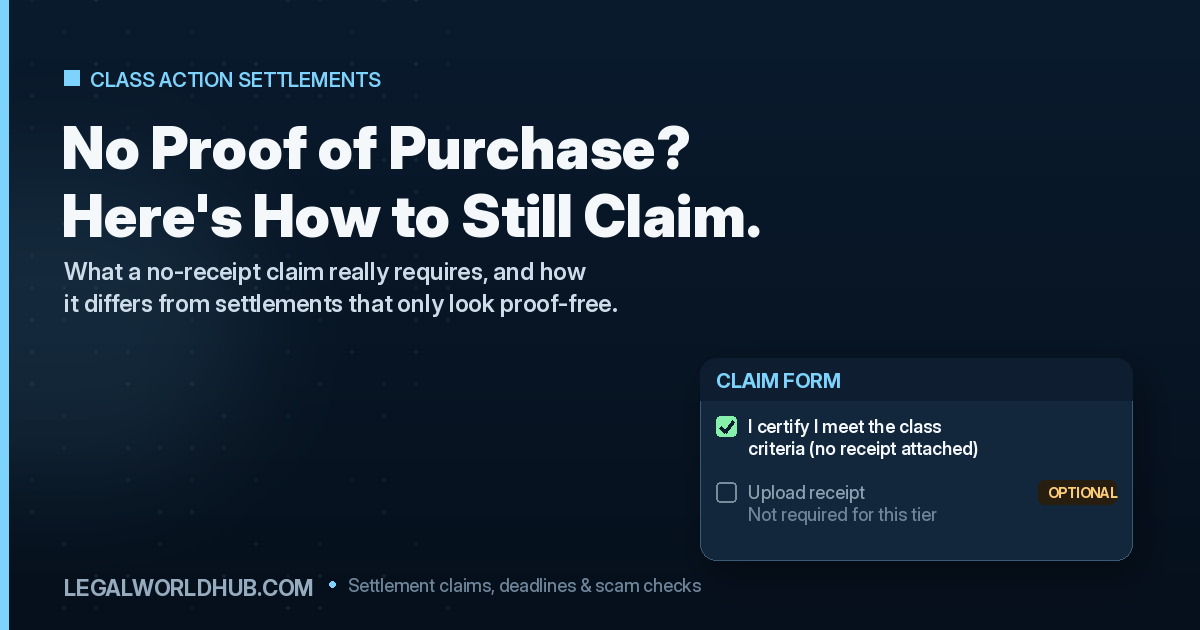
Most people assume they need a receipt to get paid from a class action settlement. For a lot of settlements, that is simply not true. Many claim forms let you check a box certifying that you bought the product or used the service, with no receipt, no order confirmation and no bank statement attached.
That does not mean anyone can file and collect a check. It means the proof requirement has shifted from paperwork to a sworn statement, and that distinction matters more than most articles on this topic explain. Here is what a no-proof claim actually asks of you, how it differs from settlements that only look proof-free, and how to file one correctly.
What Does No Proof of Purchase Actually Mean?
A no-proof settlement lets you file a claim by checking a box or signing a statement that you meet the class definition, rather than uploading a receipt, invoice or screenshot. Instead of documentary evidence, the claim form relies on your certification, made under penalty of perjury, that what you are stating is true.
This is common for low-dollar consumer settlements where the individual purchase was small enough that almost nobody kept a receipt, think shampoo, snack food or a subscription fee. Courts and settlement administrators generally accept self-certification in these cases because requiring receipts for a five dollar item would exclude the vast majority of the class. For the background on why settlements are structured this way in the first place, see our guide on how class action settlements work.
You Still Have to Actually Qualify
No proof of purchase is not the same thing as no eligibility requirement. You still have to fall within the class period, the product list, the geographic scope or whatever criteria the settlement defines. Filing a claim for a product you never bought, or for a time period outside the class window, is a false claim even if you never had to attach a document.
Read the settlement notice or the claim form itself before filing. If you are unsure whether your situation matches, our explainer on what a settlement claim actually means and our guide to settlement eligibility both walk through how class definitions typically work.
No Proof of Purchase and No Notice ID Are Not the Same Thing
This is the distinction that trips people up most often. A settlement can genuinely require no proof of a specific purchase, and still require a Unique ID, Claim ID or PIN printed on a notice that was mailed or emailed to you personally. If you never received that notice, or you lost it, you may not be able to file online at all, even though the settlement is technically a no-proof case for anyone who did receive one.
Before you assume you can file with nothing but your name and address, check the claim form itself. If it asks for a code from a letter or email, that code is functioning as your proof of class membership, even though the settlement does not ask you to document a specific loss.
No-Proof vs Documented-Loss Claims: Which Pays More?
Many settlements offer both options side by side. A flat, no-proof payment is usually modest, often in the range of a few dollars to around fifty dollars for everyday consumer products, though data breach settlements sometimes set the flat tier higher. A documented-loss claim, which requires receipts, bank records or other evidence of an actual out-of-pocket cost, can pay significantly more, sometimes into the hundreds or thousands of dollars, but only if you can support it.
If you genuinely have supporting records, it is worth checking whether the documented option applies to you before defaulting to the simpler flat payment. Our guide on how class action payouts are calculated explains why the advertised maximum in a settlement notice is rarely what a typical claimant actually receives, and why both tiers are usually subject to a pro rata adjustment once the claims window closes.
What Happens If You File a Claim You Are Not Sure You Qualify For?
Every claim form of this kind includes language stating that you are certifying the information under penalty of perjury. Filing a claim for a settlement you do not actually qualify for is a false claim, not a clever workaround. It can also work against everyone else in the class: most settlements distribute a fixed fund on a pro rata basis, so claims that should not have been paid dilute what legitimate claimants receive.
If you are genuinely unsure whether you qualify, review the class definition in the settlement notice, or contact the settlement administrator directly, rather than guessing.
How to File a No-Proof Class Action Claim
1. Find the official settlement website. Search the case name plus the word settlement, or check the notice you received, and confirm the URL matches what the notice or court documents cite.
2. Read the class definition. Confirm the dates, product, service or notice type actually apply to you before filing.
3. Choose the correct payment tier. If a documented-loss option exists and you have records, compare it against the flat no-proof payment.
4. Complete the claim form honestly. Provide your real name, current address and any notice ID the form requests.
5. Submit before the deadline. Online claims must usually be submitted by the stated date; mailed forms must be postmarked by then.
6. Save your confirmation. Keep the confirmation email, code or screenshot in case you need to follow up.
For a more detailed walkthrough that applies across settlement types, see our step by step guide on how to claim settlement money. And if you received a notice and are not sure what it is asking of you, our guide on what to do when you get a class action notice covers the first steps.
How to Find Open No-Proof Settlements
New settlements open and close on a rolling basis, so any list is only accurate for a snapshot in time. We keep a running list of open class action settlements with current deadlines, and a separate guide on how to find class action settlements you may qualify for, including how to search official case dockets and settlement administrator sites directly rather than relying on aggregator lists alone.
If you specifically want settlements that do require documentation and are trying to figure out what counts as acceptable proof, our companion guide on class action proof of purchase requirements covers that side of the process.
Is a No-Proof Settlement Claim Legit?
Yes, no-proof claim tiers are a standard, court-approved part of many legitimate settlements. The absence of a documentation requirement is not itself a red flag. What is a red flag is anyone asking you to pay a fee to file a normal claim, asking for your banking password, or contacting you through a link or number that does not match the official settlement website.
The Federal Trade Commission’s own refund program guidance makes the same point about legitimate settlement and refund payments generally: a real administrator will never require an upfront fee or ask for sensitive information like your Social Security number or bank login to process a claim.
For more on recognizing fake settlement communications specifically, see our guide on class action settlement scams, and if you have already received a check and want to confirm it is real before depositing it, read how to tell if a settlement check is real.
When Will You Actually Get Paid?
Filing a claim, proof-free or not, does not mean payment arrives right away. Most settlements only distribute funds after the court grants final approval and the settlement becomes effective, which can take weeks or months after the claims deadline passes. Our guide on how long it takes to get paid after a class action settlement breaks down the typical timeline stage by stage.
Is No-Proof Settlement Money Taxable?
It depends on what the payment represents, and a flat no-proof payment is treated the same way for tax purposes as a documented one of the same type. This is genuinely case specific rather than a blanket yes or no. See our general explainer on whether settlement money is taxable, and talk to a tax professional about your own return.
Frequently Asked Questions
Can you really claim a class action settlement without a receipt?
Yes, for settlements that offer a no-proof tier. You certify under penalty of perjury that you meet the class criteria instead of submitting documentation, but you still have to genuinely qualify.
Is it illegal to file a no-proof claim if I am not sure I qualify?
Filing a claim you know does not apply to you is a false statement made under penalty of perjury. If you are unsure, check the class definition in the settlement notice or contact the administrator before filing.
Why do some settlements not require proof of purchase?
Usually because the individual purchase amount was small enough that requiring receipts would exclude most of the class. Self-certification lets more eligible people actually get paid.
Do I need a notice ID if a settlement says no proof of purchase is required?
Sometimes, yes. No proof of purchase refers to documentation of your specific purchase or loss. Some settlements separately require a Unique ID or PIN from a mailed or emailed notice to file online, which is a different requirement.
Which pays more, a no-proof claim or a documented-loss claim?
Documented-loss claims typically pay more per claimant, but only if you can support the claim with receipts, statements or similar records. Flat no-proof payments are simpler but usually smaller.
How do I find current no-proof class action settlements?
Check our open class action settlements list, which is updated as new settlements open and existing ones close.
Is filing a no-proof settlement claim free?
Yes. Filing a standard claim through an official settlement website should never cost you anything. Treat any request for a fee as a scam.
Can a no-proof claim be rejected?
Yes. The administrator can still deny a claim that does not match the class definition, is submitted after the deadline, or contains inconsistent information, even without a documentation requirement attached.
Bottom Line
A no-proof claim tier means you are not required to submit a receipt, not that eligibility rules disappear. Read the class definition, be honest about whether you qualify, watch for a separate notice ID requirement hiding behind the no-proof label, and file before the deadline.
For settlements currently accepting claims, start with our open class action settlements list, and if you want to understand the full claims process from start to finish, our pillar guide on how class action settlements work is the place to begin.
This article is for general information only and is not legal or tax advice. Settlement terms, eligibility and deadlines are set by the court and the claims administrator in each case and can change. Always verify current details on the official settlement website before filing a claim.