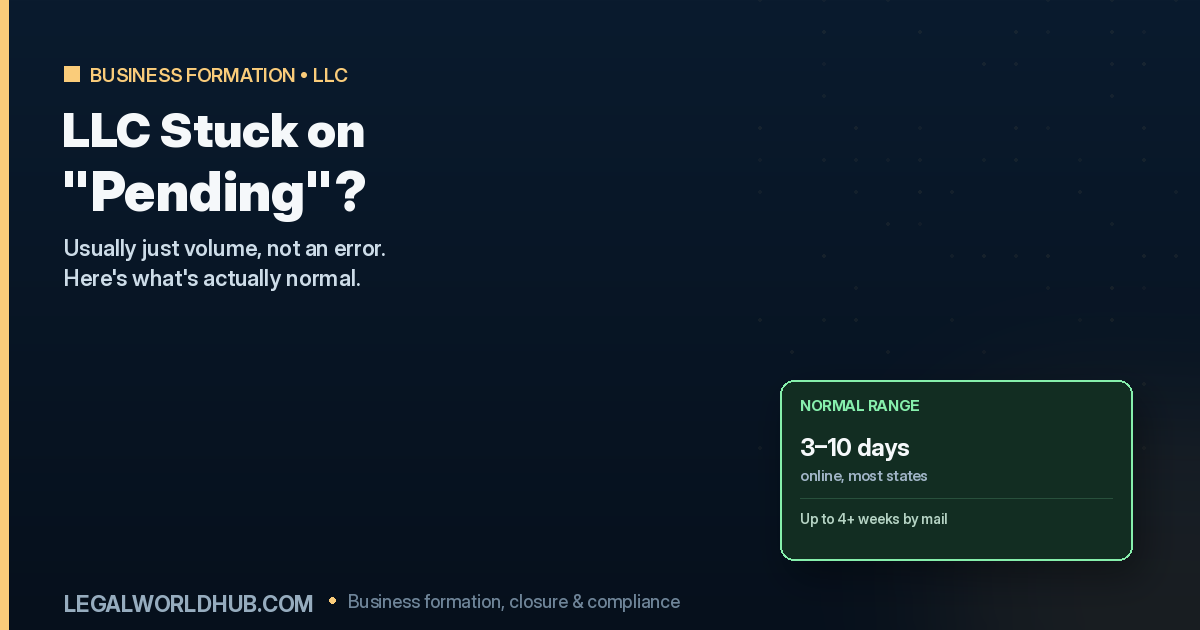
You filed, you got a confirmation, and then… nothing. No rejection, no approval, just pending, week after week. Before you assume the worst, here’s what’s actually going on most of the time, how to tell if something genuinely needs your attention, and when it’s time to actually follow up. If your filing came back rejected rather than stuck, see our guide on why LLC filings get rejected instead.
Typical Processing Times, So You Know What’s Actually Normal
| Filing Method | Typical Timeline |
| Online filing, standard processing | 3 to 10 business days in most states |
| Mail filing | 2 to 4 weeks, sometimes longer |
| Slower states (example: Arizona) | Roughly 22 to 27 business days even under normal conditions |
| Expedited processing (where offered) | 1 to 3 business days, sometimes same-day, for an added fee |
| Peak season (year-end, tax deadline season) | Add real time to any of the above; this is when backlogs are worst |
Notice how wide this range actually is. A filing that feels alarmingly slow in one state might be completely normal in another, and the same state can run faster or slower depending on the time of year. Before assuming something is wrong, check your specific state’s currently published processing time, not a general number from a different state or a different season.
The Honest Truth: Most “Stuck” Applications Are Just in Line
State filing offices process thousands of applications every week, and even a completely correct, error-free filing can simply be waiting behind a backlog of earlier submissions. This is the most common reason an application feels stuck, and it isn’t a sign that anything is wrong with your specific filing. It’s genuinely just volume.
This is easy to forget when you’re the one waiting, but it’s worth internalizing before you start worrying that something you did triggered the delay. In the large majority of cases, nothing did.
The One Thing Worth Actually Checking
Before assuming your delay is purely about volume, check whether the state has actually tried to reach you. Some states send a notice, by email or posted directly to your online filing account, when they need additional information or a correction before they can move your application forward. If a notice like this is sitting unread in your email or your state’s online portal, your application isn’t progressing simply because it’s waiting on you, not because it’s stuck in a queue. This is genuinely worth ruling out first, since it’s the one scenario where the delay is something you can actually fix yourself.
When and How to Actually Follow Up
If your filing has been pending noticeably longer than your state’s currently published processing timeframe, it’s reasonable to check in. Here’s how to do it in a way that actually gets you an answer rather than adding to the confusion:
1. Check your state’s official business entity search tool first, to see whether your LLC’s status has updated even if you haven’t received a separate notification.
2. Check your email, including spam and promotions folders, and your online filing account for any state notices you might have missed.
3. If neither shows anything new, contact the filing office directly, by phone if that option exists, since it’s typically faster than email for a status check.
4. Have your filing date and confirmation number ready before you call. This lets staff locate your specific application quickly rather than searching by name alone.
5. Ask specifically whether your application is simply in the processing queue, or whether it requires something further from you.
Don’t Do This While You Wait
Resist the urge to file a second, duplicate application because the first one feels slow. This doesn’t speed anything up, and it can actually create real confusion, potentially even a rejection on one of the two filings once the state’s system flags what looks like a duplicate submission. If you’re genuinely concerned, a status check is always the better move than filing again.
It’s also worth knowing that you generally cannot legally begin operating under your LLC’s name, signing contracts, opening a business bank account in the LLC’s name, until the state has actually approved your filing. If a pending application is holding up something time-sensitive, that timeline pressure is worth mentioning specifically when you follow up, since some states can expedite an already-filed application for an additional fee even after the fact.
Frequently Asked Questions
How long should an LLC application stay pending before I worry?
Compare it against your specific state’s currently published processing timeframe rather than a general number. If you’ve clearly exceeded that window, it’s reasonable to check in, though volume-driven delays beyond the typical estimate aren’t unusual either.
Why hasn’t my LLC been approved yet?
Most commonly, simple processing volume. Less commonly, the state may be waiting on additional information or a correction from you, which is why checking your email and online filing account for a notice is worth doing before assuming the delay is purely about backlog.
Can I operate my business while my LLC is still pending?
No. You generally need to wait until your Articles of Organization are officially approved before conducting business under your LLC’s name or opening accounts in the LLC’s name.
Should I file a second LLC application if the first one is taking too long?
No. This doesn’t speed up processing and can create confusion or even trigger a rejection once the state’s system identifies what looks like a duplicate filing. Check the status instead.
Can I pay to expedite an application that’s already pending?
In some states, yes. It’s worth asking directly when you follow up, since some states allow expedited processing to be added to an already-submitted filing for an additional fee, not just at the time of original submission.
Bottom Line
A pending LLC application is almost always a matter of normal processing volume, not a sign something went wrong. Check your state’s current timeline, look for any notice requesting more information before assuming the worst, and follow up with your filing date and confirmation number in hand if you’ve genuinely exceeded the typical window. For what to do if your filing actually came back rejected rather than simply delayed, see our guide on why LLC filings get rejected.
This article is general information, not legal advice. LLC processing times vary by state and by season; confirm current timelines directly with your state’s Secretary of State or equivalent filing office.