
Last verified: October 2026
Most people who get a call from Transworld Systems do the same thing: they assume it must be legitimate, panic a little, and wonder if they should pay before something worse happens to their credit.
Here is the part most people do not know: you have 30 days from the date of first contact to dispute the debt in writing and legally compel TSI to stop all collection activity until they can prove the debt is valid and belongs to you. If they cannot or do not respond with proper validation, the debt cannot be collected. No one tells you this on the call.
TSI is a real company. They are one of the larger debt collection agencies in the United States, handling collections for hospitals, universities, credit card companies, and government agencies. A call from TSI does not necessarily mean you owe what they say you owe, or that the debt is even yours. It means someone has hired them to collect money. Your response in the first 30 days determines almost everything about how this plays out.
Key Takeaways
- Transworld Systems Inc. (TSI) is a legitimate third-party debt collection agency operating under the Fair Debt Collection Practices Act (FDCPA).
- You have 30 days from first contact to send a written debt validation request. During that window, TSI must stop collecting until they verify the debt.
- If the debt is wrong, not yours, or past the statute of limitations, you have grounds to dispute it and potentially have it removed.
- TSI cannot call before 8 a.m. or after 9 p.m., threaten arrest, use abusive language, or misrepresent the amount owed. Violations can be worth up to $1,000 per lawsuit.
- After seven years, a debt falls off your credit report regardless of whether it was paid.
- Get any settlement agreement in writing before you pay a single dollar.
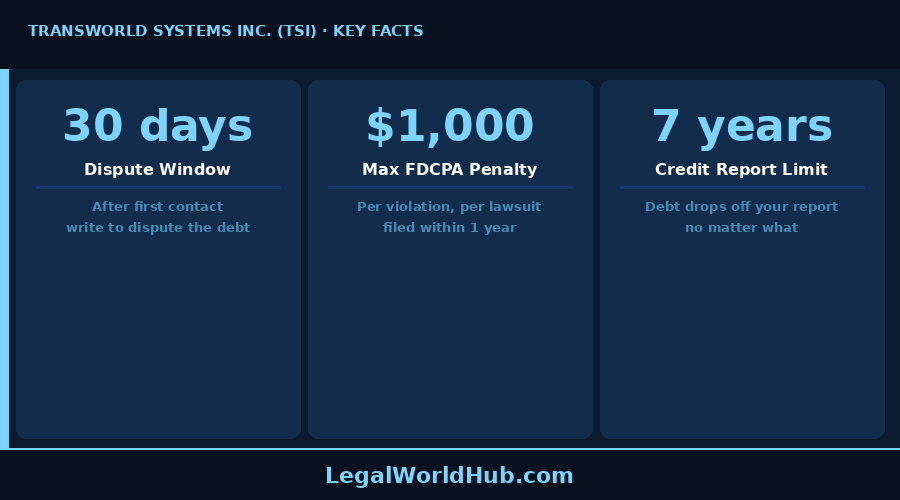
The 30-day window starts from the date of their first written notice, not from when you actually read it. If you are unsure when the clock started, send your dispute now, in certified mail with return receipt.
Who Is Transworld Systems Inc.?
Transworld Systems Inc. usually shortened to TSI, is a for-profit third-party debt collection company headquartered in Wilmington, Delaware. They collect debts on behalf of original creditors and sometimes purchase debt portfolios themselves.
Their clients include healthcare systems, student loan servicers, credit card issuers, cable and telecom companies, and government entities. If you received a letter or call from TSI, it is because one of those clients hired them to recover a balance they believe you owe.
TSI operates under several names depending on who they are collecting for, which sometimes confuses consumers into thinking they are being contacted by a different entity. Common variations include Transworld Systems, TSI, and University Accounting Service (a student loan arm they operate).
The fact that TSI is legitimate does not mean their records are accurate. Debt buyers and collection agencies frequently have incomplete files. A debt can be assigned to the wrong person due to a similar name or Social Security number. The amount can be inflated through fees. The debt can be so old it has passed the statute of limitations. All of this happens routinely, and none of it relieves you of the obligation to respond in writing within 30 days if you want to contest it.
Your Four Options
When TSI contacts you, these are your choices and they are not mutually exclusive.
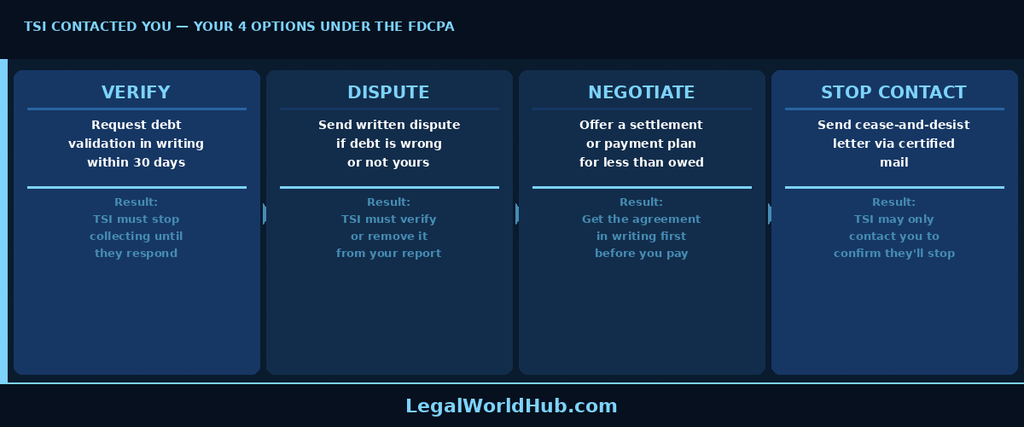
Most people skip straight to paying or ignoring. Neither is usually the best move. Verification and dispute are free to send, take 20 minutes, and can result in the debt disappearing entirely if TSI’s records don’t hold up.
Option 1: Request Debt Validation
This is the most powerful tool you have and the one most people don’t use.
Within 30 days of receiving their first written notice, send TSI a written request for debt validation. This legally requires them to:
- Stop all collection activity
- Provide written verification of the debt
- Show the original creditor’s name and address
- Confirm the amount actually owed (not their version of it)
Until they respond with proper validation, they cannot legally continue pursuing the debt. If they cannot validate it, which happens more often than you might expect, they must cease collection activity entirely.
Send the request by certified mail with return receipt. Keep a copy. This creates the paper trail that protects you in every scenario that follows.
What to include in the letter:
- Your full name and address
- The account number referenced in their notice
- A clear statement that you are requesting verification under the FDCPA
- A request that they cease all collection contact until they comply
Do not include payment or an admission that you owe the debt.
Option 2: Dispute a Wrong or Inaccurate Debt
If the debt is not yours, the amount is wrong, you already paid it, or you were a victim of identity theft, you can send a written dispute.
A dispute is different from a validation request. Validation says “prove it’s valid.” A dispute says “this information is wrong, and here’s why.”
Supporting your dispute with documentation strengthens it:
- A payment confirmation showing you already paid
- A police report or FTC identity theft report if the debt is not yours
- A bank statement showing the charge was refunded or reversed
- Correspondence with the original creditor showing the balance was resolved
Once you dispute in writing, TSI must investigate and report back. If the dispute leads to the account being removed from your credit report, they must notify the credit bureaus. A proper dispute letter sent early can prevent a collection account from ever appearing on your report.
Option 3: Negotiate a Settlement
If you owe the debt but cannot pay the full amount, negotiation is legitimate and common. Debt collection agencies often purchase debts for significantly less than face value and have room to settle for less than what they’re asking.
How to negotiate:
- Start lower than what you are willing to pay, typically 40-60% of the balance
- Do not agree to anything verbally. Ask for a written settlement agreement first.
- The written agreement must state the settlement amount, that it constitutes payment in full, and that they will report the account as “settled” (or ideally “paid in full” if they will agree to it)
- Only pay after you have the written agreement in hand
Important: making a payment on a very old debt can restart the statute of limitations in some states, potentially exposing you to a lawsuit on debt you could otherwise have ignored. Before paying anything on a debt you believe may be old, check the statute of limitations in your state.
Option 4: Send a Cease-and-Desist Letter
Under the FDCPA, you have the right to demand that TSI stop contacting you entirely. You do not need a lawyer to do this.
Send a written cease-and-desist letter by certified mail with return receipt. After receiving it, TSI may contact you only:
- To confirm they are ceasing contact
- To notify you they are taking a specific legal action (such as filing a lawsuit)
A cease-and-desist stops contact, it does not make the debt go away. If they have a valid debt, they can still sue you, report to credit bureaus (if within the reporting window), and sell the debt to another collector. Use cease-and-desist when the harassment needs to stop and you have a separate strategy for the underlying debt.
What TSI Can and Cannot Do Under the FDCPA
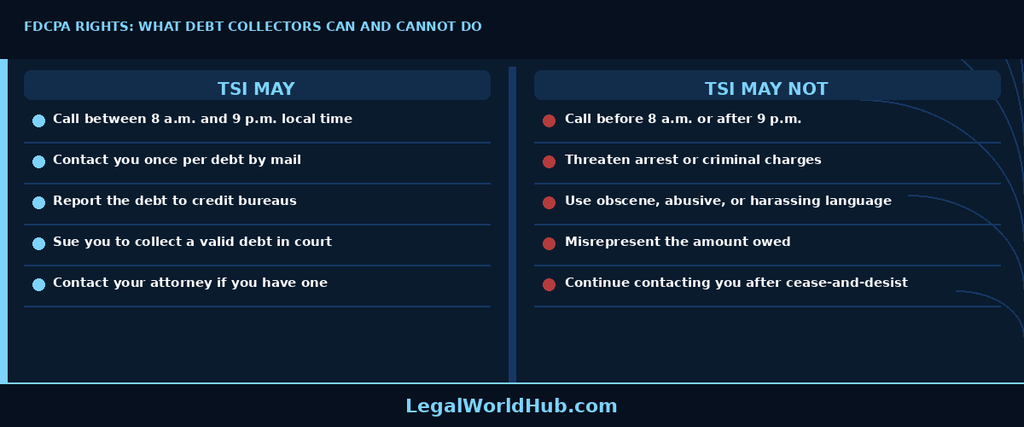
The rules in the FDCPA apply to TSI and every third-party debt collector in the United States. Violations are individually actionable, you can sue for up to $1,000 per violation in federal court, plus actual damages and attorney’s fees. Many consumer attorneys take these cases on contingency.
The Fair Debt Collection Practices Act, enforced by the Consumer Financial Protection Bureau (CFPB) and the Federal Trade Commission (FTC), sets the rules for how TSI can operate.
TSI may:
- Contact you between 8 a.m. and 9 p.m. in your local time zone
- Send letters and make phone calls
- Report the debt to the three major credit bureaus
- Pursue legal action in court to collect a valid debt
- Contact an attorney if you have one listed
TSI may not:
- Call before 8 a.m. or after 9 p.m.
- Threaten arrest, criminal prosecution, or jail time (civil debt cannot lead to arrest)
- Use obscene, profane, or abusive language
- Misrepresent the amount owed or claim to be a government agency or attorney
- Discuss your debt with third parties (other than a spouse or attorney)
- Continue contacting you after receiving a written cease-and-desist
- Contact you at work after being told your employer prohibits it
- Add unauthorized fees or interest to the amount owed
If TSI violates any of these rules, you can file a complaint with the CFPB, the FTC, and your state attorney general, and you can sue in federal court within one year of the violation.
How Debt Collection Affects Your Credit
A collection account from TSI can appear on your credit report for up to seven years from the date of the original delinquency, not from the date TSI acquired the debt. After seven years, it must be removed under the Fair Credit Reporting Act (FCRA), whether or not it was paid.
Several things are worth knowing:
Paying a collection account does not remove it from your report. It changes the status from “unpaid” to “paid collection,” but it remains for the full seven years.
Pay-for-delete agreements exist but are not guaranteed. Some collectors will agree in writing to remove the account from your report in exchange for payment. Get this in writing before paying. Not all collectors honor these agreements, and the credit bureaus are not obligated to remove an account simply because a collector requests it.
Disputing an inaccurate collection is different from paying it. If TSI is reporting a collection that is not yours, was already paid through the original creditor, or contains incorrect information, file a dispute with each credit bureau directly. The FCRA requires them to investigate and correct or remove inaccurate items.
The statute of limitations is separate from the credit reporting window. Even if a debt can no longer be legally sued on, it may still appear on your report. And even if it has dropped off your report, the legal obligation may technically still exist (though in practice very old debts are rarely collectible).
TSI and Student Loans
Transworld Systems operates University Accounting Service (UAS), which handles collections specifically for college and university accounts. If you received a notice from UAS, it is still TSI.
For federal student loans specifically, the rules are different. Federal student loan collectors operate under the Higher Education Act, not purely under the FDCPA, which changes some of the protections available to borrowers. If TSI is collecting a federal student loan, contact your loan servicer and the Federal Student Aid office directly, the dispute process for federal loans runs through the Department of Education.
For private student loan collections, the full FDCPA protections apply.
Transworld Systems vs Crown Asset Management: What Is the Difference?
People often see both names on the same credit report or in the same stack of letters. They do different jobs, and the difference changes who you should write to.
| Transworld Systems (TSI) | Crown Asset Management | |
|---|---|---|
| What it is | Third-party collection agency | Debt buyer |
| Owns the debt? | Usually not. It collects for the creditor. | Yes. It buys delinquent accounts from creditors at a discount. |
| Based in | Delaware | Duluth, Georgia |
| Who you may owe | The original creditor or current owner | Crown, as the new owner of the account |
Both are covered by the Fair Debt Collection Practices Act. A federal appeals court has treated Crown, whose only business is buying debts in order to collect them, as a debt collector under that law.
If both names appear on the same account, the debt may have been placed with a collector and later sold. Send each company a written validation request and ask who owns the account today. Do not pay either one until you have that answer, and watch for the same debt being reported twice on your credit file.
Is TSI a Scam?
TSI itself is a legitimate company. But the existence of TSI as a real company means scammers sometimes impersonate them.
Warning signs that a TSI contact may be a scam:
- They demand immediate payment by gift card, wire transfer, or cryptocurrency
- They refuse to provide written verification of the debt
- They claim you will be arrested immediately if you do not pay
- The phone number does not match TSI’s verified contact information
- They cannot provide a specific account number or original creditor
Verify by looking up TSI’s contact information independently (not from the letter or call you received) and calling to confirm the account.
Step-by-Step: What to Do Right Now
1. Locate the original notice. Find the first written communication from TSI. The 30-day clock runs from that date.
2. Request debt validation in writing. Even if you think you might owe the debt, send the validation request. This is free, takes 20 minutes, and creates legal protection regardless of whether you owe anything.
3. Pull your credit report. Check all three bureaus at AnnualCreditReport.com (the only federally authorized free source). Confirm what TSI is reporting, when the original delinquency date was, and when it should fall off.
4. Check the statute of limitations. Each state has its own rules for how many years a debt can be sued on. After that period, you can still be contacted but cannot be successfully sued. Your state attorney general’s office publishes this information.
5. Decide your approach. Validate first. If the debt is wrong, dispute it. If you want to settle, negotiate in writing. If contact is harassing you, send the cease-and-desist.
6. Document everything. Keep copies of every letter sent and received. Note the dates and content of every phone call. This documentation matters if you ever need to enforce your rights.
Frequently Asked Questions
Is Transworld Systems a legitimate debt collector?
Yes. Transworld Systems Inc. (TSI) is a licensed debt collection agency operating in the United States. They are subject to the FDCPA and regulated by the CFPB. Receiving a notice from them does not mean the debt is accurate or that you owe what they claim, only that a creditor has hired them to collect.
What should I do if TSI calls me?
Do not make a payment on the call. Ask for their mailing address and the account number, then send a written debt validation request by certified mail with return receipt within 30 days. Until they respond to that request, they must stop all collection activity.
Can Transworld Systems sue me?
Yes. TSI can file a lawsuit to collect a valid debt, within the statute of limitations for your state. If you are sued, responding to the lawsuit matters, not responding typically results in a default judgment against you. If you receive court documents from TSI, consult an attorney.
Will TSI negotiate a settlement?
Often yes. TSI frequently has room to negotiate, particularly on debts they purchased for less than face value. Start at 40-50% of the balance and get any agreement in writing before paying.
How do I get TSI off my credit report?
If the debt is legitimate and within the seven-year window, you cannot force removal by paying it. Your options are: dispute inaccurate information through the credit bureaus, attempt a pay-for-delete negotiation (get it in writing), or wait for the seven-year period to expire. If TSI is reporting a debt that is not yours or contains errors, file a dispute directly with each credit bureau.
Can TSI garnish my wages?
Only if they have obtained a court judgment against you. TSI cannot garnish wages without first suing you and winning (or receiving a default judgment). If you receive court documents, respond and consult a consumer rights attorney.
What happens if I ignore TSI?
Ignoring them does not make the debt go away. TSI can continue contacting you, report the debt to credit bureaus, and sue you in court. Ignoring a lawsuit results in a default judgment. If you believe you do not owe the debt or the amount is wrong, the validation and dispute process is your best tool, not silence.
How do I stop TSI from calling?
Send a cease-and-desist letter by certified mail with return receipt. TSI must stop contacting you after receiving it, except to confirm they are stopping or to notify you of specific legal action.
Is Transworld Systems the same as University Accounting Service?
Yes. University Accounting Service (UAS) is TSI’s division that handles collections for colleges and universities. Same company, same FDCPA rules.
Bottom Line
Getting a call or letter from Transworld Systems is unsettling, but it does not require panic or an immediate payment. Your 30-day window to request debt validation is the most powerful tool available to you, and it costs nothing to use.
The fundamental question before you pay anything: is this debt valid, is it yours, and is the amount correct? A written validation request forces TSI to answer those questions before they can continue collecting. Start there.
For help with related consumer rights issues, see our guides on what debt collectors can and cannot do, how to spot a debt collection scam, how to get a debt lawsuit dismissed, consumer law, how to sue a debt collector and how to dispute credit report errors. If you want legal help, read how to choose a consumer rights attorney. State rules can add protection: see Texas, Massachusetts, Michigan, Washington and California, plus unfair business practices.
If you believe TSI has violated your rights, the CFPB complaint portal and FTC ReportFraud site both accept FDCPA complaints at no cost.
The FDCPA and state statutes of limitation vary. This article is for general informational purposes only and does not constitute legal advice. For advice specific to your situation, consult a licensed consumer rights attorney.