
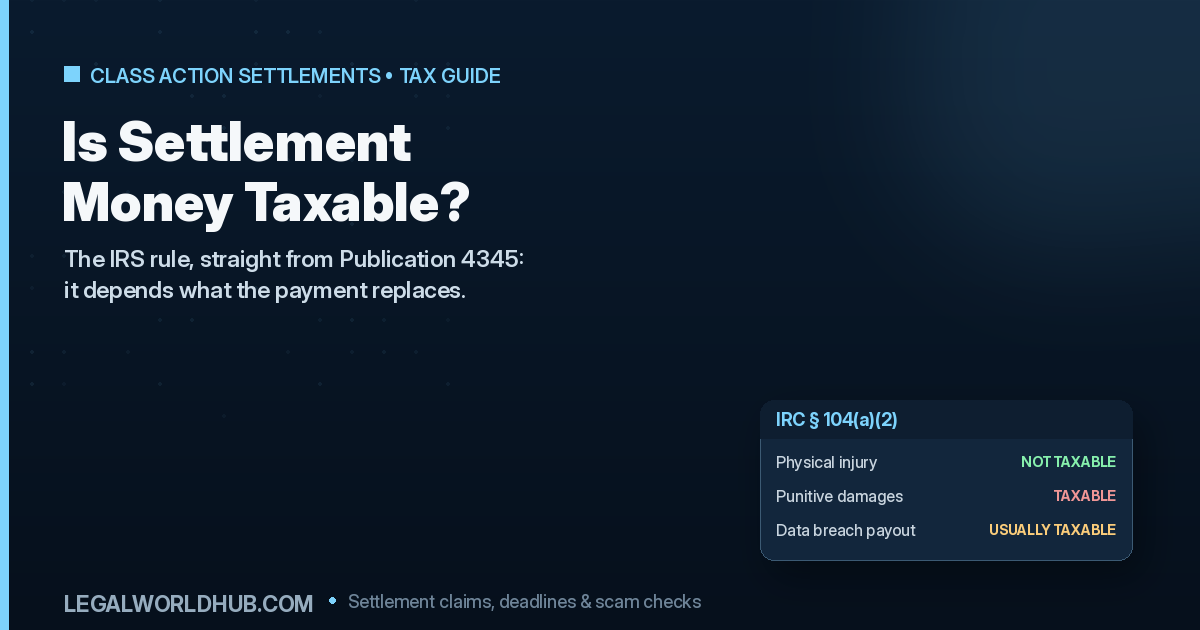
The honest answer is that it depends entirely on what the payment is compensating you for, not on the fact that it came from a lawsuit. The IRS applies the same rule to a personal injury settlement, an employment settlement, and a data breach class action payout: it looks at what the money was intended to replace, and taxes it accordingly. Here is how that actually works, based directly on the IRS’s own published guidance.
The General Rule
Under Internal Revenue Code Section 61, all income is taxable from whatever source, unless another part of the tax code specifically excludes it. Section 104 provides that exclusion for certain lawsuit and settlement payments, but only under specific circumstances. The IRS frames the key question this way: what was the settlement, and its corresponding payment, intended to replace?
When Settlement Money Is Not Taxable
Under IRC Section 104(a)(2), damages received on account of personal physical injuries or physical sickness are generally excluded from gross income, other than punitive damages. This exclusion covers compensatory damages broadly, including amounts for lost wages, when the loss stems from a physical injury or sickness. According to IRS Publication 4345, if you receive this kind of settlement and did not previously deduct related medical expenses, the full amount is non-taxable and does not need to be reported as income.
This is why most car accident, slip and fall and medical malpractice settlements are largely tax-free at the federal level, since they compensate for physical harm.
When Settlement Money Is Taxable
| Type of Payment | General Tax Treatment |
| Emotional distress not stemming from a physical injury | Taxable, though reduced by unreimbursed medical costs related to the distress |
| Lost wages or economic loss not tied to a physical injury | Taxable |
| Punitive damages | Always taxable, even in an otherwise tax-free physical injury settlement (with a narrow wrongful-death exception under state law) |
| Interest on a settlement | Taxable, reported separately from the underlying award |
| Employment discrimination back pay and damages | Taxable, per IRS Revenue Ruling 96-65 |
| Most consumer class action payouts (data breach, privacy, overcharge) | Generally taxable as ordinary income, since they do not arise from physical injury |
What About Data Breach and Consumer Class Action Settlements?
This is the category most readers researching this question are actually dealing with, and it is the one general settlement guides gloss over. A data breach, privacy, or overcharge settlement does not involve a physical injury, so the Section 104(a)(2) exclusion generally does not apply. Whether a specific payment is taxable still depends on what it is compensating for.
A payment that reimburses a documented, specific out-of-pocket loss, such as money actually spent on credit monitoring after a breach, may be treated differently than a flat payment that does not tie to a specific expense. The settlement agreement’s own characterization of the payment matters here; the IRS generally defers to how the parties intended the payment to be characterized, and looks at the payor’s intent when the agreement is silent.
In practice, most flat, no-documentation cash payments from consumer class actions should be treated as taxable income unless you have a specific reason to believe otherwise. This is general information, not a determination about your specific settlement, and you should not treat it as a substitute for professional advice.
Do You Get a 1099 for a Settlement?
Often, yes. The IRS requires payors, meaning the defendant or its insurer, to issue an information return, typically Form 1099, for settlement payments unless the payment qualifies for one of the tax exceptions such as the physical injury exclusion. If attorneys’ fees are paid as part of a settlement that is includable in your income, both you and your attorney may separately receive reporting on those fees, even though only one check may have been issued.
What About Attorney’s Fees?
If your settlement is taxable, you are generally taxed on the full settlement amount, including the portion that goes directly to your attorney as a contingency fee, not just the amount you personally receive. This is a widely cited but often overlooked rule, and it can meaningfully affect what you actually owe relative to what you actually took home.
How Settlement Agreements Affect Your Taxes
Because taxability depends on what a payment is intended to replace, how a settlement agreement allocates and describes its payments genuinely matters. Settlement agreements that clearly break out amounts for physical injury, emotional distress, lost wages and punitive damages give both taxpayers and the IRS a clearer basis for tax treatment than a single lump sum with no allocation.
If you are a plaintiff negotiating a settlement of any significant size, this is a reasonable topic to raise with your attorney or a tax professional before the agreement is finalized, not after you receive the check.
Frequently Asked Questions
Is money from a class action settlement always taxable?
No. It depends on what the payment compensates for. Damages for a physical injury or physical sickness are generally excludable from income; most other categories, including typical data breach or consumer overcharge payouts, are generally taxable.
Are punitive damages ever tax-free?
Almost never. Punitive damages are taxable even when they arise from an otherwise tax-free physical injury case, with one narrow exception for certain wrongful death claims under specific state statutes.
Do I owe tax on the part of my settlement that went to my attorney?
If your settlement is taxable, generally yes. You are typically taxed on the full settlement amount, including the attorney’s contingency fee, even though that portion never reaches your bank account.
Will I get a 1099 for a settlement payment?
Often, unless the payment qualifies for the physical injury exclusion or another specific exception. Check with the settlement administrator or your tax preparer about what forms you should expect.
Is a data breach settlement payment taxable?
Generally, yes, since it does not typically arise from a physical injury. Whether a specific reimbursement for documented losses is treated differently depends on the settlement’s terms and how the payment is characterized. Consult a tax professional for your specific situation.
Do I need to report a settlement if I never received a 1099 for it?
Taxable income generally must be reported whether or not you receive a 1099. Talk to a tax professional if you are unsure how to report a specific payment.
Bottom Line
Settlement taxability comes down to one question: what was the payment meant to replace? Physical injury and sickness damages are generally tax-free. Emotional distress unconnected to a physical injury, lost wages outside a physical injury context, punitive damages, interest and most consumer class action payouts are generally taxable. This article explains the general framework the IRS applies, not a determination about your specific settlement.
For the source material behind this framework, see the IRS’s own page on tax implications of settlements and judgments, and consult a qualified tax professional about your own return before filing.
This article is for general information only and is not tax or legal advice. Tax treatment depends on the specific facts of your settlement. Consult a qualified tax professional for guidance on your own situation.