Searching for a Cash App settlement update gets confusing fast, because there are three separate Block, Inc. programs that have nothing to do with each other beyond sharing a parent company. All three have claim deadlines that have already passed, but they are in different stages, and one of them requires no claim at all. Here is how to tell which one applies to you.
The Three Cash App Money Programs
| Program | Fund | Claim Status | Payment Status |
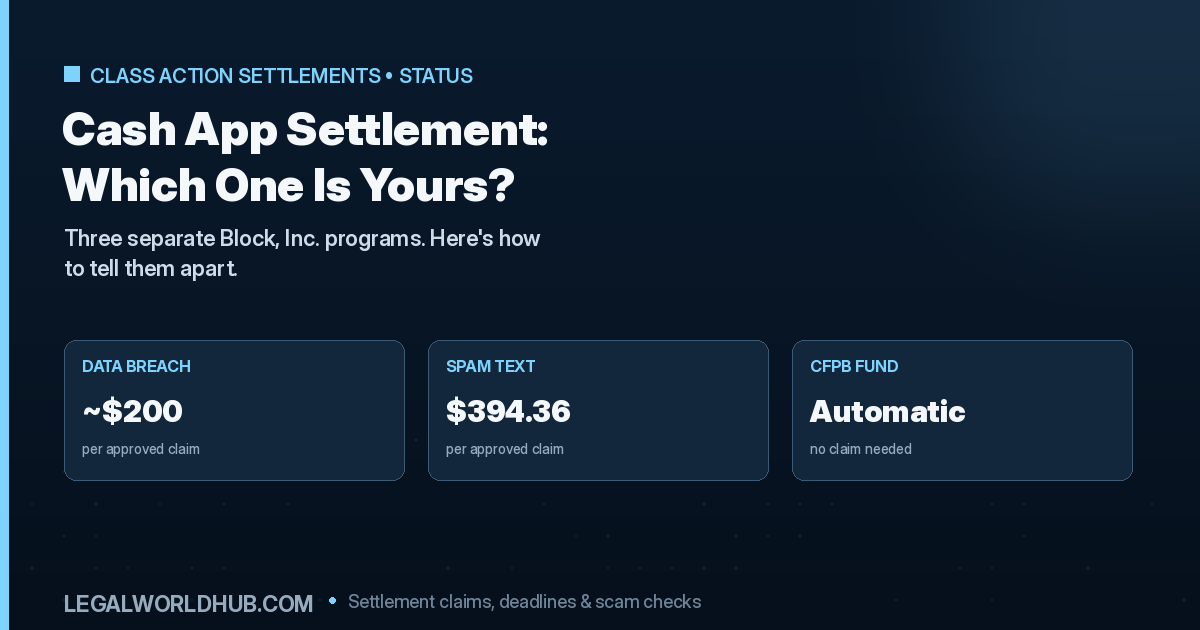
| Salinas v. Block (data breach) | $15,000,000 | Closed, Nov 18, 2024 | Distributing, ~$200 avg per approved claim |
| Bottoms v. Block (spam text, Washington) | $12,500,000 | Closed, Oct 27, 2025 | Distributing, $394.36 per approved claim |
| CFPB consumer redress order | $120,000,000 + $55M penalty | No claim required | Automatic mailed payments to fraud victims |
Program 1: The Data Breach Settlement (Salinas v. Block)
This is the case most people mean when they search for a Cash App settlement. It resolves claims that Block, Inc. and Cash App Investing, LLC were negligent in protecting customer data and failed to properly respond to a data security incident. The case is Salinas, et al. v. Block, Inc. and Cash App Investing, LLC, Case No. 22-cv-04823, in the U.S. District Court for the Northern District of California.
The claim deadline was November 18, 2024, and late claims are not being accepted. The court granted final approval on March 27, 2025. Of more than 667,000 claims filed, approximately 40,380 were approved, totaling roughly $5.6 million distributed so far out of the $15 million fund, with average approved payments around $200, varying based on documented losses.
Electronic payments began April 10, 2025, and paper checks started mailing April 20, 2025. Paper checks expire 90 days from their issue date. The administrator has continued processing replacement checks for returned or undeliverable payments into 2026.
Program 2: The Spam Text Settlement (Bottoms v. Block)
This is a separate case alleging Block sent unwanted text messages in violation of Washington state law, unrelated to the data breach. The claim and exclusion deadline was October 27, 2025, and the court granted final approval on December 2, 2025. Payments of $394.36 per approved claimant began distributing on February 2, 2026.
If you are trying to figure out why a Cash App-related check for exactly $394.36 arrived, this is almost certainly the program it came from, not the data breach settlement.
Program 3: The CFPB Consumer Redress Fund
This is not a class action lawsuit at all. It stems from a federal regulatory action, a Consumer Financial Protection Bureau consent order dated January 16, 2025, requiring Block to pay up to $120 million in consumer redress plus a $55 million civil penalty over allegations related to how the company handled fraud disputes and refunds.
This program requires no claim form. Eligible consumers who were denied proper fraud refunds are being sent compensation automatically by mail, with a notice explaining the payment. If you believe you were affected but have not received anything, this is the program to ask the administrator about, since it is the only one of the three still actively identifying and paying eligible people without requiring you to have filed anything by a deadline.
Which Program Actually Applies to You?
- Check for $200: likely the data breach settlement (Salinas)
- Check for exactly $394.36: likely the spam text settlement (Bottoms)
- Unprompted mailed compensation with no claim filed: likely the CFPB redress fund
- None of the above, but you filed a claim in one of the two lawsuits: contact that specific settlement’s administrator to check your status
Can You Still File a Claim?
Not for the two class action settlements. Both claim deadlines have passed and late claims are not being accepted under either one. If you never filed and did not opt out, you generally remain bound by whichever settlement applied to you but will not receive a payment from it.
The CFPB redress fund is different since it requires no claim, so if you believe you are eligible and have not been contacted, reaching out to ask about your status is worthwhile rather than assuming you missed a deadline that does not apply to this program. For the general difference between these approaches, see our guide on how class action settlements work.
Is a Cash App Settlement Check Real?
Settlements involving a major fintech company are a common target for impersonation scams. A check or message referencing Salinas v. Block, Bottoms v. Block, or the CFPB order can be verified against the case name and the amounts described above. Never pay a fee or send money back in response to any of these programs. See our guide on how to tell if a settlement check is real and class action settlement scams before acting on anything unexpected.
Frequently Asked Questions
Can I still file a Cash App settlement claim?
No, for either of the two class action settlements; both claim deadlines have passed. The CFPB redress fund does not require a claim at all.
Why did I get a check for $394.36?
That specific amount matches the Bottoms v. Block spam text settlement, a different case from the Cash App data breach settlement.
How much did the data breach settlement pay?
Approved claims have averaged around $200, varying based on documented losses, out of a $15 million fund.
What is the CFPB redress fund and do I need to file anything?
It is a separate regulatory action requiring Block to pay up to $120 million to consumers who were denied proper fraud refunds. No claim form is required; eligible payments are sent automatically.
Is it too late to get money from Cash App?
For the two lawsuits, yes, if you did not file by their respective deadlines. If you believe you were denied a fraud refund and have not been contacted about the CFPB fund, it is worth asking the administrator about your status.
Bottom Line
Three separate Block, Inc. money programs get confused with each other constantly. The data breach settlement and the spam text settlement are both closed to new claims and are in active distribution. The CFPB redress fund requires no claim and pays automatically. Match the amount or the situation you are dealing with to the right program before assuming you missed a deadline or that a payment is fake.
This article is for general information only and is not legal advice. Settlement and enforcement terms are set by the court, the administrator, or the regulator in each matter and can change.