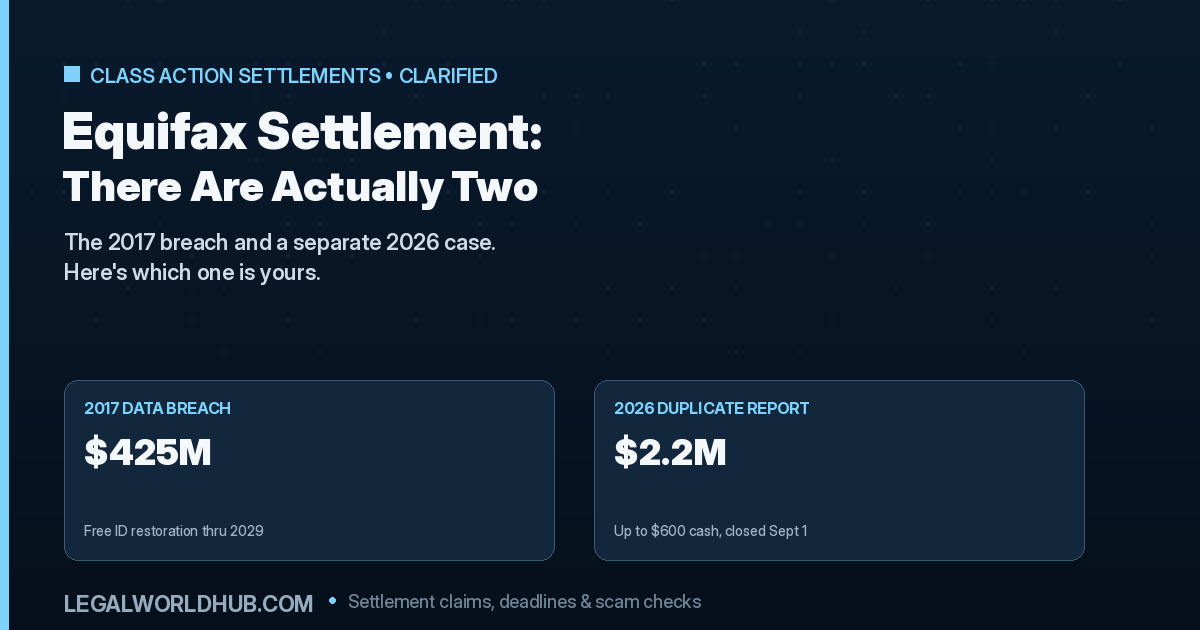
Searching for an Equifax settlement almost always leads to confusion, because there are two entirely separate cases with the word Equifax attached to them, years apart, with different eligibility rules and different amounts. Here is how to tell which one you actually qualify for.
The Two Equifax Settlements at a Glance
| 2017 Data Breach Settlement | |
| What it covers | The 2017 data breach exposing 147 million people’s personal information |
| Total settlement | Up to $425 million |
| Claim deadline | Closed, January 22, 2024 |
| Still available now | Free identity restoration services through January 2029, and 7 free Equifax credit reports per year for all U.S. consumers through 2026, via AnnualCreditReport.com |
| Official site | EquifaxBreachSettlement.com |
| 2026 Duplicate Reporting Settlement | |
| What it covers | Equifax reporting the same collection account twice on some consumers’ credit files (2022) |
| Total settlement | $2.2 million |
| Claim deadline | Closed, September 1, 2026 |
| Cash payment | Up to $600, plus 6 months of Equifax Complete credit monitoring |
| Official site | DuplicateAccountFCRASettlement.com |
Settlement 1: The 2017 Equifax Data Breach
This is the settlement most people think of when they hear “Equifax settlement.” In September 2017, Equifax announced a data breach exposing the personal information of approximately 147 million people. Equifax reached a global settlement with the Federal Trade Commission, the Consumer Financial Protection Bureau, and 50 U.S. states and territories, providing up to $425 million to help affected consumers. The claim deadline for that settlement was January 22, 2024, and has been closed for over a year.
According to the FTC’s own Equifax settlement page, even though the general claim window is closed, two benefits remain available now, regardless of whether you ever filed a claim:
- Free identity restoration services through January 2029, if you use the settlement’s look-up tool to confirm you were affected
- Seven free Equifax credit reports per year for all U.S. consumers, through 2026, via AnnualCreditReport.com
The FTC notes that legitimate emails about this settlement come only from distribution@equifaxbreachsettlement.com or info@equifaxbreachsettlement.com, and the official settlement site is EquifaxBreachSettlement.com.
Settlement 2: The 2026 Duplicate Reporting Settlement
This is a much smaller, unrelated case: Bradberry v. Equifax Information Services LLC, resolving allegations that Equifax violated the Fair Credit Reporting Act by listing the same collection account more than once on some consumers’ credit files. This is not a data breach case. It concerns a reporting accuracy problem affecting roughly 37,651 people who received a Duplicate Reporting Letter from Equifax in August or September 2022.
Eligible class members could claim up to $600 in cash plus six months of Equifax Complete credit monitoring, including up to $500,000 in identity theft insurance. The claim and opt-out deadline was September 1, 2026, and a final approval hearing is scheduled for October 6, 2026.
If you did not file a claim by the deadline, you generally remain part of the class and should still receive the credit monitoring benefit automatically, but you will not receive the cash payment. For a general explanation of what filing a claim actually accomplishes, see our guide on what a settlement claim means.
Which One Applies to You?
- If your notice mentions a data breach, personal information exposure, or dates back to 2017, that is the older, larger settlement
- If your notice mentions a Duplicate Reporting Letter, a collection account, or dates to 2022, that is the newer, smaller settlement
- You can potentially be part of both, since they involve entirely different alleged issues
Are Both Claim Windows Closed Now?
Yes, both cash claim deadlines have passed: January 22, 2024 for the 2017 breach settlement, and September 1, 2026 for the duplicate reporting settlement. However, the 2017 settlement still offers ongoing free benefits described above that do not require having filed a claim.
Is an Equifax Settlement Message Legitimate?
Equifax settlements, especially the well-known 2017 breach case, are a common target for scam messages given how widely reported the case was. Verify any Equifax settlement communication against the correct official website for whichever case it claims to reference, rather than assuming it is fake or real based on the Equifax name alone. See our guide on class action settlement scams for current impersonation tactics.
Frequently Asked Questions
Can I still file for either Equifax settlement?
No. Both cash claim deadlines have passed. The 2017 breach settlement’s free identity restoration and credit report benefits remain available separately, without a new claim, through their own stated end dates.
How do I know which Equifax settlement my notice is about?
Check whether it references a data breach and 2017, or a Duplicate Reporting Letter and 2022. Those details point to two entirely different cases.
I never filed a claim for the 2017 breach. Can I still get anything?
Yes. Free identity restoration services remain available through January 2029 if you use the settlement’s look-up tool to confirm you were affected, and all U.S. consumers can get free Equifax credit reports through AnnualCreditReport.com through 2026, regardless of whether a claim was ever filed.
Is DuplicateAccountFCRASettlement.com a scam?
No, it is the official website for the 2026 duplicate reporting settlement, a real, court-supervised case separate from the 2017 breach.
Bottom Line
There are two separate Equifax settlements, one covering the massive 2017 data breach with ongoing free benefits through 2029, and a much smaller 2026 settlement over duplicate credit reporting with cash claims that closed September 1, 2026. Both cash claim windows are closed, but the 2017 settlement’s identity protection and free credit report benefits are still worth using if you have not already. For the general process behind settlements like these, see our guide on how class action settlements work.
This article is for general information only and is not legal advice. Settlement terms are set by the court, the FTC, or the claims administrator in each matter and can change. Always verify current details on the correct official settlement website.