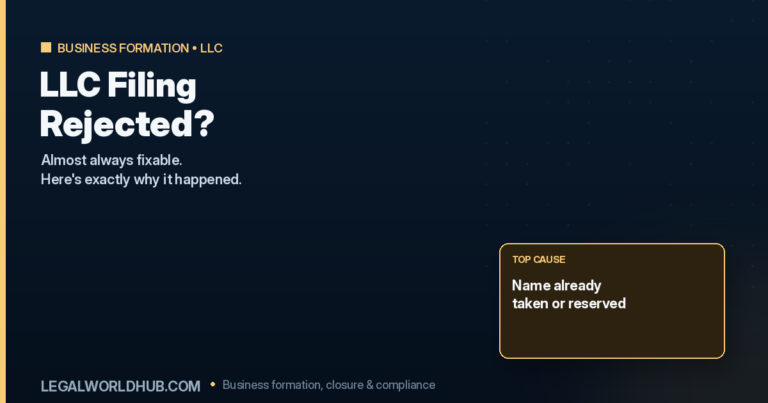
Your business name got rejected, and you’re staring at a notice that doesn’t explain much. Here’s what’s actually happening behind the scenes: when you file your Articles of Organization, the Secretary of State runs your proposed name through a narrow, specific administrative test, not a creative judgment, not a trademark check, a specific set of database and rule comparisons. Understanding what that test actually looks for makes fixing the problem considerably faster. For rejections unrelated to your name, see our broader guide on why LLC filings get rejected.
The Distinction Most People Miss: State Approval Is Not Trademark Approval
This is worth understanding before anything else, because it cuts both ways. The question your state’s filing office is asking is narrow: is this exact name, or something close enough to cause confusion, already on file in this state’s database, and does it comply with this state’s specific naming statute? That is a completely different question from whether a federal trademark holder somewhere else has rights to that name.
This means two things. First, your state accepting your LLC name does not mean you’re safe from a trademark dispute; a federal trademark holder can still demand you stop using a name your state was perfectly happy to approve. Second, and this surprises people the other way, a name being unavailable in your specific state doesn’t necessarily mean it’s trademarked or owned nationally, it may simply already belong to an unrelated business that happens to be registered in that same state.
The Four Things That Actually Get Checked
1. Is the Exact Name, or Something Deceptively Similar, Already Taken?
States reject names that are identical to an existing registered entity, and most also reject names considered deceptively similar, even without an exact match. What counts as deceptively similar varies by state, but common wording changes, spacing differences, or swapping a single word usually aren’t enough to clear this bar on their own.
2. Does the Name Include a Proper Entity Designator?
Your name needs to include an accepted indicator that it’s an LLC, LLC, L.L.C., or Limited Liability Company, depending on your state’s specific requirements. Using an unaccepted variation, or omitting it entirely, is a straightforward, easily fixed rejection reason.
3. Does It Contain a Restricted or Regulated Word?
Names including terms tied to banking, insurance, trust services, or other licensed professions often trigger automatic flags requiring additional documentation proving you’re actually authorized to operate in that regulated space. This doesn’t necessarily mean permanent rejection, it usually means an extra step most first-time filers don’t expect.
4. Is There a Pending or Reserved Filing You Can’t See?
This is the one that catches people off guard, since it doesn’t show up in a standard search. Some names are tied to filings still under review or names another applicant has formally reserved, and these records don’t always appear in the public search tools most people check before filing. If your name search came back clear but your filing was still rejected for availability, this is very likely why.
How to Actually Fix It
1. Read the specific rejection reason if your state’s notice provides one; not every state explains exactly which of the four checks above your name failed.
2. Run your proposed name, and close variations of it, through your state’s official business name search tool directly, not a general web search.
3. If the issue is availability, make a small, meaningful change, adding a distinctive word, adjusting the structure, or choosing an entirely different name, rather than resubmitting the identical name and hoping for a different result.
4. If the issue is a restricted word, check your state’s specific guidance on what additional documentation or licensing proof is required, or consider whether the word is genuinely necessary to your business name.
5. If you’re still unsure why the name was rejected, call the filing office directly rather than guessing and resubmitting repeatedly.
Consider Reserving Your Name Next Time
Most states allow you to formally reserve a business name for a set period, often 60 to 120 days, before you file your full Articles of Organization. This is worth doing if you’ve settled on a name and aren’t ready to file immediately, since it closes the exact gap that causes some name-availability rejections: someone else filing for a similar name in the window between when you checked availability and when you actually submitted your paperwork.
Frequently Asked Questions
Why was my LLC name rejected if no one else seems to be using it?
It may be tied to a pending filing or a name reservation that doesn’t show up in standard public search tools. It could also be considered deceptively similar to an existing name under your state’s specific rules, even without being identical.
Does an approved LLC name mean I’m protected from trademark issues?
No. State approval only confirms the name isn’t already registered as an entity in that state and follows the state’s naming rules. It does not check federal trademark databases, so a trademark holder could still have a valid claim against your business name.
What words automatically trigger extra scrutiny in an LLC name?
Terms related to banking, insurance, trust services, and other licensed professions commonly require additional documentation showing you’re authorized to operate in that regulated space.
How long can I reserve an LLC name before filing?
This varies by state, but 60 to 120 days is common. Check your specific state’s rules for both the reservation period and the fee involved.
Can two LLCs in different states have the same name?
Generally yes, since state name-availability checks are limited to that state’s own database. This is separate from federal trademark protection, which can apply nationally regardless of state-level name availability.
Bottom Line
An LLC name rejection almost always comes down to one of four specific checks: exact or similar-name conflicts, a missing entity designator, a restricted word, or a pending filing you couldn’t see in advance. Once you know which one applies, fixing it is usually straightforward. For rejections unrelated to your name specifically, see our broader guide on why LLC filings get rejected.
This article is general information, not legal advice. LLC naming rules vary by state, and this article does not address trademark law; consult a licensed attorney for trademark concerns.