Somewhere between a formation service telling you anyone can own a US LLC, and a worried forum post asking whether that’s actually true for someone on a visa, is a real, specific, well-established legal answer that almost nobody explains clearly in one place. Here it is, sourced from actual case law, immigration attorneys, and USCIS’s own framework, not a guess. If you’re on a specific visa type, F-1, H-1B, L-1, TN, or you’ve moved past visa status entirely onto a green card, see our dedicated guides on owning an LLC on an F-1 student visa, owning an LLC on an H-1B visa, owning an LLC on an L-1 or TN visa, or what changes once you have a green card or work permit for the specifics that apply to you. This pillar covers the underlying principle that governs all of them.
The Short Answer
Yes, almost anyone on almost any visa can legally own an LLC, regardless of immigration status. Forming an LLC is a state-level filing, and no US state checks your citizenship or immigration status when you register a business entity. The Immigration and Nationality Act itself does not prohibit a foreign national, including someone on a temporary visa, from owning equity in a US company.
But ownership and work are two completely different things under immigration law, and this is where almost everyone runs into trouble. You can own the LLC. Whether you can work for it, draw a salary from it, manage its day-to-day operations, or perform any service on its behalf, depends entirely on your specific visa category, and for most work and student visas, the answer is no, not without separate authorization.
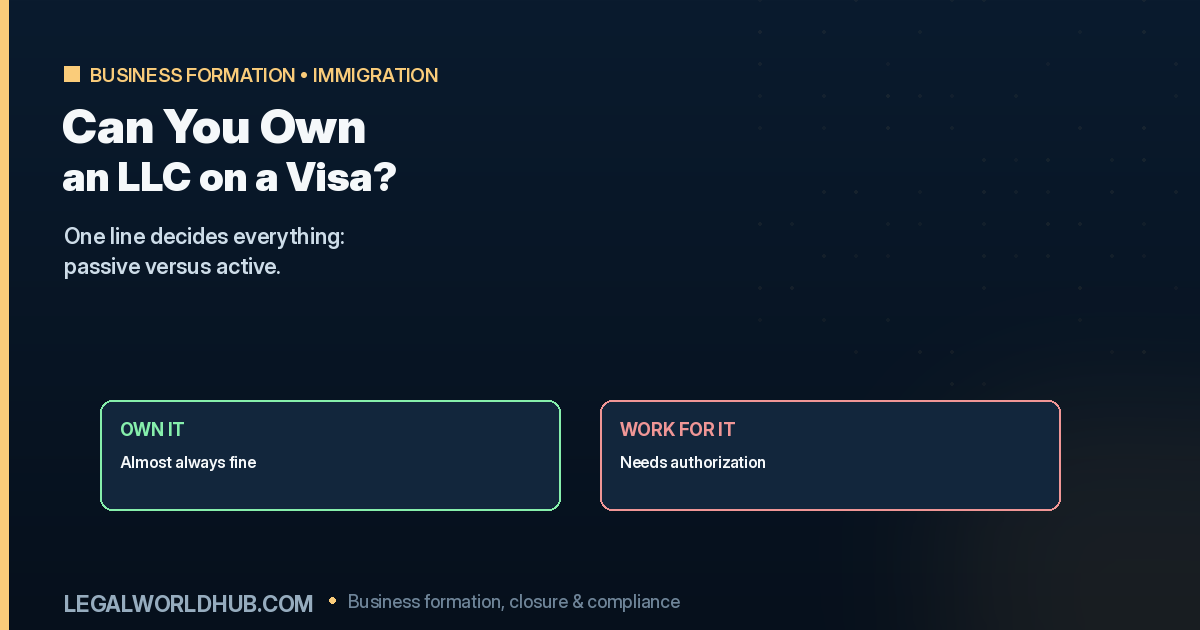
The One Distinction That Actually Matters: Passive Ownership vs. Active Work
Every question about LLCs and visa status ultimately comes back to this single line, and understanding it properly will answer most of what you’re actually trying to figure out.
Passive ownership means you hold equity, receive your share of profits or distributions, and have no operational involvement in how the business actually runs. You can invest capital. You can review financial statements as an owner. You can vote on major structural decisions the way any shareholder might, selling the company, admitting a new partner, without that alone crossing into employment.
Active work means performing services, labor, or operational functions for the business, regardless of whether you’re paid for it. This is the part that surprises people most: unpaid work still counts. Immigration law doesn’t ask whether you received a paycheck; it asks whether you provided labor or services. Managing day-to-day operations, negotiating contracts on the company’s behalf, directing employees, or personally performing the actual work the business sells, all of this is active work, and all of it generally requires separate work authorization beyond simply being an owner.
This Isn’t a Guess, It’s Established in Case Law
The passive-versus-active distinction isn’t an informal rule of thumb attorneys invented; it has real legal precedent behind it. In Bhakta v. Immigration and Naturalization Service (1981), a federal appeals court found that a foreign national who owned a motel chain had not engaged in unauthorized employment, specifically because his role was ownership rather than labor. By contrast, in Wettasinghe v. United States Department of Justice, Immigration and Naturalization Service (1983), a court reached a different conclusion where the individual’s involvement crossed from ownership into active participation. These aren’t obscure technicalities; they’re the actual legal foundation immigration attorneys point to when explaining why ownership alone is safe but involvement often isn’t.
Why This Line Gets Blurry in Practice
The theory is clean. Real life usually isn’t, and this is exactly where people get into trouble without realizing it. A few patterns come up constantly in real cases and attorney consultations:
“I’m the Only Owner, So I Have to Be Involved”
Single-member LLCs create a genuine structural problem. If you’re the sole owner, who’s actually running the business day to day? Immigration officers and USCIS reviewers scrutinize sole-member LLCs more carefully precisely because there’s no obvious separation between owner and operator. A manager-managed structure, where someone else, a US citizen, green card holder, or otherwise work-authorized person, handles actual operations while you remain a purely financial owner, is meaningfully safer than a member-managed structure where you’re both owner and de facto operator.
“I’m Not Getting Paid, So It’s Not Employment”
This is one of the most common and most dangerous misconceptions. Unauthorized employment under immigration law is about labor and service, not compensation. Volunteering your time to run errands for your own company, negotiate with a vendor, or handle customer service, all of it counts as work regardless of whether a dollar changed hands. One attorney consultation captured this exactly: someone asked whether picking up packaging supplies and going to the post office for their LLC, unpaid, would be a problem. The answer was direct: that doesn’t sound passive at all.
“Forming the LLC and Paying Myself a Salary Creates Work Authorization”
It does not, and this misunderstanding has serious consequences. Your ability to legally work comes from your underlying immigration status and any approved petition tied to it, not from the fact that a company, even your own, decided to pay you. Paying yourself a salary from an LLC you’re not authorized to work for doesn’t create authorization; it creates evidence of unauthorized employment if the arrangement is ever reviewed.
What Actually Happens If You Get This Wrong
This isn’t a minor administrative issue. If USCIS discovers unauthorized employment, whether during a green card application, a visa extension, or a status inquiry triggered by something else entirely, the consequences can include denial of the benefit you’re seeking and, in serious cases, the issuance of a Notice to Appear, which places you into removal proceedings. Unauthorized employment discovered years later, during a green card interview for example, can undo years of otherwise careful immigration planning. This is precisely why the distinction between owning and working matters so much more than it might initially seem.
What Generally Stays Safe Across Most Visa Categories
- Holding equity or membership interest in an LLC as a purely financial investment
- Receiving passive income: profit distributions, dividends, capital gains from an eventual sale
- Voting on major structural matters as an owner, without directing daily operations
- Raising investment capital for your company by meeting with investors and pitching the business, generally considered a passive activity rather than day-to-day operational work
- Reviewing financial statements and exercising standard ownership oversight
What Generally Crosses the Line, Regardless of Pay
- Managing daily operations or directing employees
- Negotiating or signing contracts on the company’s behalf
- Personally performing the services or labor the business sells to customers
- Any task performed regularly and specifically because the business needs it done, even unpaid and even small
This Varies by Visa Type, and the Differences Are Real
| Status | General Rule |
| F-1 student visa | Passive ownership generally fine; active work requires CPT or OPT authorization tied to your field of study, with specific structural requirements |
| H-1B work visa | Passive ownership generally fine; active work requires the LLC itself to sponsor your H-1B or separate authorization, since you’re otherwise legally tied to your petitioning employer |
| L-1 and TN visas | Passive ownership generally fine; no self-employment path exists for either, and TN specifically treats officer titles like CEO as active involvement |
| Green card holder | Full authorization to both own and actively work for any business, including your own, without these restrictions |
| Work permit (EAD) holder | Generally authorized to work broadly, though specifics depend on the category under which the EAD was issued |
See our dedicated guides on F-1 visa specifics, H-1B visa specifics, L-1 and TN visa specifics, and what changes with a green card or work permit for the details specific to each situation.
If You Actually Want to Run Your Business: The Visas Built for That
If passive ownership isn’t enough, because you genuinely want to run the company you’re forming, several visa categories exist specifically for that purpose, and pursuing one of these is the legitimate path rather than trying to stretch passive ownership rules further than they’re designed to go.
- O-1 visa: for individuals with extraordinary ability in their field, which can allow self-petitioning in some circumstances
- E-2 treaty investor visa: for nationals of countries with a qualifying treaty with the United States who make a substantial investment in a business they will actively direct and develop
- EB-2 National Interest Waiver or EB-1A: green card categories that can permit self-sponsorship without an employer petition, for those who qualify based on their specific achievements or the national importance of their work
Each of these has its own detailed eligibility requirements well beyond the scope of a general overview, but knowing they exist matters, since many people don’t realize passive ownership isn’t their only option if active involvement is genuinely what they need.
Frequently Asked Questions
Can a non-citizen on a visa legally own an LLC in the US?
Yes. No US state checks immigration status when you register an LLC, and nothing in federal immigration law prohibits a foreign national from owning equity in a US company.
Does owning an LLC count as employment under immigration law?
Ownership alone does not. Active work performed for the LLC, managing operations, negotiating contracts, performing the actual services it provides, generally does count as employment regardless of whether you’re paid for it.
Can I work for my own LLC if I don’t take a salary?
Generally no, if the work itself would otherwise require authorization. Unauthorized employment is defined by the labor or service performed, not by whether compensation was paid.
Does forming an LLC and paying myself give me work authorization?
No. Work authorization comes from your underlying immigration status and any approved petition, not from your own company deciding to pay you. A salary without proper authorization is evidence of unauthorized employment, not a source of legal permission to work.
What happens if USCIS finds unauthorized employment on my record?
It can result in denial of an immigration benefit you’re seeking, such as a green card or visa extension, and in serious cases can lead to a Notice to Appear, placing you into removal proceedings.
What visa should I get if I want to actively run my own business?
Consider the O-1 (extraordinary ability), E-2 (treaty investor, for eligible nationalities), or certain green card categories like EB-2 NIW or EB-1A that allow self-sponsorship. These are specifically designed for active entrepreneurship, unlike passive ownership under most other visa types.
Bottom Line
You can almost certainly own an LLC on your current visa. Whether you can work for it is a completely separate question with real legal consequences if you get it wrong, and the line between the two comes down to whether you’re providing labor or service, not whether you’re getting paid. This is genuinely a situation where the cost of a single consultation with an immigration attorney before you act is far lower than the cost of guessing wrong. For the specifics that apply to your exact visa category, see our guides on F-1 student visas, H-1B work visas, and green cards and work permits.
This article is general information, not legal or immigration advice. The line between passive ownership and unauthorized employment involves genuinely fact-specific determinations with serious consequences for your immigration status. Consult a licensed immigration attorney before forming or operating an LLC while on a visa.