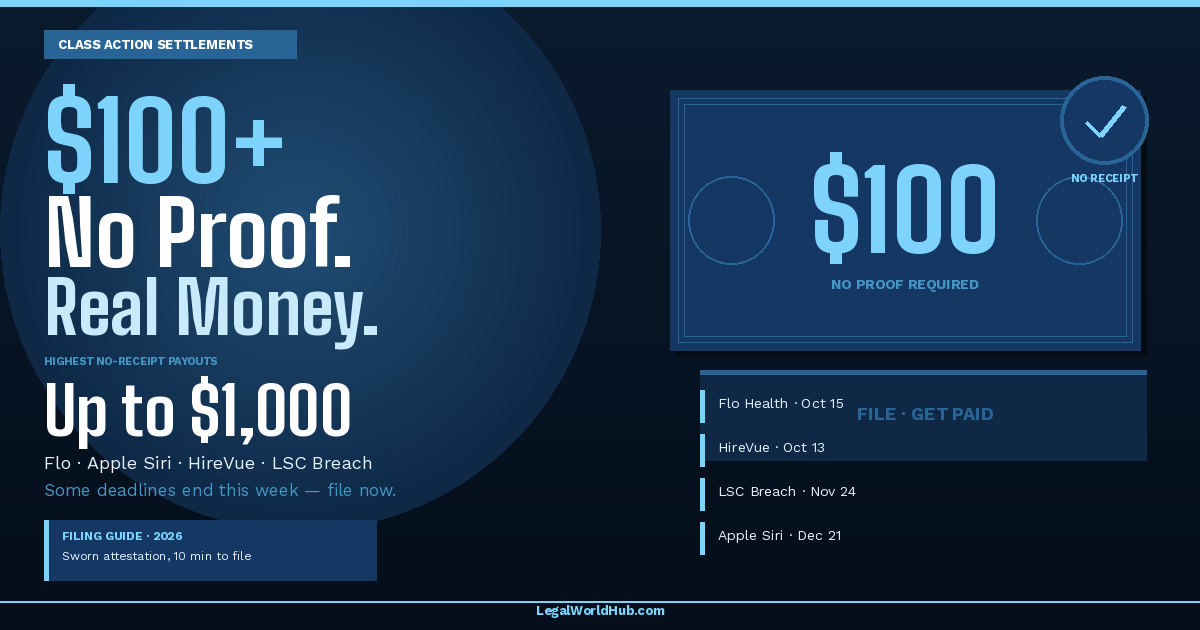
Quick Answer: Multiple class action settlements currently open in 2026 pay $100 or more per person with no receipt required. The highest include Apple Siri ($95, close to $100), Flo Health (pro rata, potentially several hundred dollars), HireVue BIPA (~$150, Illinois only), and GEICO’s credit reporting case (~$150, automatic payment). For data breach cases, payouts of $100 to $1,000 with attestation-only claims are common right now.
Key Takeaways
- “No proof” means no receipt, but you still sign a sworn attestation under penalty of perjury
- The $100+ tier without documentation is dominated by data breach, biometric privacy, and large consumer privacy cases
- State-specific settlements (Illinois BIPA, California privacy) consistently pay more than nationwide consumer product cases
- Some high-payout settlements are automatic, eligible class members receive payment without filing at all
- Documented claims always pay more when a settlement offers both tiers; always search your email and bank history before filing as no-proof
- Flo Health closes October 15, 2026 and HireVue closes October 13, 2026, file immediately if you qualify
Why the $100+ No-Proof Tier Exists
Most consumer class action settlements that require no documentation pay between $5 and $50. The cases that exceed $100 with no proof share a few characteristics:
Statutory damages cases like Illinois BIPA set a floor of $1,000 per violation by law, which forces settlements upward even for a no-proof attestation.
Large privacy cases with a defined, small class pay more per person because the fund is not diluted by millions of filings. A $3.75 million settlement with 25,000 eligible Illinois residents pays roughly $150 each. The same fund split among 3 million people pays $1.25.
Healthcare and sensitive data breaches involve data that courts value more highly than a financial overcharge case. Settlements for healthcare-adjacent breaches routinely offer $100 to $500 at the attestation tier.
California residents receive elevated payouts in many consumer privacy cases due to the California Consumer Privacy Act (CCPA) and California’s private right of action under its Invasion of Privacy Act (CIPA). If you are a California resident, always check whether a settlement has a California-specific subclass.
Open Settlements Paying $100+ With No Proof (October 2026)
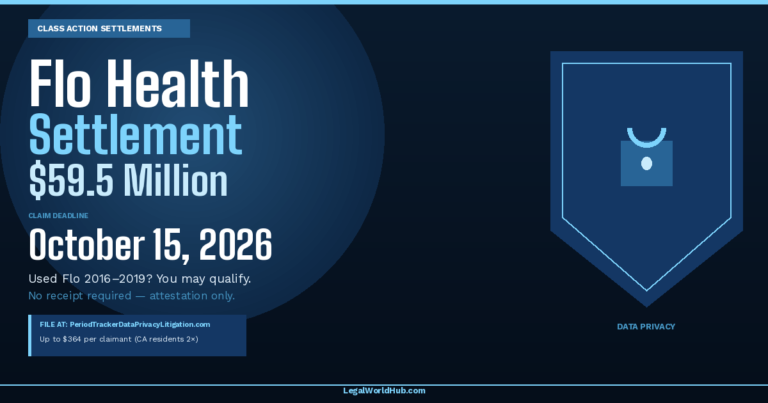
Flo Health: Up to Several Hundred Dollars (Pro Rata)
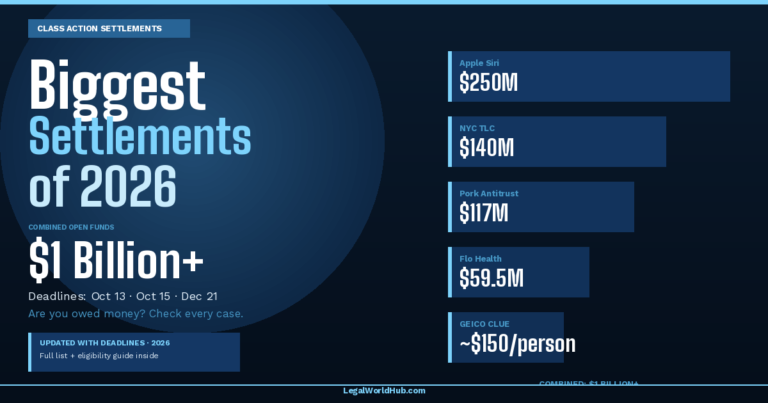
Fund: $59.5 million
Deadline: October 15, 2026 — URGENT
Eligibility: Used the Flo Period Tracker app and entered menstrual or pregnancy data between November 1, 2016, and February 28, 2019
Proof needed: Your Flo account email address; proof of California residency if you are claiming as a California resident
California residents: Receive 2x the base share
Flo Health allegedly shared intimate reproductive health data with Facebook and Google without user consent. At $59.5 million with the final approval hearing set for October 29, 2026, this is the highest-value no-receipt consumer settlement still accepting claims.
No one knows the exact per-person amount until the claim deadline closes and the administrator counts submissions. Based on settlement fund size and typical filing rates for this type of case, estimates have ranged from $50 to over $300 for non-California residents and double that for California filers. The fewer people who file before the October 15 deadline, the larger each share becomes.
File at PeriodTrackerDataPrivacyLitigation.com. Full filing details are in our Flo Health settlement guide.
HireVue BIPA: ~$150 (Illinois Residents Only)
Fund: $3.75 million
Deadline: October 13, 2026
Eligibility: Completed a HireVue video interview in Illinois using voice or facial recognition technology between January 27, 2017, and June 25, 2026
Proof needed: None, attestation only
Illinois BIPA cases are the most reliable source of $100+ no-proof payouts. HireVue collected job applicants’ biometric data through its AI video interview platform without the written consent Illinois law requires. The estimated $150 per-person payout reflects the settlement fund divided among a limited class of Illinois-only claimants.
This deadline is October 13, which is days away. If you applied for jobs in Illinois and used HireVue between 2017 and 2026, file immediately at VideoInterviewBIPASettlement.com.
GEICO CLUE Report Settlement: ~$150 (Automatic Payment)
Fund: $1.65 million
Deadline: No claim form required; opt-out deadline October 20, 2026
Eligibility: Filed a dispute with LexisNexis between March 13, 2022, and May 1, 2026, over GEICO-sourced errors in a C.L.U.E. auto insurance report that remained uncorrected
Proof needed: None, automatic payment if you received a notice
This is the best-case scenario for a settlement claimant: you do nothing and receive approximately $150. If you received a mailed or emailed settlement notice, your payment is already being processed. The only action available is updating your payment preference or address using the Notice ID and PIN from your notice.
If you believe you qualify but did not receive a notice, contact the settlement administrator before October 20 to determine eligibility.
Apple Siri Settlement: $25 to $95
Fund: $250 million
Deadline: December 21, 2026
Eligibility: Purchased an eligible iPhone in the U.S. between June 10, 2024, and March 29, 2025
Eligible devices: iPhone 15 Pro, iPhone 15 Pro Max, iPhone 16, iPhone 16 Plus, iPhone 16 Pro, iPhone 16 Pro Max, iPhone 16e
Proof needed: Device purchase or ownership verification
The Apple Siri settlement technically requires ownership verification, not a receipt per se. Your Apple ID purchase history, carrier records, or AppleCare registration confirms eligibility for most claimants. The base payout is $25 per device, capped at $95 depending on how many claims are filed.
At $250 million across what could be millions of iPhone 15 Pro and 16 owners, the per-device payout is likely to settle near the lower end of the range. Still, it is one of the few consumer tech settlements that clears $25 without documentation. See our guide on the Apple Siri settlement for full instructions.
LSC / Planned Parenthood Lab Data Breach: Up to $1,000
Fund: Undisclosed
Deadline: November 24, 2026
Eligibility: Individuals whose personal and healthcare data was exposed in the Laboratory Services Cooperative (LSC) breach, including patients whose lab work was processed through Planned Parenthood affiliates
Proof needed: No, breach notification letter is the practical qualifier
Healthcare data breaches pay more than financial or consumer product cases because the data involved is more sensitive and the harm is more concrete. The LSC breach exposed medical information. Claimants who received a breach notification letter can file for up to $1,000 with no additional documentation.
If you used Planned Parenthood lab services between the breach window dates and received a notification, this is the highest straightforward no-proof payout currently open.
ConnectOnCall Data Breach: Up to $75
Fund: $4.95 million
Deadline: November 2, 2026
Eligibility: Patients whose data was exposed in the ConnectOnCall healthcare platform breach
Proof needed: No
Payout: Up to $75 for attestation; up to $10,000 for documented extraordinary harm
ConnectOnCall is an after-hours medical call management platform. Its 2023 data breach exposed patient names, dates of birth, medical conditions, and call recordings. The $4.95 million settlement pays up to $75 for a standard claim and significantly more for claimants who can document unusual harm like identity theft expenses, lost time, or medical monitoring costs.
Modernizing Medicine Data Breach: Up to $75
Fund: $2.99 million
Deadline: November 2, 2026
Eligibility: Patients of healthcare providers using the Modernizing Medicine (ModMed) EHR platform whose data was breached
Proof needed: No
Payout: Up to $75 for standard claim
EHR (electronic health records) platform breaches affect large numbers of patients across multiple healthcare providers simultaneously. This settlement shares a deadline with ConnectOnCall. If you received a breach notification from ModMed or a provider using ModMed, file by November 2.
Settlements Offering $100+ With Documentation (Worth Searching For)
These cases are worth the extra effort of finding purchase evidence:
| Settlement | No-proof payout | Documented payout | Deadline |
|---|---|---|---|
| Pork price-fixing ($117M) | N/A — receipts required | Varies by purchase volume | Oct 29, 2026 |
| Flo Health | Pro rata | California 2x | Oct 15, 2026 |
| ConnectOnCall breach | Up to $75 | Up to $10,000 | Nov 2, 2026 |
| LSC data breach | Up to $1,000 | Up to $3,000+ extraordinary harm | Nov 24, 2026 |
For data breach settlements specifically, the documented extraordinary harm tier almost always pays 10 to 20 times the standard no-proof amount. If you experienced identity theft, fraud, or had to freeze your credit because of a breach, document those costs before filing.
How to Check If You Qualify for the $100+ Tier
Most claimants who would receive $100 or more without proof fall into one of these groups:
Illinois residents who used technology between 2017 and 2026. Illinois BIPA cases have produced a steady stream of biometric privacy settlements. If you lived or worked in Illinois and used any platform with facial recognition, voice recognition, fingerprint scanning, or retinal scanning, search “[platform name] BIPA settlement 2025 2026” to see if your case has settled.
Healthcare patients from 2022 to 2025. The wave of healthcare data breaches from this period is now producing settlements. If you received any data breach notification from a hospital, clinic, pharmacy, insurance company, or health app, that notification is your entry point to a potential claim.
Users of major apps between 2016 and 2022. Many consumer app privacy cases covering this period are at or approaching settlement. Check whether any apps you used regularly during that window have active settlements.
California and Illinois residents in consumer privacy cases. Both states have laws that provide elevated statutory damages. California residents often receive 2x the standard payout in consumer privacy cases; Illinois residents often receive more in BIPA cases due to statutory minimums.
Avoiding the Mistakes That Cap Your Payout
Filing as no-proof when you qualify for a documented tier. Ten minutes searching your email for a brand name or order confirmation can triple your payout. Always check first. Our guide on strengthening a no-proof claim walks through every source worth checking.
Missing the deadline. There are no extensions. File as soon as you confirm eligibility.
Overstating quantities. This is the most common reason legitimate claims get flagged. If you are not certain how many units you purchased, estimate conservatively.
Using a paid filing service. Third-party claim filing services charge 10 to 25 percent of your payout. Filing directly through the settlement administrator’s official website is always free and takes the same amount of time.
Not checking back after a settlement fund increases. Some settlements receive additional defendant contributions after the original announcement. A case you passed on at $20 per person may have increased. Keep our open settlements tracker bookmarked for updated amounts.
Common Questions
Are there class action settlements paying over $500 with no proof?
Yes, but they are rare and usually tied to specific circumstances. Illinois BIPA cases can pay $1,000 or more per violation by statute. Healthcare data breach cases with sensitive data exposure can reach $500 to $1,000 at the standard claim tier. Cases with extraordinary documented harm (identity theft, fraud expenses) can pay much more. Outside these categories, settlements paying over $200 without documentation are uncommon for general consumer cases.
Why do data breach settlements pay more than consumer product settlements?
Courts and defendants treat data breach harm differently from a false advertising overcharge. With a breach, the argument is that your private information was exposed and you face ongoing risk. With a mislabeled food product, the argument is that you overpaid by some amount per unit. The concrete privacy harm and the potential for ongoing consequences push breach settlement values higher.
Can I file for multiple settlements at once?
Yes. There is no rule preventing you from filing claims in multiple settlements simultaneously. Each settlement is a separate legal action with its own administrator. Receiving money from one settlement does not affect eligibility for another.
Do I need to opt out of a settlement to sue separately?
Yes. If you want to preserve your right to sue the defendant independently, you must submit a written opt-out request before the opt-out deadline. If you file a claim or do nothing, the class release applies to you once the settlement receives final approval, and you cannot sue separately over the same conduct.
How do I know if a settlement check is real?
Verify any unexpected check against the official settlement website before cashing it. Legitimate administrators send checks directly or through settlement payment processors. Red flags include checks that ask you to wire back a portion, checks from unknown companies with no case information, and checks for amounts that do not match what was announced. Our guide on how to verify a settlement check covers the full verification process.
What if I moved since the qualifying purchase period?
You can still file. Settlement claim forms ask for your current mailing address or payment method, not the address you had during the class period. Your current information is how the administrator gets the money to you.
Summary
The $100-and-up no-proof tier in 2026 is dominated by healthcare data breach cases, state biometric privacy settlements (Illinois), and the major consumer app privacy cases. The most urgent opportunity right now is the Flo Health settlement closing October 15, followed by HireVue on October 13. Apple Siri ($250M, December 21 deadline) has the widest potential audience. For Illinois residents, every BIPA settlement is worth filing; for California residents, check whether you are in a California subclass for any open privacy case. Ten minutes per claim, and you keep the full payout.
This article is for general information only and is not legal advice. Settlement terms and deadlines are subject to court approval. Verify details at the official settlement administrator website before filing.