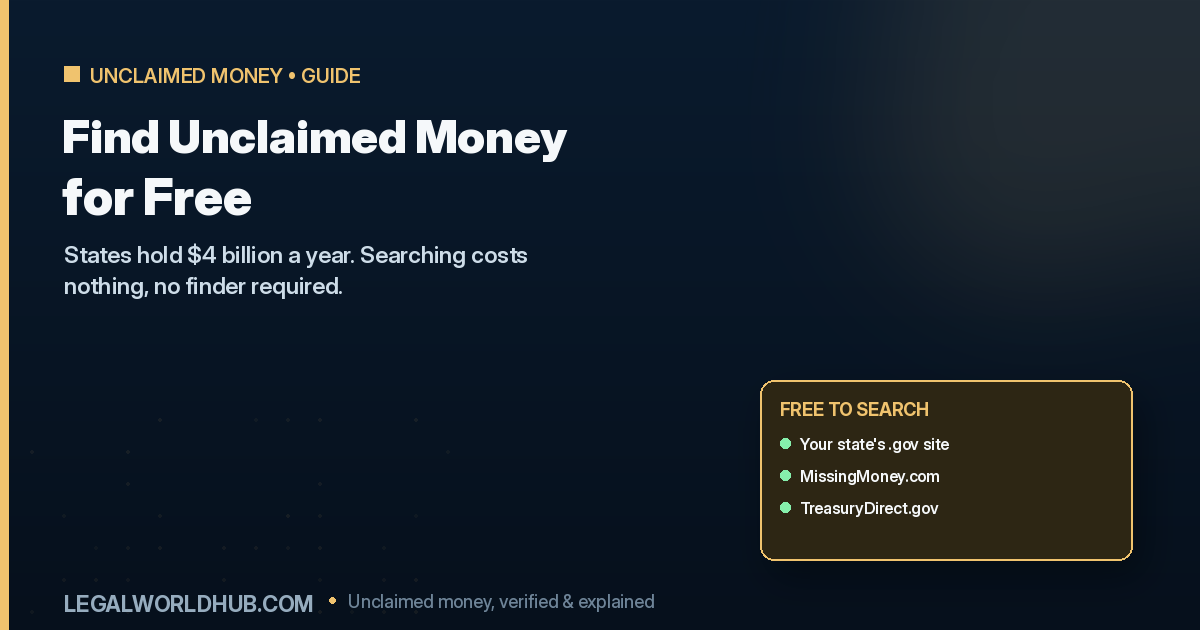
States are currently holding roughly $4 billion a year in unclaimed property, money from old bank accounts, uncashed checks, forgotten security deposits, insurance payouts, and more. Finding out whether any of it belongs to you costs nothing and takes a few minutes. Here is exactly how to search, and why you should be skeptical of anyone who contacts you offering to do it for a fee.
What Counts as Unclaimed Money?
Unclaimed property is money or assets that a business, bank, or government agency owed you but could not deliver, often because you moved, changed banks, or simply forgot about it. Common sources include:
- Old checking or savings accounts left inactive for several years
- Uncashed paychecks, refund checks, or insurance payments
- Security or utility deposits never returned
- Life insurance policies never claimed by a beneficiary
- Stock, dividends, or contents of an abandoned safe deposit box
By law, businesses holding this kind of unclaimed property have to eventually turn it over to the state, a process called escheatment. The state then holds it, in most cases indefinitely, waiting for the rightful owner to claim it.
Where to Search, for Free
1. Your State’s Official Unclaimed Property Office
Every state runs its own unclaimed property program, and every one of them lets you search for free. Search directly using the state’s official .gov site rather than a link from an email or letter.
2. MissingMoney.com
MissingMoney.com is a free, multi-state search tool sponsored by the National Association of Unclaimed Property Administrators (NAUPA), the organization of state unclaimed property officials. Because unclaimed property is filed based on where the company holding it operated, not necessarily where you currently live, this is useful if you have moved between states.
3. Treasury Hunt (Federal Securities)
If you believe you are owed money from U.S. savings bonds or other Treasury securities, TreasuryDirect.gov runs a free search tool called Treasury Hunt specifically for that category.
4. Agency-Specific Searches
Some categories of unclaimed money are not covered by state unclaimed property programs at all, and instead sit with the specific federal agency involved. There is no single, government-wide database covering everything.
| Type of Money | Where to Look |
| Bankruptcy proceeds | Search through the U.S. Courts system |
| Tax refunds | Check directly with the IRS |
| Pension benefits from a failed company plan | Pension Benefit Guaranty Corporation |
| FDIC-insured bank failures | Search the FDIC’s unclaimed funds database |
| HUD/FHA mortgage insurance refunds | Search directly through HUD |
How to Search Effectively
1. Search every name you have used, including maiden names, nicknames, and common misspellings.
2. Search every state you have lived in, not just your current one.
3. Search for close family members too. You may be able to claim property on behalf of a deceased relative as their legal heir.
4. If you find a match, follow the link to the official state site to file a claim, generally at no cost.
5. Be ready to prove your identity and current address, since that is what most claims require.
Do You Need to Pay Someone to Find This for You?
No. Every legitimate path to unclaimed money described above is free to search and free to claim. Companies calling themselves “finders,” “locators,” or “asset recovery specialists” do exist, and in many states they operate legally, but they are optional, not necessary, and most states cap what they are allowed to charge. See our guide on unclaimed money finder fees for exactly how those rules work and how to tell a properly registered finder from a scam.
Warning Signs of an Unclaimed Money Scam
- You are asked to pay a fee before you can even find out if money exists
- You are pressured to act immediately or told the money will be lost
- You are contacted by text message, since states generally do not use text as their primary outreach for this
- You are asked for a full Social Security number through an unsolicited link before you have verified anything independently
- The link goes to a private .com or .net domain rather than a .gov site, missingmoney.com, or unclaimed.org
For more on how these scams typically present themselves, see our guide on class action settlement scams, since many of the same red flags apply.
Frequently Asked Questions
Is it really free to search for unclaimed money?
Yes. Every official state unclaimed property program, MissingMoney.com, and Treasury Hunt are free to search and free to file a claim through.
Why does unclaimed money exist in the first place?
Businesses are legally required to turn over property to the state after it sits unclaimed for a set number of years, often because the owner moved or lost track of an old account, check, or deposit.
Can I claim money on behalf of a deceased relative?
Often, yes, if you are their legal heir, though the documentation required varies by state and by the size of the claim.
Does unclaimed money expire?
Generally, no. Most states hold unclaimed property indefinitely rather than on a deadline, though the exact rules vary by state and by the type of property.
How do I know if a letter about unclaimed money is real?
Do not rely on the letter alone. Search your name directly at your state’s official site or MissingMoney.com to verify the property actually exists before responding to anyone who contacted you first.
Bottom Line
Searching for unclaimed money costs nothing and takes only a few minutes through official state and federal tools. If you are ever contacted by someone offering to find or release money for a fee, verify independently first, since the search itself is always free. See our guide on unclaimed money finder fees if you are specifically weighing whether to use a paid finder service.
This article is for general information only and is not legal advice. Unclaimed property rules vary by state.