You checked your state’s business database, or got a letter you didn’t expect, and now you know: your LLC isn’t active anymore. The state dissolved it. Nobody sat you down and explained what that actually means, whether you owe anything, or whether you’re now personally on the hook for something you thought was safely tucked inside a business entity. Here is the honest, complete answer.
What Administrative Dissolution Actually Means
Administrative dissolution is what happens when your state’s Secretary of State, or equivalent agency, revokes your LLC’s legal status because it fell out of compliance, not because you asked for it to end. This is different from voluntary dissolution, where you and your fellow members deliberately choose to close the business and file the paperwork to do so properly. Administrative dissolution happens to you, often without much warning, because of something the state considers a compliance failure.
The three most common triggers are failing to file a required annual or biennial report by its due date, failing to pay a franchise tax or annual fee, and failing to maintain a registered agent with a valid, current address on file. Any one of these, left unresolved long enough, can trigger dissolution. Critically, this often happens by accident rather than intention. A lot of small LLC owners assume that if their business made no money and owed no income tax, there was nothing else to file, not realizing that annual report and franchise tax obligations exist entirely separately from income tax and often apply whether or not the business earned a dollar.
Do You Still Owe Money? Almost Certainly Yes.
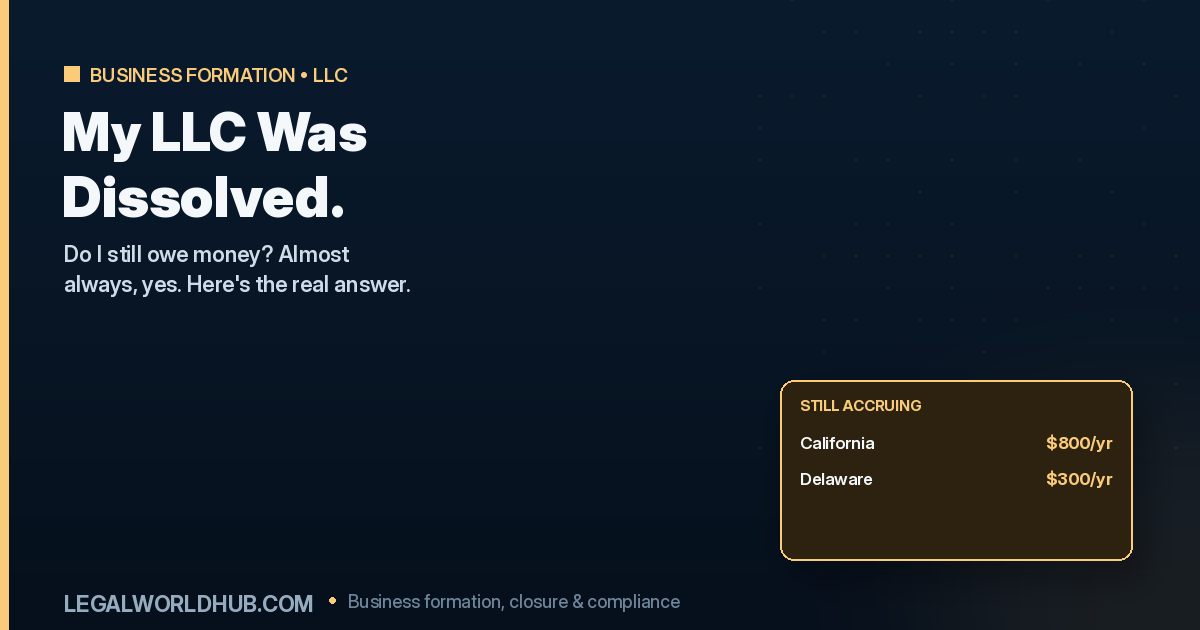
This is the question everyone actually wants answered, and the honest answer is yes, in most cases. Administrative dissolution does not erase what you already owed. The unpaid annual report fee, the unpaid franchise tax, and any late penalties that accumulated before dissolution are still your responsibility. Some states will continue assessing certain fees even after dissolution until you take further action, so the amount owed does not necessarily freeze at the moment your LLC’s status changed.
This matters more than people expect, because unpaid state fees do not simply disappear into bureaucratic silence. Several states will send unpaid business debts to collections, and if you personally signed as the responsible party when the LLC was formed, that unpaid debt can show up as a mark against your personal credit, not just an abstract business record nobody checks.
| State | What Keeps Accruing |
| California | $800 annual franchise tax, charged whether or not the LLC did any business that year |
| Delaware | $300 annual franchise tax, regardless of LLC activity |
| Most other states | Annual or biennial report fees typically ranging from $0 to a few hundred dollars, plus escalating late penalties |
Are You Personally Liable for Anything?
This is where people get genuinely nervous, and the real answer requires separating two different things. The LLC’s own debts and obligations, contracts it signed as a business entity, generally remain the LLC’s problem even after dissolution, not automatically your personal problem, precisely because limited liability was the whole point of forming an LLC in the first place.
But that protection has limits that dissolution does not change. If you personally signed a lease, a loan, or a vendor contract in your own name rather than strictly as the LLC, or if you personally guaranteed a business debt, that personal obligation survives the LLC’s dissolution completely intact. Dissolving or losing the entity does not retroactively erase something you agreed to as an individual. It is also worth knowing that once an LLC loses good standing, it may lose the ability to sue or defend itself in that state’s courts until it is reinstated, which matters if the business, or you as its owner, ever need to enforce a contract or defend against a claim.
Can You Get It Back? Reinstatement, Explained
In most states, yes, administrative dissolution is not necessarily permanent, and reinstatement is usually available if you act within a window that commonly runs anywhere from one to five years, depending on the state. The general process looks similar almost everywhere: confirm your LLC’s exact status through your state’s business entity search, file all the overdue reports that triggered the dissolution in the first place, pay the back fees and any accumulated penalties, and submit a reinstatement application, sometimes called an application for reinstatement or a certificate of revival depending on the state’s terminology.
The sooner you act, the lower your total cost usually ends up being, since penalties and interest tend to compound the longer an LLC sits in dissolved status. If you want to keep operating under the same business name and entity history, reinstatement is almost always simpler and cheaper than starting an entirely new LLC from scratch, and it preserves your original formation date and any business history tied to that entity.
What If You Don’t Actually Want the LLC Anymore?
This is the situation a lot of people searching for this exact topic are actually in. The business never took off, or you moved on to something else, and your instinct is to simply let the dissolved status stand rather than deal with any of it further. Understand what that choice actually costs you before deciding.
In some states, an administratively dissolved LLC can continue accruing fees or penalties even in its dissolved status until it is either reinstated or formally, permanently terminated through a separate closing process. Simply ignoring a dissolved LLC is not the same as properly closing it, and it is not necessarily the cheaper option long term. The cleaner path, if you genuinely do not want the business anymore, is usually to reinstate the LLC just long enough to file proper dissolution paperwork, settle any final obligations, cancel your EIN with the IRS, and close out business bank accounts and licenses, rather than leaving an ambiguous, potentially fee-accruing entity sitting in limbo indefinitely.
- Confirm exactly what your state currently shows for the LLC’s status and any amount owed
- Decide whether reinstating briefly to close properly is worth it compared to your state’s ongoing fee structure if you do nothing
- If there is any chance you owed final tax returns, even at zero income, consult a tax professional before assuming nothing is required
- Cancel any business licenses or permits tied to the LLC once you’ve decided on a path forward
How to Check Your LLC’s Actual Status
Do not rely on assumption or an old letter. Every state maintains a free, searchable business entity database through its Secretary of State or equivalent office, and searching your LLC’s name there will show its current status, active, dissolved, revoked, or forfeited depending on your state’s specific terminology, along with any amounts the state’s own records show as outstanding. This is the single most reliable first step before deciding what to do next, since guessing at your situation based on a letter from months or years ago can lead you to either overreact or underreact to what’s actually happening.
Frequently Asked Questions
What does it mean if my LLC was administratively dissolved?
It means your state revoked your LLC’s legal status because of a compliance failure, most commonly a missed annual report, an unpaid franchise tax, or a lapsed registered agent, rather than because you chose to close the business.
Do I still owe money if my LLC was dissolved?
In most cases, yes. Dissolution does not erase fees, taxes, or penalties that accrued before or, in some states, even after the dissolution. Unpaid amounts can be sent to collections and may affect your personal credit if you signed as the responsible party.
Am I personally liable for my dissolved LLC’s debts?
Generally not for debts the LLC itself signed as a business entity, but you remain personally liable for anything you personally signed, guaranteed, or agreed to as an individual, regardless of what happens to the LLC.
Can I get my LLC reinstated after administrative dissolution?
Usually yes, typically within a window of one to five years depending on the state, by filing overdue reports, paying back fees and penalties, and submitting a reinstatement application.
Is administrative dissolution the same as closing my business?
No, and this distinction matters. Administrative dissolution is the state penalizing non-compliance, not a clean closure. In some states, fees can keep accruing even after dissolution until the entity is either reinstated or properly, formally terminated.
I don’t want my LLC anymore. Should I just let it stay dissolved?
Be careful with that assumption. Depending on your state, doing nothing can mean continued fee accrual rather than a clean end. Reinstating briefly to file proper dissolution paperwork is often the more reliable way to actually close the door on ongoing obligations.
Bottom Line
Administrative dissolution is not the same as your business simply ceasing to exist, and it is rarely the end of the story financially. In most cases you still owe whatever triggered the dissolution in the first place, you generally remain protected from the LLC’s own business debts unless you personally signed something, and reinstatement is usually available if you act within your state’s window. If you genuinely do not want the business anymore, formally closing it is typically the more reliable path than letting a dissolved LLC sit indefinitely.
This article is general information, not legal or tax advice. Administrative dissolution rules, fees, reinstatement windows and personal liability exposure vary significantly by state; confirm your specific situation with your state’s business filing office or a licensed attorney or accountant.