
Search for a slip and fall settlement amount and you will find confident numbers everywhere. A typical range. An average payout. A calculator that produces a figure from three inputs.
Treat all of it carefully.
There is no authoritative public dataset of slip and fall settlement amounts. Most settlements are confidential, most cases never reach a verdict, and the figures circulating online are drawn from law firm marketing material rather than any central record. A number presented as “the average” is usually an average of the cases someone chose to publish.
What can be explained honestly is what actually drives the number, and why two people who fell in the same shop can end up with wildly different outcomes.
The short answer
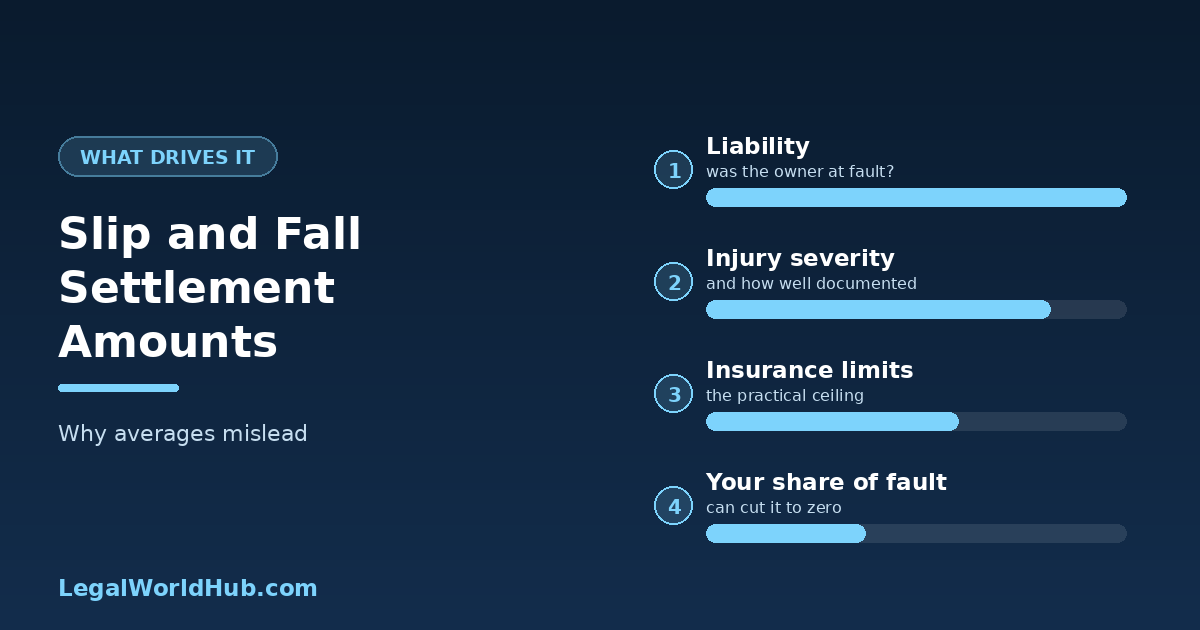
A slip and fall settlement amount is decided by four things, roughly in this order:
- Whether the property owner was legally at fault, and how provably
- How severe and how well documented the injury is
- How much insurance is available
- What share of the blame is assigned to you
The fourth one is where most people lose money they expected, and it is the least discussed. More on that below.
Why published averages mislead
Three structural reasons, and they all point the same way.
Selection bias. Firms publish their wins. A page listing a $1.2 million recovery is accurate and unrepresentative. Nobody publishes the cases that settled for $4,000 or were declined at intake.
Confidentiality. Many settlements include non disclosure terms, so the cases most likely to be public are verdicts, which are a small and unusual subset.
Enormous variance. A bruised elbow and a fractured hip requiring surgery are both slip and fall injuries. Averaging them produces a number that describes neither.
If you take one thing from this page: an average is not a prediction, and nobody can value your case without reviewing it. Any site or service quoting you a figure before seeing your medical records and the facts of the fall is guessing.
Factor 1: liability is the threshold question
Before any amount matters, there has to be legal fault. This is where most slip and fall claims actually fail.
Falling on someone’s property does not by itself make them liable. Broadly, a claim requires showing that the property owner or occupier knew or should have known about a hazardous condition and failed to fix it or warn about it within a reasonable time.
That last part does the heavy lifting. A spill that happened ninety seconds before you slipped is very different from one that had been on the floor for an hour with staff walking past it.
What tends to strengthen liability:
- Evidence the hazard existed for a meaningful period
- Prior complaints or a history of the same problem
- Missing or ignored inspection and cleaning logs
- No warning sign where one would be expected
- A condition that breached a building code or safety regulation
- CCTV showing the hazard and the response to it
What tends to weaken it:
- No evidence of how long the hazard was there
- A hazard that was open, obvious and avoidable
- Adequate warning signage in place
- Footwear or conduct that contributed to the fall
- A delay before reporting the incident or seeking treatment
Factor 2: injury severity and documentation
Injury severity drives the number more than any other single input, but documentation is what converts severity into value.
An injury that is real but poorly documented is worth less than a lesser injury with a clean medical record, because the claim is only as strong as what can be proved.
Roughly in ascending order of typical value: soft tissue strains and bruising, then fractures, then injuries requiring surgery, then permanent impairment, then traumatic brain injury or spinal injury with lasting effects.
The scale of the underlying problem is not in dispute. The CDC reports that falls are the leading cause of injury for adults aged 65 and older, that over 14 million older adults report falling each year, and that around 3 million emergency department visits and roughly 1 million hospitalisations result from older adult falls annually. It also notes that falls are the most common cause of traumatic brain injuries.
Those figures are about falls generally rather than premises liability claims, but they explain why the severity range in this area is so wide.
The two components of a claim
Economic damages are the ones with receipts: medical bills to date, projected future treatment, lost earnings, reduced earning capacity, and out of pocket costs.
Non economic damages cover pain and suffering, loss of enjoyment of life, and similar. These are far more variable and are the part most heavily negotiated.
Some jurisdictions cap non economic damages in certain case types. That is a state law question and worth asking an attorney about early, because it can change the realistic ceiling of a case before anything else is considered.
Factor 3: insurance limits are the practical ceiling
This is the factor people almost never consider, and it can matter more than the injury.
Most slip and fall claims are paid by a liability insurance policy, not by the property owner personally. If the policy limit is $300,000, that is realistically the ceiling on what can be recovered, regardless of what the case is theoretically worth.
A serious injury in a small independent shop with a modest policy can be worth less in practice than a moderate injury on premises owned by a national chain carrying substantial coverage.
Pursuing an owner personally beyond their policy is possible but often uneconomic, since many defendants have limited recoverable assets.
Factor 4: comparative negligence, the rule that quietly cuts payouts
Here is where expectations most often break, and it varies by state.
If you are found partly responsible for your own fall, your recovery is reduced or eliminated depending on which rule your state applies. Cornell’s Legal Information Institute has a plain overview of comparative negligence, and the three broad approaches are:
Pure comparative negligence. Your damages are reduced by your percentage of fault. At 80% at fault you can still recover 20%.
Modified comparative negligence. You can recover only if your share of fault is below a threshold, commonly 50% or 51%. Cross it and you recover nothing.
Contributory negligence. Used in a small number of jurisdictions. If you are found even slightly at fault, you may be barred from recovering entirely.
The practical effect is large. A claim valued at $100,000 where you are found 30% at fault becomes $70,000 under a comparative rule, and potentially nothing under contributory negligence.
This is also why insurers work hard to attribute fault to the injured person: distraction, footwear, ignoring a sign, or being somewhere they should not have been. Which rule applies to you depends entirely on your state, and it is one of the first things worth establishing.
What to do after a fall, if you want the claim to hold up
Most of what determines the eventual amount is decided in the first days.
- Report it immediately to the manager or property owner, and ask for a written incident report and a copy.
- Photograph everything before it is cleaned up. The hazard, the surroundings, the lighting, any missing signage, and your footwear.
- Get names and contact details for witnesses and staff present.
- Seek medical attention promptly, even if you feel fine. A gap between the fall and treatment is the single most common argument used to dispute causation.
- Ask about CCTV in writing, quickly. Footage is often overwritten within days or weeks.
- Keep every receipt and record, including time off work.
- Do not give a recorded statement to an insurer before taking advice, and do not accept an early offer without understanding what you are releasing.
The deadline that ends a case before it starts
Every state sets a statute of limitations for personal injury claims, and once it expires the claim is generally gone regardless of merit.
The periods vary meaningfully between states, and some claims against public entities carry much shorter notice requirements, sometimes measured in months rather than years.
Do not rely on a general figure you read online, including here. Confirm the deadline for your state and your type of defendant with a licensed attorney promptly. Missing it is the one mistake with no remedy.
Settling versus suing
Most slip and fall claims settle. Very few reach trial.
Settling gives certainty, speed and lower cost. It also ends the matter permanently. Once you sign a release, you generally cannot return for more if your injury turns out worse than expected, which is why settling before your medical position is clear is risky.
Litigating may produce more, but takes far longer, costs more, and carries real risk of recovering nothing.
The first offer is typically low and is a starting position rather than a valuation. Under Federal Rule of Evidence 408, an offer to settle generally cannot be used as evidence to prove the validity or amount of a disputed claim, precisely so that both sides can negotiate frankly.
Is a slip and fall settlement taxable?
Broadly, damages received on account of personal physical injuries or physical sickness are excluded from gross income under the tax code. But the exclusion has limits that catch people out.
Punitive damages are generally outside it even in a physical injury case. Interest on a settlement is taxable. And where a settlement compensates lost wages in an employment context rather than a physical injury case, different treatment applies.
The IRS test is what the payment was intended to replace. See the IRS guidance on tax implications of settlements and judgments and Publication 4345, plus our guide on whether settlement money is taxable. For a settlement of any size, take advice rather than assuming.
Frequently asked questions
What is the average slip and fall settlement amount?
There is no reliable average. Settlements are usually confidential, and the figures published online come from law firm marketing rather than any central record, so they overrepresent large recoveries. Amounts range from a few thousand dollars for minor soft tissue injuries to seven figures for catastrophic ones. An average across that range describes almost nobody.
How is a slip and fall settlement calculated?
There is no formula. Negotiations start from documented economic losses, meaning medical costs, lost earnings and out of pocket expenses, then account for non economic damages such as pain and suffering. The result is then constrained by how provable liability is, how much insurance is available, and what share of fault is attributed to you.
Can I still claim if I was partly at fault?
In most states, yes, but your recovery is reduced by your share of fault. Some states bar recovery entirely once your fault crosses roughly half, and a small number bar it if you are even slightly at fault. Which rule applies depends on your state, so establish that early.
How long do I have to file a slip and fall claim?
It depends on your state, and claims against public entities often have much shorter notice deadlines than claims against private businesses. Because missing the deadline usually ends the claim permanently regardless of merit, confirm it with a licensed attorney in your state rather than relying on a general figure.
Should I accept the first offer?
Rarely, and never before your medical position is clear. First offers are opening positions. More importantly, accepting a settlement generally releases the other side permanently, so if your injury turns out worse than expected you cannot return for more.
Do I need a lawyer for a slip and fall claim?
For a minor injury with no lasting effect, possibly not. For anything involving surgery, time off work, lasting symptoms, or a disputed liability position, legal advice is worthwhile. Most personal injury attorneys offer a free initial consultation and work on contingency, so the practical cost of asking is low.
What if the fall happened at work?
That is usually a workers’ compensation matter rather than a premises liability claim, and it runs under a different system with different rules, deadlines and benefits. There are situations where a separate claim against a third party is possible alongside it, which is worth asking about.
Why did my claim get denied?
Most commonly because liability could not be established, meaning there was no evidence the owner knew or should have known about the hazard in time to address it. Other frequent reasons include a gap between the fall and medical treatment, no incident report, and lost CCTV footage.
This article is general information, not legal, medical or tax advice. Nobody can value a claim without reviewing the facts and the medical records. If you have been injured, speak to a licensed attorney in your state promptly, because deadlines apply and missing one usually ends the claim.