A settlement notice often leads with a big number, the total fund, or a maximum possible payment. What it rarely tells you upfront is how that number turns into your actual check. Here is how class action payouts are really calculated, and why the amount you receive is usually smaller than the headline figure suggests.
The Two Numbers That Actually Matter
Every settlement has a total fund, the total amount the defendant agreed to pay, and a net fund, what remains after subtracting administrative costs, attorneys’ fees, and any service awards to the lead plaintiffs. Your payment comes out of the net fund, not the headline total.
Attorneys’ fees in consumer class actions commonly run up to a third of the settlement fund, sometimes capped lower, plus reimbursement of litigation costs. Service awards to the class representatives who led the case are typically a few thousand dollars each. None of this is hidden, it is disclosed in the settlement agreement and has to be approved by the court, but it does mean the number available for class members is smaller than the total fund advertised.
How Pro Rata Payments Work
Most consumer settlements do not promise a fixed dollar amount per person. Instead, the net fund is divided proportionally, or pro rata, among everyone who files a valid claim. This has a direct consequence: your payment depends not just on what you are owed, but on how many other people file claims.
If fewer people file than the fund was designed to cover, individual payments can rise above the originally estimated amount. If more people file valid claims than expected, payments can be reduced proportionally. This is why many settlement notices use language like an estimated payment, subject to increase or decrease depending on the number of claims filed, rather than a guaranteed figure.
Flat Payments vs. Documented Loss Payments
| Payment Type | How It Works |
| Flat / no-proof payment | A set amount, or pro rata share, available without documenting a specific loss. Usually smaller but simpler to claim. |
| Documented loss payment | Requires receipts, statements or records showing an actual out-of-pocket cost. Often capped higher, sometimes into the thousands of dollars, but only pays what you can support. |
| Tiered payment | Some settlements pay more to class members in a higher-risk category, for example those whose Social Security number was exposed in a data breach, versus those whose was not. |
For more on how the no-documentation option specifically works, see our guide on settlements without proof of purchase.
Why the ‘Up To’ Amount Rarely Matches the Average Payout
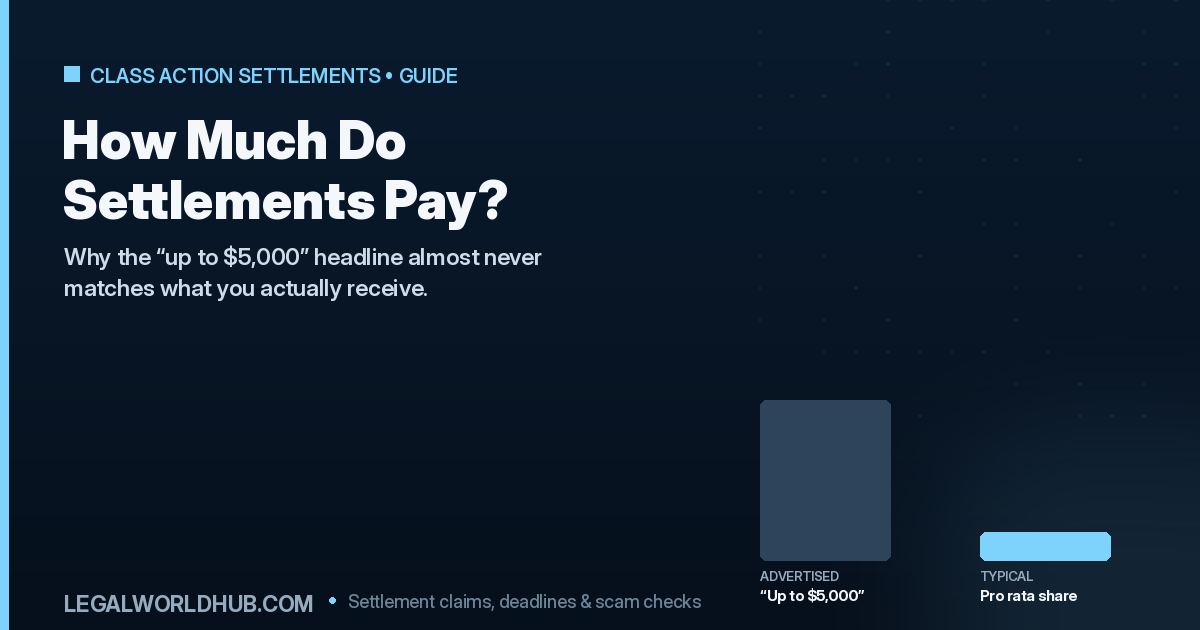
A settlement notice advertising up to $5,000 is describing a ceiling, not an average. That ceiling typically applies only to the documented loss tier, requires you to actually have and submit qualifying documentation, and represents the maximum anyone could receive, not what a typical claimant gets. The realistic per-person payout on most flat, no-proof tiers in large consumer settlements lands anywhere from a few dollars to around fifty or a hundred dollars, though data breach settlements with tiered SSN exposure payments can run higher.
What Reduces Your Payment
- A larger than expected number of valid claims filed, since the fund is fixed
- Attorneys’ fees, costs and service awards, deducted before distribution
- Claims denied for missing documentation, late submission, or not meeting the class definition
- Payments below a stated minimum threshold sometimes not issued at all
When Will You Actually Know Your Payment Amount?
In most pro rata settlements, the exact figure is not calculated until after the claims deadline passes and the court grants final approval, since the administrator needs the final claim count to do the math. Our guide on how long it takes to get paid after a class action settlement explains why this stage can take months after the claims window closes.
Is There a Minimum Payout?
Some settlements specify that payments below a certain threshold, often a dollar or two, will not be issued, since the cost of processing and mailing a tiny payment can exceed its value. Check the specific settlement’s terms rather than assuming every valid claim results in a check.
Frequently Asked Questions
Why did I get less than the amount advertised in the settlement notice?
Most settlements pay pro rata, meaning the fund is divided among everyone who filed a valid claim. The advertised figure is usually a maximum or an early estimate, not a guarantee.
Do more claims filed mean a smaller payout for everyone?
Generally yes, for a fixed pro rata fund. More valid claims means the same total amount is divided more ways.
Why do attorneys get paid before class members?
Attorneys’ fees and litigation costs are deducted from the settlement fund before distribution, similar to a contingency fee arrangement, and must be approved by the court as part of final approval.
Can my payment amount change after I file a claim?
Yes. Many settlements do not finalize per-person amounts until after the claims deadline passes and the total number of valid claims is known.
What’s the difference between a flat payment and a documented loss payment?
A flat payment requires no proof of a specific loss and is usually smaller. A documented loss payment requires supporting records but can pay significantly more. See our guide on settlements without proof of purchase for details.
Bottom Line
Class action payouts are calculated from a net fund, after fees and costs, divided among valid claimants, usually on a pro rata basis. Treat any advertised maximum as a ceiling, not an expectation, and expect your final amount to be confirmed only after the claims window closes. For the full settlement process from start to finish, see our guide on how class action settlements work.
This article is for general information only and is not legal or financial advice. Payout structures vary by settlement.