Usually not, and the reason is practical rather than generous.
Class periods routinely stretch back five, ten or fifteen years. Requiring a receipt from 2016 would exclude almost everyone who genuinely qualifies, which is why most consumer settlements let you attest instead of prove.
But “no proof required” does not mean “no rules,” and the phrase appears on claim forms in three quite different ways. Getting them mixed up is how people either miss out on money they were owed or get a claim denied.
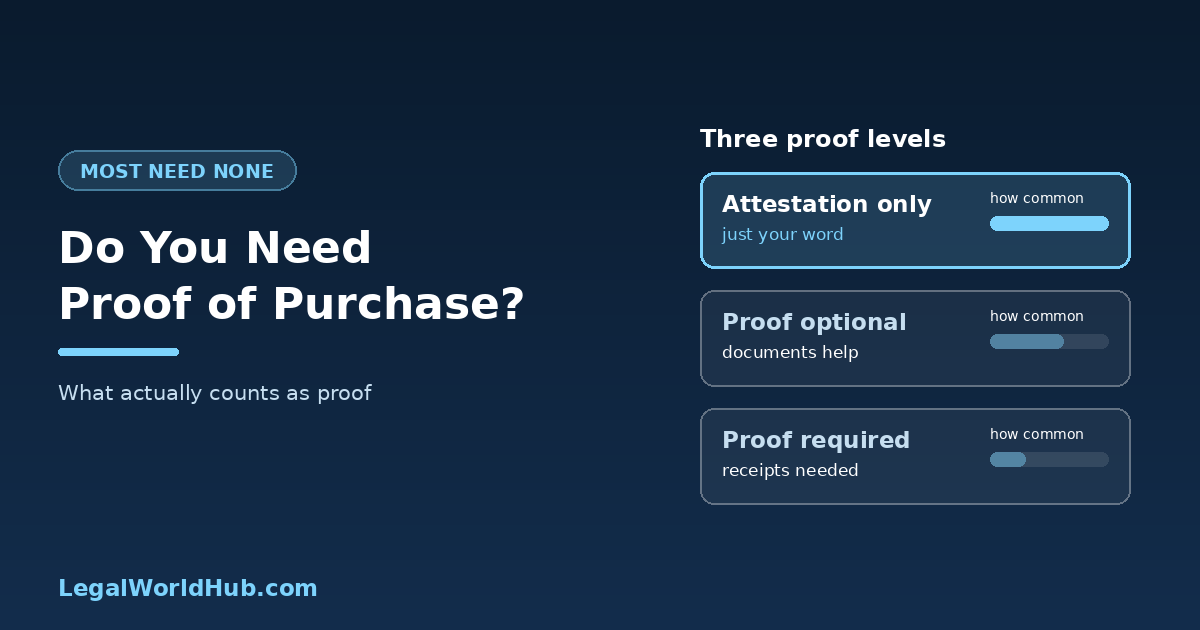
The three proof levels you will actually encounter
| Level | What you submit | What it pays |
|---|---|---|
| Attestation only | A sworn statement that you qualify | The lowest, fixed tier |
| Proof optional | Attestation, documents improve your position | Base tier, more if documented |
| Proof required | Receipts, statements, records | The highest amounts |
Most consumer settlements use the first or second. The third is normally reserved for the documented-loss tier of a settlement that also offers a no-proof option.
Our main guide to class action settlements with no proof required covers which ones are open right now.
What “proof of purchase” means on a claim form
It rarely means the original receipt, and that is the misconception that stops people filing.
Administrators are trying to establish that you plausibly belong in the class. Anything that supports your attestation generally does the job.
Commonly accepted:
- Bank or credit card statements showing the transaction
- Order confirmation emails
- Account or purchase history from the company’s own site
- Pharmacy prescription payment printouts
- Invoices or delivery notes
- Serial numbers, model numbers or product photographs
- Correspondence with the company
Frequently overlooked but usable:
- Email archives. Search your inbox for the company name and the class period. Order confirmations from years ago are often still there
- Loyalty or rewards account history
- Pharmacy payment histories, which most pharmacies will print on request going back several years
- App store purchase history for digital goods
- Your own account page on the retailer’s website
Rarely enough on its own: memory, a screenshot with no identifying detail, or a general recollection that you used the product.
Why so many settlements ask for nothing
Three structural reasons, and understanding them tells you how seriously to take the requirement.
The defendant already holds the records. In a bank fee case, a data breach, or a subscription billing dispute, the company knows exactly who was affected. Asking you to re-supply what they already have serves no purpose, which is why these settlements often pre-populate your claim or issue you a claim ID.
Courts want participation to be meaningful. Under Rule 23 of the Federal Rules of Civil Procedure, a court must find a settlement fair, reasonable and adequate before approving it. A settlement almost nobody can successfully claim from is a harder sell.
The amounts are small. When a payment is $30 or $50, reviewing evidence costs more than the payment. Attestation is cheaper for everyone involved.
The documentation gap that costs people money
Here is the part worth acting on.
Where a settlement offers both routes, the documented tier usually pays several times more. In the Comcast data breach settlement the choice is between an alternative cash payment with no documentation and reimbursement of documented losses reported at up to $10,000. In the Lands’ End settlement it is a cash payment reported at around $60 against documented losses reported up to $5,000.
Most people take the easy option without checking what the other one requires. Twenty minutes finding a bank statement can multiply the payment several times over.
The reverse is also true, and it is the more common error. Filing a documented claim without adequate documentation gets it reduced or denied. In the Federal Trade Commission’s study of 149 consumer class action settlements, Consumers and Class Actions, the median claim approval rate was 93% and the weighted mean 86%, meaning roughly 15% of claims were denied, most commonly as incomplete or inconsistent with the class definition.
A useful safety net exists in some settlements. The 700Credit data breach settlement, for example, states that if a documented-loss claim lacks adequate documentation and is not cured, it is processed as the flat cash payment instead rather than denied outright. Check whether yours does the same before deciding which tier to claim.
When proof genuinely is required
Some situations do demand it:
- Documented loss tiers, where you are being reimbursed for money you actually spent
- Product settlements with per-unit payments, where the number of items matters
- High-value claims, where the payment justifies the review
- Settlements where the defendant has no customer records, common with products sold through third-party retailers
- Claims above a stated threshold, where a settlement pays a small amount on attestation and requires proof above it
If a settlement covers something bought in a shop with cash, expect to need something.
What you are signing when you attest
This matters, and it is why “no proof” is not the same as “no accountability.”
Claim forms are generally signed under penalty of perjury. Under 28 U.S.C. § 1746, an unsworn written declaration made under penalty of perjury carries the same legal weight as a sworn affidavit.
In practice, a claim form is a legal declaration rather than a marketing form. The standard is good faith. “I believe I bought this in 2021, though I cannot recall the exact date” is an honest attestation. “I have never used this product but the payment looks easy” is not.
Our guide to what happens if you lie on a class action claim form covers the consequences in detail.
How to decide which tier to claim
Work through it in this order.
- Read the class definition first. Proof is irrelevant if you do not qualify. See how to know if you qualify.
- Check whether a documented tier exists, and what it pays.
- Spend fifteen minutes looking for evidence before assuming you have none. Email archives and bank statements find more than people expect.
- If you find documentation, claim the higher tier. If you find nothing, take the attestation route without hesitation. That is exactly what it exists for.
- Check what happens to a failed documented claim in that settlement. Some convert to the flat payment, some deny outright.
- File early. If the administrator queries your documents, a claim filed on the deadline leaves no time to fix it. See how to claim settlement money.
Frequently asked questions
Do I need receipts to file a class action claim?
Usually not. Most consumer settlements allow you to attest that you qualify rather than prove it, because class periods often stretch back a decade and requiring receipts would exclude nearly everyone eligible. Documentation is normally only required for the higher, documented-loss tier where you are being reimbursed for money you actually spent.
What counts as proof of purchase for a settlement?
More than people assume. Bank or card statements, order confirmation emails, account purchase history on the company’s website, pharmacy payment printouts, invoices, serial numbers and correspondence with the company are all commonly accepted. Administrators are looking for something that plausibly supports your attestation, not the original paper receipt.
What happens if I claim a documented tier without enough documentation?
It depends on the settlement. Some convert the claim to the flat no-proof payment instead of denying it. Others reject it outright. The FTC’s study of 149 consumer settlements found roughly 15% of claims were denied, most often as incomplete or inconsistent with the class definition, so check the terms before choosing the higher tier.
Is it legal to file a claim without proof?
Yes, provided your attestation is true. The no-proof route is written into the settlement terms deliberately. What you sign is a declaration under penalty of perjury that you meet the class definition, so the requirement is honesty rather than paperwork.
Can I still file if I threw away my receipts years ago?
Yes, in most consumer settlements. That situation is precisely why attestation tiers exist. Before assuming you have nothing, search your email for order confirmations and check whether the retailer still holds your purchase history, since either may support a higher-paying documented claim.
Does the administrator check my attestation?
Often, yes, against the defendant’s own records where those exist. A claim that contradicts the company’s data can be flagged, queried or denied. Administrators also screen for duplicate and automated submissions. Honest claims from genuine class members are not the target of that screening.
Why do some settlements require proof and others not?
Mainly whether the defendant already holds the records. A bank, telecom or app knows who its customers were. A manufacturer whose product was sold through third-party shops does not, so it has to ask you. Payment size matters too: reviewing evidence for a $30 payment costs more than the payment itself.
This article is general information, not legal advice. Documentation requirements are set by each individual settlement. Always follow the instructions on the official settlement website before filing.