When someone dies, it is common for at least one forgotten bank account, uncashed check, or old insurance policy to eventually get turned over to the state as unclaimed property. Their heirs often have no idea it exists. Here is how to search for it, what you will need to actually claim it, and where taxes and probate fit in.
Can You Claim a Deceased Relative’s Unclaimed Money?
Generally, yes, if you are a legal heir, the named beneficiary, or the appointed executor or administrator of the estate. States do not automatically know who a deceased property owner’s heirs are, so the property sits unclaimed until someone comes forward with proof. See our guide on how to find unclaimed money for free for the general search process; everything there applies here too, you are simply searching under the deceased person’s name instead of your own.
How to Search for a Deceased Relative’s Unclaimed Property
1. Search MissingMoney.com and the unclaimed property site for every state your relative lived in, using their full legal name and any name variations, including maiden names.
2. Search your own name too. If you were the beneficiary on a life insurance policy or retirement account, the property may already be listed under your name rather than theirs.
3. Check with your relative’s bank, employer, and insurance providers directly, since not everything unclaimed has necessarily been turned over to the state yet.
4. If you cannot find anything but believe property exists, contact your state’s unclaimed property office directly rather than assuming there is nothing there.
What You’ll Typically Need to File a Claim
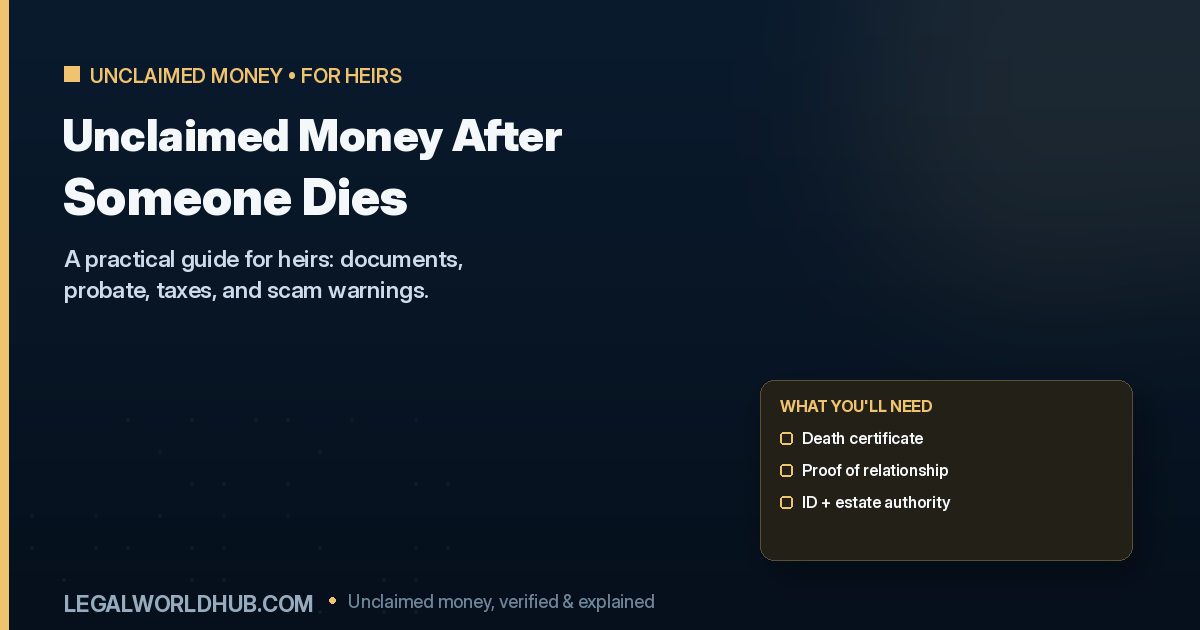
Documentation requirements vary by state and by the size of the claim, but most states ask for some combination of the following:
- A certified copy of the death certificate
- Your own government-issued photo ID
- Proof of your relationship to the deceased, such as a birth certificate or marriage certificate
- Proof of your authority to act on behalf of the estate, such as Letters Testamentary from a probate court, if probate was opened
- The deceased person’s Social Security number, if not already shown on the death certificate
If you do not already have a certified death certificate, you generally order one from the vital records office in the state where the death occurred; expect a cost per copy and one to three weeks for standard delivery.
Do You Need to Go Through Probate?
Not always. Many states offer a simplified path for smaller estates, often called a small estate affidavit, that lets an heir claim assets below a certain dollar threshold without opening a full probate case. Whether this applies depends on the size of the unclaimed property and your state’s specific threshold. For larger estates, or when there is disagreement among potential heirs, formal probate and court-issued Letters Testamentary or Letters of Administration are typically required to prove you have legal authority to claim the property.
Is Unclaimed Inheritance Money Taxable?
It depends on what the underlying asset actually was, the same principle that applies to inheritances generally. A cash bank account typically is not subject to federal income tax when inherited. Other assets can be treated differently: for example, an inherited retirement account balance or an asset that appreciated in value can carry income tax consequences when distributed or sold. Federal estate tax rarely applies, since it only affects estates above a very high threshold, but a handful of states impose their own estate or inheritance tax at lower thresholds. Because this varies by asset type and by state, consult a tax professional about your specific situation rather than assuming one blanket rule applies.
What Happens If No Heir Ever Comes Forward?
Most states do not put a time limit on how long unclaimed property can sit before an heir claims it. If genuinely no rightful owner or heir is ever identified, state law generally determines what happens to the property, which can eventually mean it passes to the state itself, but this typically takes far longer than most families realize, and searching costs nothing, so it is worth checking even years after a death.
Watch for Scams Targeting Grieving Families
Because obituaries and probate filings are often public, this is an area where scammers specifically target grieving families, contacting them to claim they have located unclaimed money belonging to the deceased and demanding a fee before releasing it. Searching and filing through official state channels is always free. See our guide on unclaimed money finder fees for exactly what a legitimate paid finder can and cannot legally charge, and our guide on class action settlement scams for the broader pattern these approaches follow.
Frequently Asked Questions
Can I claim unclaimed money for a parent who died years ago?
Generally yes. Most states do not impose a deadline on when heirs must come forward to claim unclaimed property, so searching is worthwhile even long after a death.
Do I need a lawyer to claim a deceased relative’s unclaimed property?
Not always. Smaller claims can often be handled directly with the state, sometimes using a simplified small estate affidavit. Larger or contested estates are more likely to require probate and a lawyer’s involvement.
What if there are multiple heirs?
States generally require documentation showing how the property should be divided among heirs, which is one of the situations where opening probate or obtaining agreement among all heirs becomes necessary.
Is money inherited through an unclaimed property claim taxable?
It depends on what the underlying asset is. A cash account is typically not subject to federal income tax when inherited, while other asset types can carry different tax treatment. Consult a tax professional for your specific situation.
Someone contacted me saying they found unclaimed money for my deceased parent. Is that legitimate?
Verify it yourself through official state search tools before responding. Legitimate searching and claiming is always free, and this is a common scam targeting grieving families.
Bottom Line
Searching for a deceased relative’s unclaimed property is free and worth doing even years after a death, since most states impose no deadline. Gather a death certificate, proof of your relationship, and proof of your authority to act for the estate if needed, and file directly with the state. For the general search process, start with our guide on how to find unclaimed money.
This article is for general information only and is not legal or tax advice. Probate requirements, documentation, and tax treatment vary by state and by the specific asset involved.