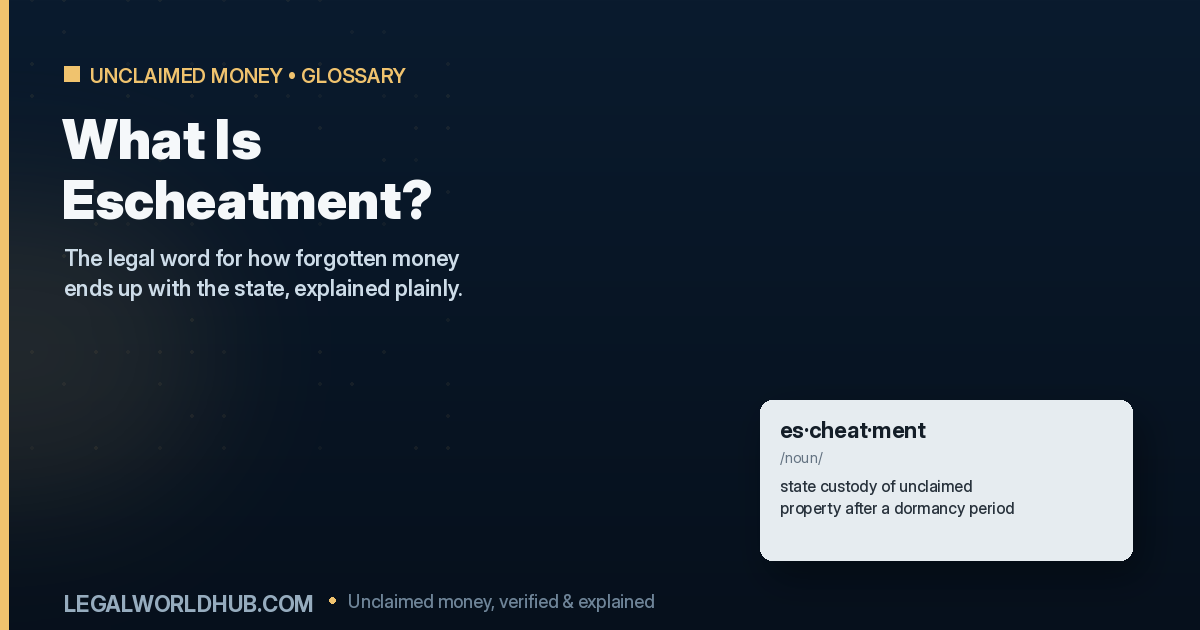
Escheatment is the legal process by which a state government takes custody of property that has been abandoned or left unclaimed by its owner for a set period of time. It sounds alarming the first time you encounter it, in a bank notice, a legal document, or a finance class, but it is a routine, well-established part of consumer protection law, not a way for the government to permanently seize your money.
Escheatment, Defined Simply
When a bank, employer, insurance company, or other business owes you money and cannot locate you after a legally defined waiting period, it is required to turn that money over to the state rather than keep it indefinitely. The state then holds the property as a custodian, not a permanent owner, until you or your legal heirs come forward to claim it. This entire process, from the company reporting the property to the state accepting custody of it, is called escheatment.
The word traces back to old English common law, where it originally applied mainly to real estate when a landowner died without any heir to inherit it. Modern state statutes have expanded the concept far beyond real estate to cover nearly any kind of intangible personal property a business might owe someone.
What Triggers Escheatment?
- A financial account, bank account, brokerage account, or similar, sits inactive for a set number of years
- A paycheck, refund check, or insurance payment is never cashed
- A person dies without a will and without any identifiable heir
- Mail sent to the account holder’s last known address is returned as undeliverable
What Is a Dormancy Period?
A dormancy period is the length of time a property can sit without any owner-initiated activity before a business is required to report it to the state as unclaimed. Dormancy periods are set by state law and vary by both the state and the type of property involved. According to data from the National Association of Unclaimed Property Administrators, general patterns include:
| Property Type | Common Dormancy Period |
| Checking and savings accounts | Typically 3 to 5 years |
| Securities (stocks, funds) | Typically 3 to 7 years, most commonly 3 to 5 |
| Uncashed wages or payroll checks | Typically 1 to 5 years, most states around 1 year |
| Gift cards | Varies widely; many states exempt gift cards from escheatment entirely |
These are general patterns, not universal rules. Exact dormancy periods differ by state and can change as legislatures update their unclaimed property laws, so check your specific state’s statute for the precise timeline that applies.
Does the State Just Keep the Money?
No. This is the most common misunderstanding about escheatment. The state acts as a custodian, holding the property on your behalf, generally with no deadline for you or your heirs to come forward and claim it. Nationally, states collectively hold roughly $70 billion in unclaimed property at any given time, money that legally still belongs to the people and businesses it was taken from, simply waiting to be reunited with them. See our guide on how to find unclaimed money for free to check whether any of it is yours.
Before a Company Escheats Your Property, It Has to Try to Find You
Businesses are generally required to perform what unclaimed property law calls due diligence before reporting property to the state. For property above a certain value, often $50, this typically means mailing a notice to your last known address within a specific window, commonly 60 to 120 days, before the property is escheated. If you receive a letter like this, it is genuinely worth responding to, since acting on it can prevent the property from ever becoming unclaimed in the first place.
How Do You Get Escheated Property Back?
Search your state’s official unclaimed property database, or use MissingMoney.com to check multiple states at once. If you find a match, you generally file a claim directly with that state at no cost. There is usually no deadline; escheated property can typically be reclaimed at any time, even decades later.
Is Escheatment the Same in Every State?
No. Escheatment is governed entirely by state law, and while many states base their statutes on a shared model, the Uniform Unclaimed Property Act, they still differ in dormancy periods, due diligence requirements, and which types of property are covered. Property is generally reported to the state of your last known address, or to the state where the holding company is incorporated if your address is unknown, which is why unclaimed property can end up in a state you no longer live in or never lived in at all.
Frequently Asked Questions
What does escheatment mean in simple terms?
It means a state government has legally taken custody of money or property that a business could not return to its rightful owner after a set waiting period. The state holds it, generally indefinitely, until the owner or their heir claims it.
Is escheated money gone forever?
No. States hold escheated property as custodians, not permanent owners, and there is generally no deadline for the rightful owner or their heirs to claim it back.
How long does it take for property to be escheated?
It depends on the type of property and the state. Common dormancy periods range from about 1 year for uncashed payroll checks to 3 to 7 years for bank accounts and securities.
Can escheatment happen to real estate?
Historically, escheatment applied mainly to real estate when someone died without an heir. Modern escheatment law has expanded to primarily cover intangible personal property like bank accounts, but the original real estate application can still apply in certain circumstances.
How do I find out if I have escheated property?
Search your state’s official unclaimed property database or MissingMoney.com, both of which are free.
Bottom Line
Escheatment is the routine legal process that moves forgotten money and property into state custody after a period of inactivity, not a permanent forfeiture. If you have ever moved, changed banks, or lost track of an old account, it is worth checking whether any of your own property has been escheated. Start with our guide on how to find unclaimed money for free.
This article is for general information only and is not legal or financial advice. Escheatment laws, dormancy periods, and procedures vary by state.