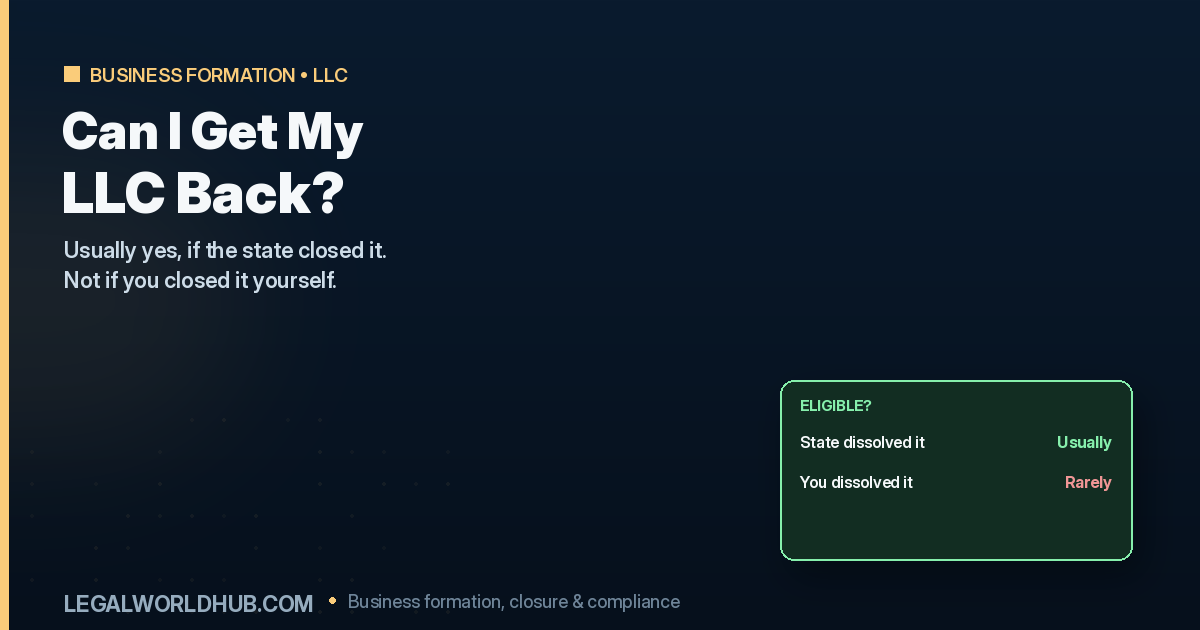
If your LLC was administratively dissolved, the good news is that in most states, it isn’t gone for good. Reinstatement is generally available, and it’s usually simpler and cheaper than starting over with a brand new entity. But there’s a real distinction buried in this process that most people never find out about until they’re already stuck: whether you can reinstate at all depends heavily on how your LLC ended up dissolved in the first place. If you haven’t already, see our guide on what happens when an LLC is administratively dissolved for the background on how this typically happens and what you might still owe. Here is exactly how to get it back.
Reinstatement Quick Facts
| Detail | Information |
| Typical cost | $100 to several hundred dollars, plus any back fees and penalties owed |
| Typical processing time | 2 to 6 weeks standard; some states offer expedited processing for an added fee |
| Administratively dissolved LLCs | Generally eligible for reinstatement in most states |
| Voluntarily dissolved LLCs | Generally not eligible for standard reinstatement in most states |
| Your EIN | Survives dissolution; the IRS does not cancel or reassign it |
| Reinstatement deadline | Varies by state; some have none, others cut off eligibility after a set number of years |
The Distinction That Actually Determines Whether You Can Do This
This is the single most important thing to understand before you spend time on anything else. There are two fundamentally different ways an LLC stops being active, and they lead to very different outcomes.
Administrative dissolution happens when the state revokes your LLC’s status because of a compliance failure, a missed annual report, an unpaid fee, a lapsed registered agent. This is the version most people accidentally end up in, and it’s the version most states genuinely allow you to reverse through a standard reinstatement process.
Voluntary dissolution is different. That’s when you, the owner, deliberately filed paperwork, often called Articles of Dissolution, to formally close the business yourself. In most states, once you’ve done that on purpose, there is no standard path back. A small number of states allow it under limited circumstances, but the large majority treat a voluntary dissolution as final. If you’re not sure which situation you’re in, this is the first thing to confirm, since it changes everything about what happens next.
Step 1: Find Out Exactly Why It Was Dissolved
Go to your state’s Secretary of State business entity search and look up your LLC by name or entity number. This will show you the current status, and often the specific reason behind it. Pay close attention to the exact wording used. Dissolved, revoked, and forfeited are not always interchangeable terms, and depending on your state, each can trigger a different reinstatement process with different requirements. If your state lists your LLC as tax forfeited specifically, you’ll likely need to resolve that directly with your state’s tax authority before the Secretary of State’s office will even begin processing a reinstatement request.
Step 2: Fix What Actually Caused It
Most states will not accept a reinstatement application until the underlying compliance failure has been resolved. This commonly means:
- Filing every missing annual or biennial report, not just the most recent one, if multiple years have lapsed
- Paying the standard filing fee for each missing year, plus any late fees or penalties that have accrued
- Designating a new registered agent if your previous one resigned, moved, or is no longer in business, since a valid registered agent is required before reinstatement can proceed
- Resolving any outstanding franchise tax or state tax obligations tied to the entity
California adds a distinctive extra step worth knowing about specifically: before the Secretary of State will reinstate a suspended or dissolved LLC, the Franchise Tax Board must separately issue a tax clearance certificate. This can take weeks on its own, especially if there are unfiled tax returns involved, so if you’re reinstating a California LLC, start that piece early rather than waiting until the rest of your paperwork is ready.
Step 3: File the Reinstatement Application
Once the underlying issues are resolved, you file a formal reinstatement application, sometimes called a Certificate of Revival, Application for Reinstatement, or similar depending on your state’s terminology. This typically asks for your LLC’s name, entity number, the date and reason for dissolution, and confirmation that all outstanding fees and filings have been addressed. Many states now offer this as an online filing through the Secretary of State’s website, though some still require paper submission.
A Real Risk Worth Knowing About: Someone Else Might Have Taken Your Name
States generally reserve a dissolved entity’s name for some period of time, but that protection isn’t indefinite and varies by state. If your LLC has been dissolved for a while, it’s worth checking name availability before you assume reinstatement will simply restore everything exactly as it was. If your original name has been claimed by another business in the meantime, you may need to reinstate under a new name instead, which carries its own complications if you had branding, contracts, or a website built around the original name.
What Happens to Your EIN, Contracts, and Bank Accounts in the Meantime?
Your EIN Is Safe
Your federal Employer Identification Number survives dissolution. The IRS does not cancel or reassign it just because a state dissolved the entity, so when you do reinstate, you’ll generally be able to use the same EIN you had before.
Contracts Sit in Legal Limbo
This is a genuinely underappreciated risk. A dissolved LLC generally cannot enforce contracts in its own name, and the other party to an agreement may argue the contract became unenforceable the moment dissolution occurred. Reinstatement, particularly when a state treats it as retroactive, meaning it’s as if the dissolution never happened, can restore enforceability. But the gap period itself creates real legal uncertainty that’s worth discussing with an attorney if a significant contract was active during the time your LLC was dissolved.
Bank Accounts Depend on Your Bank
Some banks will freeze or close accounts tied to a dissolved entity once they become aware of the status change, particularly if they run their own periodic status checks. Others may not notice for a long time. Either way, don’t assume your accounts are unaffected; check directly with your bank once you know your LLC’s status.
Is Reinstating Worth It, or Should You Just Start Over?
Reinstatement generally makes the most sense when there’s something specific worth preserving: your original business name, existing contracts you want to keep enforceable, an established bank account and credit history, or ongoing client relationships tied to that specific entity. If none of that applies, and you were essentially starting fresh anyway, forming a brand new LLC can sometimes be simpler and faster than untangling multiple years of back filings and penalties, particularly if your dissolved LLC accumulated substantial unpaid fees over a long lapsed period.
Do the math on both paths before deciding. Add up the back filing fees, penalties, and reinstatement cost for your specific state and situation, and compare that total, along with the time it will take, against the cost and simplicity of forming a new entity. There’s no universally right answer; it genuinely depends on what’s actually worth preserving in your specific case.
When You Legally Can’t Reinstate
- Your LLC was dissolved by court order rather than administratively, which typically isn’t eligible for the standard reinstatement process at all
- Your state imposes a reinstatement deadline, sometimes measured in a fixed number of years, and that window has already closed
- You voluntarily dissolved the LLC yourself, which most states treat as final rather than reversible through standard reinstatement
Frequently Asked Questions
Can I reinstate an LLC I dissolved myself on purpose?
Generally not through the standard reinstatement process. Most states treat a voluntary dissolution as final. Reinstatement is designed primarily for LLCs the state administratively dissolved due to a compliance failure, not ones the owner intentionally closed.
How much does it cost to reinstate a dissolved LLC?
Typically somewhere between $100 and several hundred dollars for the reinstatement filing itself, plus whatever back fees, missing annual report costs, and penalties accumulated during the time your LLC was dissolved.
How long does LLC reinstatement take?
Usually two to six weeks for standard processing, though this varies by state, and some states offer expedited processing for an additional fee, sometimes in as little as a few business days.
Will I get to keep my original EIN?
Yes. The IRS does not cancel your Employer Identification Number when a state dissolves your LLC, so it remains usable once you’re reinstated.
What if someone else took my LLC’s name while it was dissolved?
States generally reserve a dissolved entity’s name for a period of time, but not indefinitely. If your name was claimed by another business, you may need to reinstate under a different name.
Is it better to reinstate or just form a new LLC?
It depends on what’s worth preserving, your original business name, existing contracts, an established bank account and credit history. If none of that applies, forming a new entity can sometimes be simpler than untangling multiple years of back filings, particularly for a long-dissolved LLC with significant accumulated penalties.
Bottom Line
Getting a dissolved LLC back is usually possible if the state dissolved it for a compliance failure, but generally not if you closed it yourself on purpose. The process comes down to finding out exactly why it was dissolved, fixing that underlying issue, and filing a reinstatement application, with real state-specific wrinkles like California’s separate tax clearance requirement along the way. Before committing to reinstatement, weigh the real cost against simply starting fresh. For the background on how LLCs end up dissolved in the first place and what you might still owe, see our guide on LLC administrative dissolution.
This article is general information, not legal or tax advice. LLC reinstatement rules, deadlines, and costs vary significantly by state; confirm your specific situation with your state’s business filing office or a licensed attorney or accountant.If your LLC was administratively dissolved, the good news is that in most states, it isn’t gone for good. Reinstatement is generally available, and it’s usually simpler and cheaper than starting over with a brand new entity. But there’s a real distinction buried in this process that most people never find out about until they’re already stuck: whether you can reinstate at all depends heavily on how your LLC ended up dissolved in the first place. If you haven’t already, see our guide on what happens when an LLC is administratively dissolved for the background on how this typically happens and what you might still owe. Here is exactly how to get it back.
Reinstatement Quick Facts
| Detail | Information |
| Typical cost | $100 to several hundred dollars, plus any back fees and penalties owed |
| Typical processing time | 2 to 6 weeks standard; some states offer expedited processing for an added fee |
| Administratively dissolved LLCs | Generally eligible for reinstatement in most states |
| Voluntarily dissolved LLCs | Generally not eligible for standard reinstatement in most states |
| Your EIN | Survives dissolution; the IRS does not cancel or reassign it |
| Reinstatement deadline | Varies by state; some have none, others cut off eligibility after a set number of years |
The Distinction That Actually Determines Whether You Can Do This
This is the single most important thing to understand before you spend time on anything else. There are two fundamentally different ways an LLC stops being active, and they lead to very different outcomes.
Administrative dissolution happens when the state revokes your LLC’s status because of a compliance failure, a missed annual report, an unpaid fee, a lapsed registered agent. This is the version most people accidentally end up in, and it’s the version most states genuinely allow you to reverse through a standard reinstatement process.
Voluntary dissolution is different. That’s when you, the owner, deliberately filed paperwork, often called Articles of Dissolution, to formally close the business yourself. In most states, once you’ve done that on purpose, there is no standard path back. A small number of states allow it under limited circumstances, but the large majority treat a voluntary dissolution as final. If you’re not sure which situation you’re in, this is the first thing to confirm, since it changes everything about what happens next.
Step 1: Find Out Exactly Why It Was Dissolved
Go to your state’s Secretary of State business entity search and look up your LLC by name or entity number. This will show you the current status, and often the specific reason behind it. Pay close attention to the exact wording used. Dissolved, revoked, and forfeited are not always interchangeable terms, and depending on your state, each can trigger a different reinstatement process with different requirements. If your state lists your LLC as tax forfeited specifically, you’ll likely need to resolve that directly with your state’s tax authority before the Secretary of State’s office will even begin processing a reinstatement request.
Step 2: Fix What Actually Caused It
Most states will not accept a reinstatement application until the underlying compliance failure has been resolved. This commonly means:
- Filing every missing annual or biennial report, not just the most recent one, if multiple years have lapsed
- Paying the standard filing fee for each missing year, plus any late fees or penalties that have accrued
- Designating a new registered agent if your previous one resigned, moved, or is no longer in business, since a valid registered agent is required before reinstatement can proceed
- Resolving any outstanding franchise tax or state tax obligations tied to the entity
California adds a distinctive extra step worth knowing about specifically: before the Secretary of State will reinstate a suspended or dissolved LLC, the Franchise Tax Board must separately issue a tax clearance certificate. This can take weeks on its own, especially if there are unfiled tax returns involved, so if you’re reinstating a California LLC, start that piece early rather than waiting until the rest of your paperwork is ready.
Step 3: File the Reinstatement Application
Once the underlying issues are resolved, you file a formal reinstatement application, sometimes called a Certificate of Revival, Application for Reinstatement, or similar depending on your state’s terminology. This typically asks for your LLC’s name, entity number, the date and reason for dissolution, and confirmation that all outstanding fees and filings have been addressed. Many states now offer this as an online filing through the Secretary of State’s website, though some still require paper submission.
A Real Risk Worth Knowing About: Someone Else Might Have Taken Your Name
States generally reserve a dissolved entity’s name for some period of time, but that protection isn’t indefinite and varies by state. If your LLC has been dissolved for a while, it’s worth checking name availability before you assume reinstatement will simply restore everything exactly as it was. If your original name has been claimed by another business in the meantime, you may need to reinstate under a new name instead, which carries its own complications if you had branding, contracts, or a website built around the original name.
What Happens to Your EIN, Contracts, and Bank Accounts in the Meantime?
Your EIN Is Safe
Your federal Employer Identification Number survives dissolution. The IRS does not cancel or reassign it just because a state dissolved the entity, so when you do reinstate, you’ll generally be able to use the same EIN you had before.
Contracts Sit in Legal Limbo
This is a genuinely underappreciated risk. A dissolved LLC generally cannot enforce contracts in its own name, and the other party to an agreement may argue the contract became unenforceable the moment dissolution occurred. Reinstatement, particularly when a state treats it as retroactive, meaning it’s as if the dissolution never happened, can restore enforceability. But the gap period itself creates real legal uncertainty that’s worth discussing with an attorney if a significant contract was active during the time your LLC was dissolved.
Bank Accounts Depend on Your Bank
Some banks will freeze or close accounts tied to a dissolved entity once they become aware of the status change, particularly if they run their own periodic status checks. Others may not notice for a long time. Either way, don’t assume your accounts are unaffected; check directly with your bank once you know your LLC’s status.
Is Reinstating Worth It, or Should You Just Start Over?
Reinstatement generally makes the most sense when there’s something specific worth preserving: your original business name, existing contracts you want to keep enforceable, an established bank account and credit history, or ongoing client relationships tied to that specific entity. If none of that applies, and you were essentially starting fresh anyway, forming a brand new LLC can sometimes be simpler and faster than untangling multiple years of back filings and penalties, particularly if your dissolved LLC accumulated substantial unpaid fees over a long lapsed period.
Do the math on both paths before deciding. Add up the back filing fees, penalties, and reinstatement cost for your specific state and situation, and compare that total, along with the time it will take, against the cost and simplicity of forming a new entity. There’s no universally right answer; it genuinely depends on what’s actually worth preserving in your specific case.
When You Legally Can’t Reinstate
- Your LLC was dissolved by court order rather than administratively, which typically isn’t eligible for the standard reinstatement process at all
- Your state imposes a reinstatement deadline, sometimes measured in a fixed number of years, and that window has already closed
- You voluntarily dissolved the LLC yourself, which most states treat as final rather than reversible through standard reinstatement
Frequently Asked Questions
Can I reinstate an LLC I dissolved myself on purpose?
Generally not through the standard reinstatement process. Most states treat a voluntary dissolution as final. Reinstatement is designed primarily for LLCs the state administratively dissolved due to a compliance failure, not ones the owner intentionally closed.
How much does it cost to reinstate a dissolved LLC?
Typically somewhere between $100 and several hundred dollars for the reinstatement filing itself, plus whatever back fees, missing annual report costs, and penalties accumulated during the time your LLC was dissolved.
How long does LLC reinstatement take?
Usually two to six weeks for standard processing, though this varies by state, and some states offer expedited processing for an additional fee, sometimes in as little as a few business days.
Will I get to keep my original EIN?
Yes. The IRS does not cancel your Employer Identification Number when a state dissolves your LLC, so it remains usable once you’re reinstated.
What if someone else took my LLC’s name while it was dissolved?
States generally reserve a dissolved entity’s name for a period of time, but not indefinitely. If your name was claimed by another business, you may need to reinstate under a different name.
Is it better to reinstate or just form a new LLC?
It depends on what’s worth preserving, your original business name, existing contracts, an established bank account and credit history. If none of that applies, forming a new entity can sometimes be simpler than untangling multiple years of back filings, particularly for a long-dissolved LLC with significant accumulated penalties.
Bottom Line
Getting a dissolved LLC back is usually possible if the state dissolved it for a compliance failure, but generally not if you closed it yourself on purpose. The process comes down to finding out exactly why it was dissolved, fixing that underlying issue, and filing a reinstatement application, with real state-specific wrinkles like California’s separate tax clearance requirement along the way. Before committing to reinstatement, weigh the real cost against simply starting fresh. For the background on how LLCs end up dissolved in the first place and what you might still owe, see our guide on LLC administrative dissolution.
This article is general information, not legal or tax advice. LLC reinstatement rules, deadlines, and costs vary significantly by state; confirm your specific situation with your state’s business filing office or a licensed attorney or accountant.