If you ever opened a Capital One 360 Savings account and watched its interest rate barely move while the bank’s own advertising bragged about high yields elsewhere, this is the settlement that resolves exactly that complaint. It is a $425 million case, it is completely separate from Capital One’s earlier data breach settlement, and it is currently stuck in appeal, which is probably why you are searching for an update right now rather than a check.
Here is the full story: what Capital One is accused of doing, how the settlement was negotiated twice before it stuck, what it actually pays, and exactly why your payment has not arrived yet even though the court already approved everything months ago.
Capital One 360 Savings Settlement Quick Facts
| Detail | Information |
| Settlement fund | $425,000,000 total ($300M in direct payments, $125M in future interest) |
| Case | In re: Capital One 360 Savings Account Interest Rate Litigation, No. 1:24-md-03111-DJN |
| Court | U.S. District Court, Eastern District of Virginia |
| Judge | Honorable David J. Novak |
| Eligible period | Held a 360 Savings account any time between September 18, 2019 and June 16, 2025 |
| Claim form required? | No, payments are calculated automatically from Capital One’s own records |
| Opt out deadline | Closed, March 30, 2026 |
| Final approval | Granted April 20, 2026 |
| Current status | Payments delayed by a pending appeal, filed June 17, 2026 |
| Official website | capitalone360savingsaccountlitigation.com |
What Was the Capital One 360 Savings Lawsuit About?
Capital One introduced its 360 Savings account back in February 2013, and marketed it consistently as the bank’s flagship high-interest, high-yield online savings product. For years, that was a reasonably accurate description. The trouble started in September 2019, when Capital One quietly rolled out a second, nearly identical account called 360 Performance Savings, and stopped offering new 360 Savings accounts to customers altogether, while continuing to service the millions of existing 360 Savings accounts already open.
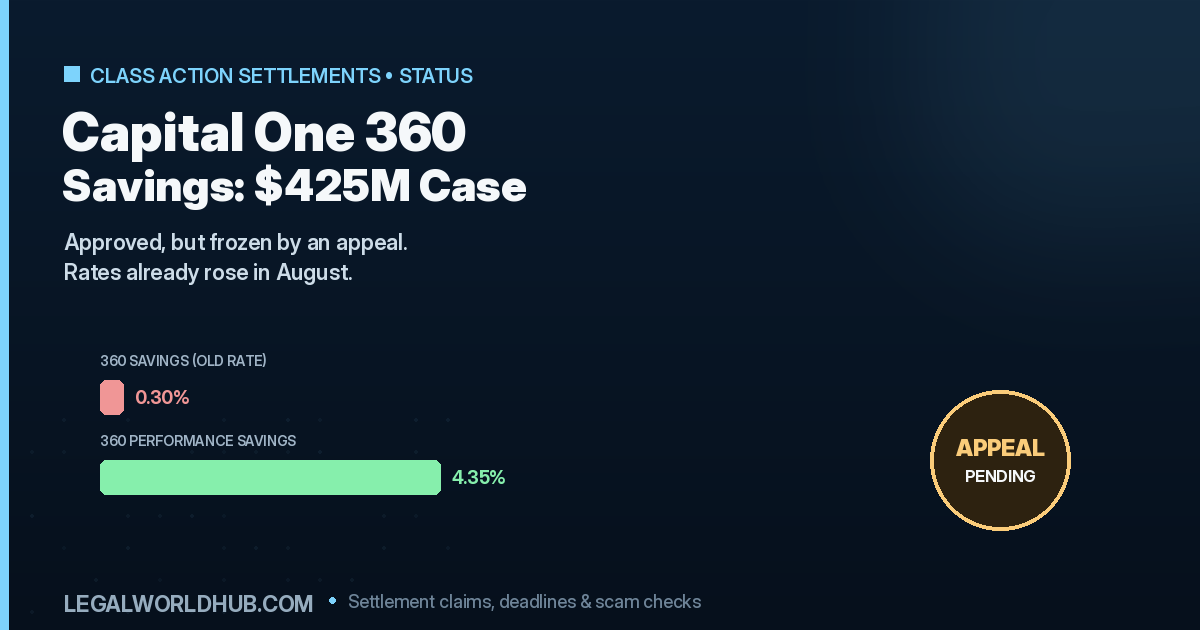
According to the lawsuit, Capital One then let the interest rate on the older 360 Savings account stagnate at a rock-bottom 0.30 percent, even as the Federal Reserve pushed interest rates sharply higher through 2022 and 2023. Meanwhile, the newer 360 Performance Savings account, functionally the same product under a different name, climbed as high as 4.35 percent in early 2023. At the widest point of that gap, one state attorney general’s office described the newer account as paying more than fourteen times what existing 360 Savings customers were earning on effectively the same money.
The core allegation was not simply that Capital One paid a low rate, banks are generally free to set their own rates, but that it never told existing 360 Savings customers the better account existed, and continued marketing 360 Savings in ways that obscured how far behind it had fallen. By June 2024, at least six separate lawsuits making this same argument had been filed in California, New Jersey, New York, Ohio and Virginia. Those cases were consolidated into a single multidistrict litigation proceeding in the U.S. District Court for the Eastern District of Virginia, where they have been overseen ever since by Judge David J. Novak.
The CFPB Also Sued, Then Dropped It
The private class action was not the only legal pressure Capital One faced over this issue. In January 2025, the Consumer Financial Protection Bureau filed its own separate lawsuit, alleging that Capital One’s marketing of 360 Savings as offering one of the nation’s best interest rates was false or misleading, and that the practice cost customers more than $2 billion in lost interest collectively. At the time, then-CFPB Director Rohit Chopra put it bluntly, saying banks should not bait customers with promises they cannot live up to.
That federal case did not survive, however. The CFPB dropped its lawsuit against Capital One in February 2026, following a broader wind-down of the agency’s enforcement activity after a change in presidential administration. The private class action, which is the subject of this article, was unaffected by that decision and continued moving toward its own resolution on a separate track.
New York Attorney General Letitia James took yet another path, both objecting to an early version of the private settlement on behalf of a coalition of states, discussed below, and separately pursuing her own state-level claims against Capital One on behalf of New York account holders. That state-level activity is distinct from the multidistrict settlement covered in this article, and this piece does not cover its current status in detail.
Why the First Settlement Was Rejected
This case did not settle cleanly on the first attempt, and understanding why helps explain how the current settlement ended up considerably larger than what was originally on the table.
An earlier proposed settlement, reached sometime before the fall of 2025, would have delivered less than $300 million in total restitution to the class, while allowing Capital One to continue underpaying interest to 360 Savings customers going forward. Attorney General James led a bipartisan coalition of eighteen state attorneys general in filing an amicus brief formally opposing that proposal, arguing it shortchanged the very customers it was supposed to compensate. The court agreed with the objecting states and rejected the settlement outright.
Capital One and class counsel went back to the negotiating table. The result, announced in a press release on March 4, 2026, was a substantially larger and more favorable settlement: the current $425 million agreement, which not only increased the direct payment pool but also added the forward-looking rate guarantee described below. After reviewing the improved terms, the same coalition of state attorneys general who had opposed the first version came out in support of the second, and Attorney General James publicly applauded the new settlement.
What Does the Approved Settlement Actually Pay?
The $425 million fund is split into two genuinely different kinds of relief, and it is worth understanding both pieces separately, since they work very differently and apply to different people.
$300 Million in Direct Cash Payments
The larger portion, $300 million, is set aside to directly reimburse class members for the interest they lost out on. The calculation is based on comparing what your 360 Savings account actually paid against what the 360 Performance Savings account was paying during the same stretch of time, for however long you held your account within the eligible window. In practical terms, someone who held a large balance in a 360 Savings account for several years during the period when the rate gap was widest would generally be owed considerably more than someone who held a smaller balance for only a few months.
$125 Million in Future Interest for Current Accountholders
The remaining $125 million works completely differently. It is not a lump sum check. Instead, it funds a court-enforced requirement that Capital One raise the rate on current 360 Savings accounts to match whatever it pays on 360 Performance Savings, and that the combined rate stay at least double the national average savings account rate as tracked by the FDIC. If you still hold a 360 Savings account today, this part of the settlement is designed to benefit you going forward through a meaningfully higher ongoing rate, rather than through a one-time payment.
Class counsel at Wolf Popper LLP, appointed lead counsel for the case, has valued the settlement’s total relief, direct payments plus the value of the future rate increase, at more than $1.2 billion when calculated over time. The settlement’s own website separately states that the $425 million fund represents an estimated 38 to 57 percent of what the class might have recovered had the case gone to trial and won on every claim, a level of transparency worth noting since it is unusually specific for a settlement disclosure.
Attorneys’ fees, capped at up to 15 percent of the fund, roughly $63.75 million, along with administrative costs, come out of the $425 million before any money reaches class members, which is standard practice in a case of this size and was factored into the court’s evaluation of whether the settlement was fair.
Who Qualifies?
You are a class member if you held a Capital One 360 Savings account at any point between September 18, 2019 and June 16, 2025. This includes joint account holders and co-holders, though the settlement specifies that cash payments will be issued to primary account holders rather than split automatically among everyone listed on a joint account. You do not need to have closed the account, and you do not need to still bank with Capital One today; former customers who moved on entirely are still covered for the period they held the account.
If you opened your 360 Savings account before September 2019 and kept it open through part or all of the eligible window, you are still covered for the portion of that period that falls within the class period, even though the alleged underpayment technically only became a live issue once the higher-rate 360 Performance Savings account launched.
Do You Need to File a Claim?
No. This is one of the settlement’s more consumer-friendly features. There is no claim form to fill out, no documentation to gather, and nothing to actively submit. Capital One is required to calculate each eligible class member’s payment directly from its own account records and issue payment automatically, whether by mailed check or electronic transfer. If you meet the eligibility window described above and did not submit a written request to exclude yourself by the opt out deadline of March 30, 2026, you are already in line to receive a payment once the settlement is actually able to move forward. See our guide on settlements without proof of purchase for more on how this kind of no-claim, records-based distribution generally works across different settlements.
The Appeal That’s Delaying Everything
This is almost certainly why you are reading this article. The court granted final approval to the settlement on April 20, 2026, and the original plan was to begin sending payments around July 21, 2026. That date came and went without payments going out, and the reason is a formal appeal that has effectively frozen the entire distribution process.
On June 17, 2026, a class member named Michelle Coles filed a notice of appeal challenging the court’s final approval order. Coles, a former attorney in the Department of Justice’s Civil Rights Division and an active member of the Washington, D.C. bar, is representing herself in the appeal and posted a required $25,000 appeal bond to proceed. In earlier filings objecting to the settlement, Coles and other objectors argued that the case was worth as much as $9 billion at trial, making the $425 million settlement, by their own math, a severe undervaluation of what the class was actually owed. The notice of appeal itself states plainly that it seeks to rescind the settlement entirely and send the case back into active litigation.
Because federal law restricts a settlement administrator from releasing funds while a final approval order is under active appeal, no cash payments and no formal rate-guarantee obligations can legally take effect until this appeal is resolved, one way or another. The settlement’s own official website is direct about the practical consequence, stating that payments will be substantially delayed, potentially by more than a year, as a result. Appeals of this kind in federal class actions can realistically take anywhere from several months to well over a year to work through the appellate court, depending on the court’s docket and how the parties choose to litigate the appeal itself.
It is worth keeping some perspective here. Objections and appeals are a routine part of large class action settlements, and the large majority of them are ultimately unsuccessful, meaning the original settlement terms are typically upheld once the appeal concludes. That does not make the wait any shorter, but it does mean an appeal alone is not a strong signal that the settlement will collapse or that class members will end up with nothing.
The August 2026 Update Most Coverage Has Missed
Here is a detail that is easy to miss if you are only reading articles from the summer of 2026, when the appeal first hit the news. According to the official settlement website’s own posted update, effective August 4, 2026, Capital One voluntarily moved forward and raised the interest rate on 360 Savings accounts to match the rate on 360 Performance Savings accounts, even though the settlement’s formal Effective Date has technically not yet occurred, precisely because that date is defined in the settlement agreement as only arriving once the pending appeal is fully resolved.
In plain terms, Capital One chose not to wait for the appeal to play out before delivering the rate increase piece of the settlement to current accountholders, even though it was not yet legally required to. This does not change anything about the frozen cash payments, those genuinely remain on hold pending the appeal, but if you currently hold a 360 Savings account, you should already be seeing a meaningfully higher rate than the 0.30 percent that originally triggered this lawsuit. If your rate has not visibly changed, it is worth checking your account directly or contacting Capital One, since this update applies broadly to current accountholders regardless of whether they were part of the original lawsuit.
When Will You Actually Get Paid?
There is no reliable payment date right now, and anyone claiming otherwise is getting ahead of the actual legal process. Once the appeal is resolved, whether by the appellate court affirming the settlement, the appeal being dismissed, or some other resolution, the settlement administrator will set a new distribution timeline and payments will begin moving. Until then, the honest answer is that the timeline is genuinely uncertain and could reasonably run into 2027. Our guide on how long it takes to get paid after a class action settlement covers why even settlements that clear every normal hurdle can still take a long time to actually pay out, and an active appeal is one of the more significant delays that process can face.
Is This the Same as Capital One’s Other Settlement?
No, and mixing these up is an easy mistake to make. Capital One separately settled a 2019 data breach case for $190 million, a completely different matter involving a hacker accessing personal information for roughly 98 million U.S. customers, unrelated to interest rates on any account. That settlement’s claim window closed back in 2022, though some free protective benefits from it remain available for existing class members. See our guide on the Capital One data breach settlement if that is the one you are actually looking for. This article covers the newer, entirely separate 360 Savings interest rate case.
Is This Settlement Legitimate?
Yes. This is a real, court-supervised federal settlement, with an official website at capitalone360savingsaccountlitigation.com maintained under the oversight of the U.S. District Court for the Eastern District of Virginia. Because payment is automatic and requires no claim form, be especially skeptical of any message asking you to click a link, confirm account details, or pay a fee to receive or speed up a payment from this settlement, since none of that is how this process actually works. See our guide on class action settlement scams for the current tactics scammers use, and our guide on how to tell if a settlement check is real for when a payment eventually does arrive.
Frequently Asked Questions
Is the Capital One 360 Savings settlement still active?
Yes. The settlement received final court approval on April 20, 2026, but payments are currently on hold because of a pending appeal filed in June 2026. The settlement itself has not been overturned or cancelled, it is simply delayed while the appeal works through the courts.
Do I need to file a claim to get paid?
No. Payments are calculated automatically from Capital One’s own account records for anyone who held a 360 Savings account between September 18, 2019 and June 16, 2025 and did not opt out by the March 30, 2026 deadline.
Why haven’t I received my payment yet?
An appeal filed on June 17, 2026 by a class member seeking to overturn the settlement has legally frozen the release of funds. The originally planned payment date of July 21, 2026 did not happen because of this appeal, and the official settlement website states the delay could run over a year.
How much money will I actually receive?
There is no flat amount. Payment is based on how long you held your 360 Savings account during the eligible period and how large the rate gap was between your account and the 360 Performance Savings account during that same time, so it varies significantly from person to person.
Did Capital One already raise interest rates because of this settlement?
For current accountholders, yes. As of August 4, 2026, Capital One voluntarily raised the rate on 360 Savings accounts to match 360 Performance Savings, ahead of when it would technically be required to under the settlement, even though the appeal is still pending. This does not affect the separate, still-frozen cash payments for past account holders.
Is this the same settlement as Capital One’s data breach case?
No. That is a separate, unrelated settlement from 2019 involving customer data exposed in a security breach, with a claim process that closed years ago. This article covers a different case entirely, about interest rates paid on 360 Savings accounts.
Can the appeal cancel the settlement entirely?
It is possible in theory, since the appeal specifically asks the court to rescind the settlement and send the case back into litigation, but the large majority of appeals against approved class action settlements do not succeed. Most result in the original settlement being upheld, just after a delay.
What should I do while I wait?
Nothing is required of you. Since payment is automatic and no claim form exists, the only action worth taking is periodically checking the official settlement website for status updates, and making sure Capital One has a current mailing address or contact information on file for you if you have moved since closing your account.
Bottom Line
The Capital One 360 Savings settlement is real, court-approved, and worth $425 million combined with a forward-looking rate guarantee that class counsel values at over $1.2 billion total. It is currently stuck behind an appeal filed by an objecting class member, which has pushed the original July 2026 payment date back indefinitely, potentially into 2027. In the meantime, Capital One has already voluntarily raised rates for current accountholders as of August 2026, even ahead of what the settlement technically requires. No action is needed on your part; if you qualify and did not opt out, you remain in line for a payment once the appeal resolves. For the general process behind settlements like this, see our guide on how class action settlements work.
This article is for general information only and is not legal or financial advice. Settlement terms, appeal outcomes and payment timelines are set by the court and the settlement administrator and can change. Always verify current details on the official settlement website before acting.