Losing someone is disorienting enough without discovering that nearly every account, benefit and legal step that follows requires a document you now have to order yourself, sometimes on a deadline, often more than once.
Here is what to know before you start: there is no federal death certificate. Exactly as with birth certificates, every original record is filed permanently at the state or, in some cases, county level, in the jurisdiction where the death occurred. The federal government does not maintain or issue these records directly.
Where to order one
Contact the vital statistics office in the state where the death occurred, not where the person lived if that differs, and not where you live. If someone passed away in a hospital while visiting another state, that state holds the record, not their home state.
Three routes are typically available:
Through the funeral home. Most funeral homes handle the initial ordering of certified copies as part of their service, since they are the ones who file the death record with the state in the first place. This is usually the fastest and simplest route if you used a funeral home.
Directly from the state or county vital records office, online, by mail, or in person, if you are ordering additional copies later or did not go through a funeral home.
Through an approved third-party vendor, which some states use for online orders, typically at an added service fee on top of the state’s own charge.
Who is actually allowed to order one
This is the step that surprises people. Death certificates are not public documents in most states, precisely because they contain sensitive information including cause of death, and states restrict who can obtain a certified copy.
Generally eligible requesters include:
- The deceased’s spouse, parent, child, or sibling
- The legal representative of the estate, such as an executor or administrator
- Someone with a documented legal or financial interest, such as an insurance beneficiary
- An attorney representing the estate or a beneficiary
If you do not fall into one of these categories, some states will still issue an informational copy that is marked as not valid for legal purposes, similar to the equivalent restriction on birth certificates. Check your specific state’s eligibility rules before ordering, since they differ.
How many copies you actually need
This is the question almost everyone underestimates, and ordering too few means paying again and waiting again later.
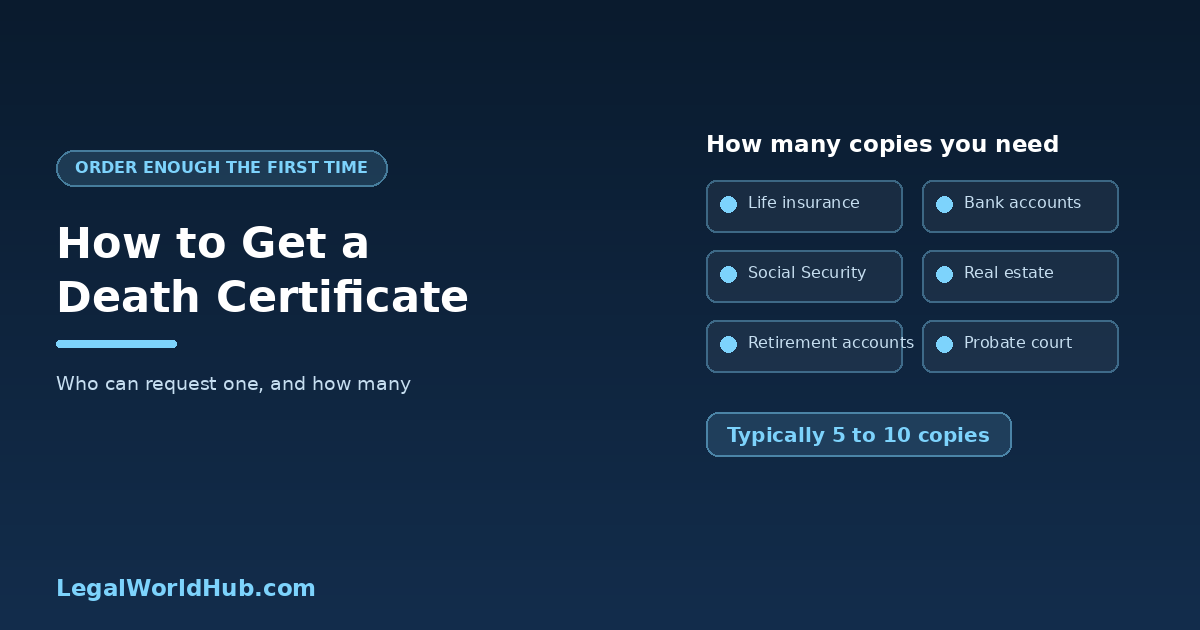
Each certified copy typically costs a modest additional fee beyond the first, so ordering enough at once is usually cheaper than reordering piecemeal. As a rough starting point, plan for a certified copy for each of the following that applies:
- Each life insurance policy claim
- The bank or credit union, for each account requiring closure
- Social Security, to report the death and stop or adjust benefits
- The county recorder’s office, for any real estate held in the deceased’s name
- Each retirement account or pension administrator
- The Department of Motor Vehicles, to cancel a license or transfer a vehicle title
- The court, if probate is opened
- Any outstanding loan or mortgage holder
Most people need somewhere between five and ten certified copies, though estates involving multiple properties, several financial institutions, or business ownership often need more. Ordering extras at the outset is nearly always cheaper than a second order later, since a second request usually repeats the full base fee rather than a smaller incremental charge.
What it costs
Fees are set individually by each state and, like birth certificates, vary meaningfully. Expect a base fee for the first certified copy, with each additional copy ordered in the same request typically priced lower than the first. Check your specific state’s official vital records fee page for the current amount, since these are updated periodically and a figure quoted elsewhere may be out of date.
Expedited service is usually available for an added fee if you need copies quickly for a time-sensitive matter such as an insurance claim deadline.
Timing matters more than people expect
Order more copies than you think you need, and order them early. Financial institutions, insurers, and government agencies each want their own certified original, not a photocopy, and running short partway through settling an estate means a delay while you wait for a reorder.
Some processes have their own deadlines. Certain insurance claims, benefit applications, and estate filings carry time limits separate from the vital records office itself, so check what each institution requires as soon as possible rather than waiting until you are ready to submit each one individually.
If the death occurred abroad
A death that occurs outside the United States to a US citizen is not filed with a US state vital records office. Instead, it is typically documented through a Consular Report of Death Abroad, issued by the US embassy or consulate in the country where the death occurred, working with that country’s local death registration. This is a separate process from state vital records entirely, and the resulting document serves a similar function for US legal and financial purposes.
Common reasons requests get delayed
Requesting from the wrong state. As with birth certificates, this is the most frequent and entirely avoidable delay.
Not meeting the eligibility requirement. A distant relative or unrelated party requesting a certified copy without a documented legal interest is a common rejection reason.
Ordering too few copies upfront, leading to a second request cycle later while an estate matter waits.
Missing or incomplete identification on a mail-in request, similar to birth certificate applications.
What to do next
- Confirm the state where the death occurred, which may differ from where the person lived
- Check if the funeral home already ordered copies, and how many
- Estimate the number of certified copies you will need across insurance, banks, retirement accounts, real estate, and any court process
- Order through the funeral home first if possible, then supplement directly through the state office if you need more
- Confirm you meet the state’s eligibility requirements before ordering as a non-immediate relative
If you are also handling a power of attorney matter or an estate that requires updating identity documents, see our guide to durable power of attorney for how that authority works, and note that a power of attorney automatically ends at death, so estate matters afterward run through the will, trust, or probate process instead. For the equivalent ordering process on the other vital record, see how to get a birth certificate. If the estate also involves the deceased’s own name having changed during their lifetime, our guide to legally changing a name explains what documentation to look for, and if it changed through marriage specifically, our guide to marriage certificate vs license explains which document actually proves it.
Frequently asked questions
Where do I get a death certificate?
From the vital statistics office in the state where the death occurred, or through the funeral home that handled the arrangements, since funeral homes typically file the initial death record with the state. There is no federal death certificate or national office that issues one.
Who is allowed to request a certified death certificate?
Generally the deceased’s spouse, parent, child, sibling, the legal representative of the estate, or someone with a documented legal or financial interest such as an insurance beneficiary. Requirements vary by state, and someone outside these categories may only be able to obtain a non-certified informational copy.
How many death certificates should I order?
Most people need between five and ten certified copies, covering life insurance claims, bank account closures, Social Security notification, real estate transfers, retirement accounts, and any probate court filing. Ordering extra copies upfront is usually cheaper than reordering later, since a fresh request generally repeats the base fee.
How much does a certified death certificate cost?
Fees are set individually by each state and vary. Expect a base fee for the first certified copy with a lower per-copy rate for additional copies in the same order. Check your state’s official vital records fee page for the current amount before ordering.
Can I get a death certificate if the person died in a different state than where they lived?
Yes, but you must request it from the state where the death actually occurred, not the person’s home state. That state holds the official record regardless of where the deceased normally resided.
What if the death happened outside the United States?
A death abroad involving a US citizen is documented through a Consular Report of Death Abroad, issued by the US embassy or consulate in the country where it occurred, rather than through a US state vital records office. This is a separate process specific to deaths outside the country.
Do I need a lawyer to request a death certificate?
No. Requesting a certified copy is an administrative process through the vital records office or funeral home, not a legal filing. A lawyer becomes relevant for the broader estate or probate process, not for ordering the certificate itself.
This article is general information, not legal advice. Eligibility rules, fees and processing times are set individually by each state and change periodically. Confirm current requirements with the vital records office for the state where the death occurred.