
Changing your name is not a form you fill in at the DMV. In most cases it is a court process, and the DMV, the Social Security Administration, and your passport office are all simply reacting to a court order after the fact.
That surprises people, and it is why so many name change attempts stall. You cannot update your driver’s license first and work backward. The order has to exist before anything else changes.
The two routes into a new legal name
Marriage or divorce. If you are changing your name as part of getting married or divorced, most states let you do it through the marriage license or the divorce decree itself, without a separate court petition. This is the cheapest and fastest route, and if it applies to you, use it rather than filing a standalone petition. See our guide to marriage certificate vs license for which document you actually need to prove the change.
Court petition. For any other reason, wanting a different first name, correcting a family name, choosing a name that reflects your identity, or simply preferring something else, you file a petition with the court. This is the process most people mean when they search for how to change their name, and it is the one covered here in detail.
The court petition process, step by step
The exact forms differ by state, but the sequence is broadly the same everywhere, and California’s process is a useful worked example because its courts publish it in unusual detail.
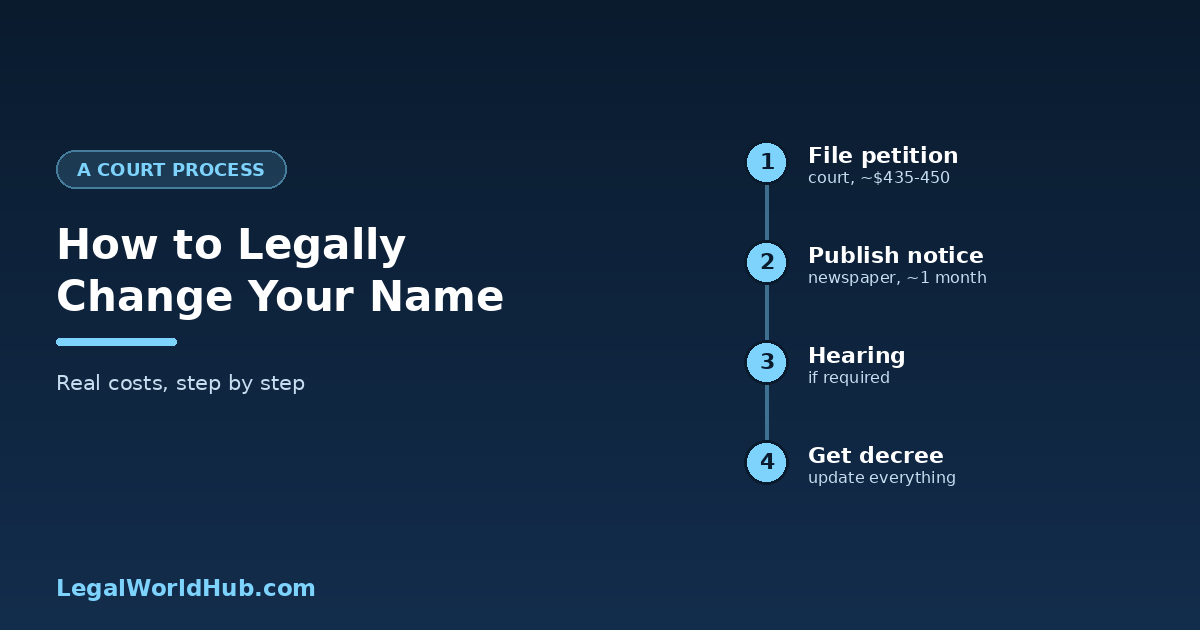
1. File a petition with the superior court in the county where you live. In California this is form NC-100, the Petition for Change of Name, along with supporting attachments.
2. Pay the filing fee, or apply for a fee waiver if you cannot afford it. In California the fee runs $435 to $450. If that feels high, apply for a waiver through the court’s fee waiver form. Courts do not require an elaborate justification for the name change itself. A brief, honest reason is generally sufficient.
3. Publish notice in a newspaper. This is the step almost everyone forgets exists until they hit it. Before a judge can decide, most states require the petition to be published in a newspaper of general circulation, typically once a week for about a month. This step exists to give any interested party the chance to object, and it carries its own separate fee, often ranging from roughly $50 to a few hundred dollars depending on the paper and the county.
4. Attend a hearing, if one is required. Some courts decide routine petitions without a hearing. Where a hearing is scheduled, you attend, a judge reviews the petition, and absent an objection or a legal problem, grants the order.
5. Receive the decree. This is the document that actually changes your name. Get several certified copies at this stage. You will need one for nearly every agency you update afterward, and requesting more later means going back to the court and paying again.
What it actually costs, all in
Treat any single number you see online with suspicion, because the true cost is several separate fees stacked together, and they vary by state and county.
| Item | Typical range |
|---|---|
| Court filing fee | A few hundred dollars, varies by state |
| Newspaper publication | Roughly $50 to a few hundred dollars |
| Certified copies of the decree | Usually $10 to $25 each |
| Updated driver’s license, passport, Social Security card | Often free to modest fees |
A fee waiver can eliminate the largest single cost if you qualify financially, which is worth checking before assuming the process is unaffordable.
Why the newspaper step exists, and what happens if you skip it
This requirement feels outdated to a lot of people, and in some states it now has exceptions, particularly for gender-marker and safety-related name changes where publication could put someone at risk. But in most ordinary petitions, skipping it is not optional. A judge generally cannot grant the petition without proof of publication filed with the court.
If your situation involves safety concerns, ask the court about a confidentiality or publication waiver rather than assuming none exists. Several states, including California, have specific provisions for exactly this.
What happens after the decree
The decree is the root document. Everything else branches from it, and the order you update things in matters, because some agencies require proof from the previous one.
Social Security first. File form SS-5 with the Social Security Administration along with your certified decree. Most other agencies and many employers will eventually cross-check your name against Social Security records, so this is the foundation.
Then your state driver’s license or ID. Bring the certified decree and your updated Social Security card if your state asks for it.
Then your passport, using the State Department’s passport renewal or new application process, with your certified decree as supporting evidence of the name change.
Then everything else: bank accounts, employer records, insurance policies, your voter registration, your lease or mortgage documents, and any professional licenses. If you also need a certified copy of your own birth certificate to support any of these updates, see our guide to how to get a birth certificate.
Keep at least one certified copy of the decree permanently. You will likely need to produce it again years later for something you cannot currently predict, a new passport renewal cycle, a real estate closing, or a background check.
If you are setting up estate planning documents around the same time, our guide to durable power of attorney covers how that separate document works and what it costs.
Special situations
Changing a minor’s name. Generally requires the consent of both parents, or proof that the other parent was properly notified if only one parent is filing. Courts scrutinize these petitions more closely, and a minor’s name typically does not have to be present at the hearing.
Name change as part of becoming a US citizen. Naturalization allows a name change as part of the same court process, avoiding a separate petition.
A criminal record or incarceration. Some states restrict or add extra steps to name change petitions for people with certain convictions or currently incarcerated individuals. This does not mean it is impossible, but expect additional requirements and check your state’s specific rules.
Correcting an error rather than choosing a new name. If your birth certificate contains a misspelling or clerical error, some states offer a simpler, cheaper correction process through the vital records office rather than a full court name change. Ask the vital records office in your state before filing a full petition.
Changing a deceased person’s name on record. Occasionally a family discovers a name discrepancy while settling an estate. See our guide to how to get a death certificate for how that record works and who is entitled to request one.
Frequently asked questions
How much does it cost to legally change your name?
There is no single national figure, because it depends on your state and county. As a real example, California’s court filing fee runs $435 to $450, plus a separate newspaper publication fee often in the range of $50 to a few hundred dollars, plus $10 to $25 per certified copy of the final decree. A fee waiver is available in most states for those who cannot afford the filing fee.
Do I need a lawyer to change my name?
Not usually. Courts design the standard name change petition to be completed without an attorney, and most state courts publish free instructions and forms specifically for people representing themselves. A lawyer becomes more useful for contested situations, complications involving a minor, or a criminal history that affects eligibility.
Why do I have to publish my name change in a newspaper?
It gives any interested party notice and the opportunity to object before a judge finalizes the change. Most states still require it for standard petitions, though a growing number offer exceptions or confidentiality options for safety-related changes, including many gender-marker cases.
What is the first thing I should update after my name change is approved?
Social Security, using form SS-5 along with your certified court decree. Many other institutions, including the DMV and employers, will eventually check your name against Social Security records, so updating there first avoids mismatches later.
Can I change my name for any reason?
In most states, yes. Courts generally do not require an elaborate justification, and a brief, honest reason is usually enough. Exceptions exist where the intent appears to be fraud, evading debt or legal obligations, or where the requested name is deemed inappropriate under state-specific rules.
Is changing your name after marriage the same process as a court petition?
No, and it is much simpler. Most states let you change your name through the marriage license application itself, without filing a separate court petition. The same generally applies to reverting to a former name as part of a divorce decree. Use that route if it applies to you rather than filing a standalone petition.
How long does the whole process take?
Several weeks to a few months in most cases, largely driven by the newspaper publication period, which typically runs about a month on its own, plus however long your court takes to schedule a hearing or review the petition afterward.
This article is general information, not legal advice. Filing fees, publication requirements and eligibility rules vary by state and county. Confirm current requirements with your local superior court or self-help center before filing.