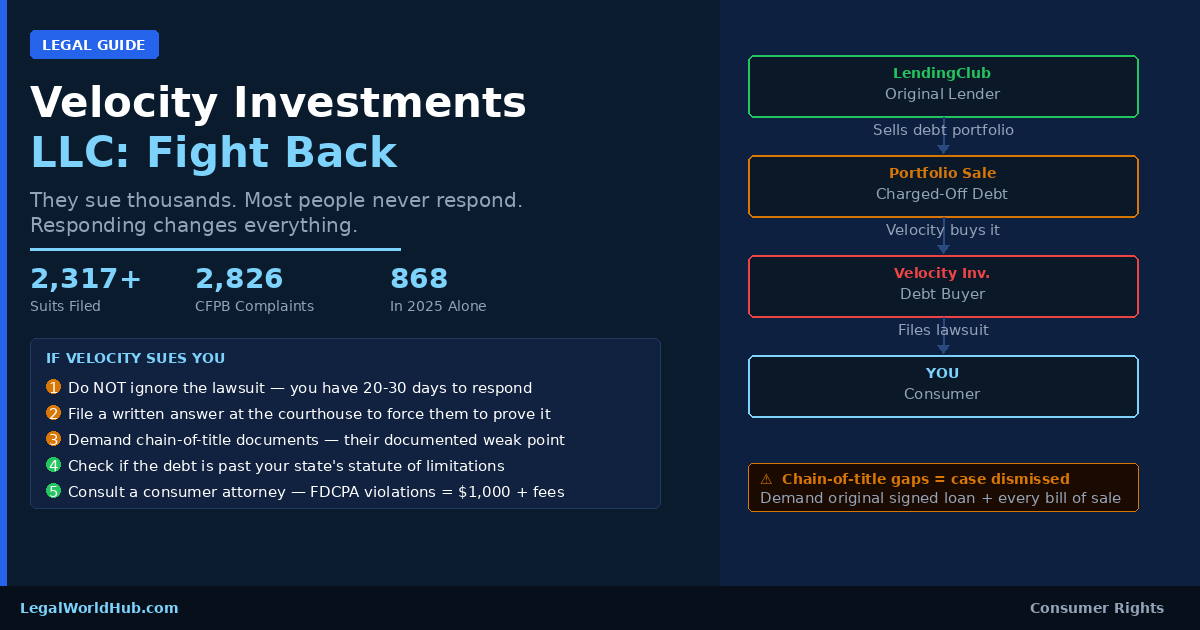
Velocity Investments LLC filed at least 2,317 collection lawsuits in a single New York county alone. Courts have repeatedly found their debt documentation deficient. They have 2,826 CFPB complaints, including 868 filed in 2025 alone. If Velocity contacts you or sues you, your documentation challenge could be their biggest weakness.
What Is Velocity Investments LLC?
Velocity Investments LLC is a debt buyer, not a traditional collection agency. The company is headquartered at 1800 Route 34, Suite 305, Wall Township, New Jersey 07719. Its parent company is Velocity Portfolio Group, Inc.
Velocity purchases portfolios of charged-off consumer debt at a fraction of face value, then tries to collect the full amount from consumers. The debt they buy comes primarily from fintech lenders including LendingClub, Prosper, and Upstart, companies that issue personal loans online.
This distinction matters. As a debt buyer, Velocity did not originate your loan. They purchased it from someone else, who may have purchased it from someone else before that. Every transfer in that chain must be documented to prove Velocity legally owns the debt and has the right to collect it. Courts have found this chain-of-title documentation lacking in multiple cases.
Velocity operates through a network of 60 or more partner law firms across all 50 states. When they decide to sue, a local attorney files the case in your state court, often a small claims or general district court where many consumers do not show up to defend themselves.
Velocity Investments LLC Lawsuits
Federal FDCPA Cases
Consumers have filed federal FDCPA lawsuits against Velocity Investments across multiple courts.
Jackson v. Velocity Investments
- Case No.: 25-cv-00087-LKG
- Court: U.S. District Court, District of Maryland
- Year: 2025
- Allegation: Velocity filed a collection lawsuit to collect a debt that was past the applicable statute of limitations, violating FDCPA Section 1692e (false and misleading representations) and Section 1692f (unfair practices)
Additional federal FDCPA cases have been filed in New Jersey, New York, and other jurisdictions, with allegations including improper collection letters, inadequate debt validation, and continued collection after written disputes.
State Court Collection Lawsuits
Velocity’s primary legal strategy is filing state court collection lawsuits. They filed at least 2,317 cases in Queens County, New York alone by 2013. They are currently active in Texas, California, New York, New Jersey, Georgia, Maryland, Indiana, Oklahoma, Missouri, and all other states.
What happens in these cases: Velocity or their law firm partner files a lawsuit in your local court. If you do not respond, Velocity wins a default judgment automatically, without presenting any evidence. With that judgment, they can garnish wages and bank accounts.
The documentation problem: Courts have repeatedly found Velocity cannot adequately prove they own the debt they are suing on. Every debt sale requires a clear chain of documents showing every transfer. When Velocity buys a portfolio from LendingClub, for example, they receive a spreadsheet of account numbers but often lack the original signed loan agreement, the charge-off records, and documentation of every intermediate sale. Challenging this chain of title is the single most effective defense in a Velocity lawsuit.
Velocity Investments Lawsuit and Complaint Timeline
| Year | Event |
|---|---|
| By 2013 | 2,317+ collection suits filed in Queens County, NY alone |
| 2018 | Multiple FDCPA class action filings in federal courts |
| 2021 | Class action filings over improper collection letters |
| 2025 | Jackson v. Velocity (D. Md.), time-barred debt suit |
| 2025 | 868 new CFPB complaints filed, highest single-year total |
Is There an Open Velocity Investments Settlement?
No. There is no open consumer class action settlement against Velocity Investments LLC as of September 2026. No CFPB, FTC, or state AG enforcement action has been filed against Velocity.
If you received a collection notice or lawsuit from Velocity, your options are individual, not through a class claim. See the defense steps below.
You can monitor open class action settlements for any new Velocity cases.
How to Write a Debt Validation Letter to Velocity Investments
If Velocity contacts you before filing a lawsuit, send this within 30 days of first contact by certified mail with return receipt. Keep the green return receipt card, it is your proof of delivery.
[Your Name] [Your Address] [Date]
Velocity Investments LLC 1800 Route 34, Suite 305 Wall Township, NJ 07719
Re: Account Number [XXXXXXX] – Request for Debt Validation
To Whom It May Concern:
I am writing in response to your communication dated [date of their letter] regarding an alleged debt. I am requesting written verification of this debt under the Fair Debt Collection Practices Act, 15 U.S.C. § 1692g.
Please provide the following:
- The name and address of the original creditor (the lender who first issued this account)
- A copy of the original signed loan agreement
- A complete account history showing how the current balance was calculated
- Documentation of every assignment or bill of sale showing the complete chain of ownership from the original lender to Velocity Investments LLC
- Proof that your company is licensed to collect debt in my state
Until you provide this written verification, please cease all collection activity as required by 15 U.S.C. § 1692g(b), including any credit reporting of this account.
Sincerely, [Your Name]
Note the chain-of-title request. Courts have dismissed Velocity cases specifically because they could not produce the original signed loan agreement and every intermediate sale document. Requesting this documentation early establishes your position.
If Velocity Investments LLC Sues You: Step-by-Step Defense
Most people Velocity sues never respond. Velocity counts on this. A default judgment gives them collection powers they would not otherwise have. Responding, even with a simple written answer, changes the entire dynamic.
Step 1: Do Not Ignore the Lawsuit
You have a deadline to respond, typically 20 to 30 days after being served, depending on your state. Missing it means Velocity wins automatically. Find the deadline on the court summons.
Step 2: File a Written Answer
You do not need a lawyer to file an answer. Go to the courthouse named on your summons, ask for an answer form (many courts have them), and check the box that says you deny the claims. Pay the filing fee (often $30 to $75). This forces Velocity to prove their case.
Step 3: Demand Proof of Debt Ownership
In your answer or in a separate discovery request, ask Velocity to produce:
- The original signed loan agreement between you and the original lender
- The bill of sale or assignment showing every transfer of the debt
- A complete accounting of the original balance, interest, and fees
- Proof that the debt is within your state’s statute of limitations
Courts have dismissed Velocity cases when they cannot produce complete chain-of-title documentation. This is their documented weakness.
Step 4: Check the Statute of Limitations
Every state sets a time limit on how long a creditor can sue to collect a debt. For personal loans, this is typically 3 to 6 years from the date of last payment. If Velocity filed a lawsuit after your state’s limit, that is an absolute defense — the case must be dismissed. It is also an FDCPA violation if they filed knowing the debt was time-barred.
| State | Personal Loan Statute of Limitations |
|---|---|
| California | 4 years |
| Texas | 4 years |
| New York | 3 years |
| New Jersey | 6 years |
| Florida | 5 years |
| Illinois | 5 years |
| Georgia | 6 years |
Check your state’s current statute, these can change.
Step 5: Consider Consulting a Consumer Rights Attorney
Many consumer rights attorneys handle debt collection defense on contingency or flat fees. If Velocity filed a time-barred lawsuit against you, that FDCPA violation could entitle you to $1,000 in statutory damages plus attorney fees, meaning the attorney gets paid by Velocity if you win, not by you.
Your FDCPA Rights Against Velocity Investments
As a debt buyer, Velocity is fully subject to the Fair Debt Collection Practices Act. Their law firm partners are also subject to the FDCPA when they send collection letters and file lawsuits on Velocity’s behalf.
Velocity cannot:
- File or threaten a lawsuit after the statute of limitations expires
- Misrepresent the amount owed
- Use deceptive tactics to pressure payment
- Call you before 8 a.m. or after 9 p.m.
- Contact you after a written cease-and-desist
You can:
- Request written debt validation within 30 days of first contact
- Send a cease-and-desist letter to stop all collection calls
- Sue Velocity for FDCPA violations, up to $1,000 statutory damages plus actual damages and attorney fees
- Raise time-barred debt as a complete defense to a collection lawsuit
How to Dispute a Velocity Investments Debt
Before a lawsuit is filed: Send a written debt validation request within 30 days of their first collection letter. Velocity must stop collection activity until they provide written verification.
After a lawsuit is filed: Respond to the lawsuit in court. Request all documentation in discovery. Challenge their ability to prove they own the debt.
For credit report disputes: If Velocity placed a collection entry on your credit report, dispute it with all three credit bureaus (Equifax, Experian, TransUnion) at annualcreditreport.com. If the entry is inaccurate or unverifiable, the bureaus must remove it.
Frequently Asked Questions About Velocity Investments LLC
Who is Velocity Investments LLC?
Velocity Investments LLC is a debt buyer headquartered in Wall Township, New Jersey. They purchase portfolios of charged-off personal loans from fintech lenders like LendingClub, Prosper, and Upstart, then attempt to collect the full balance from consumers through letters, calls, and state court lawsuits. Their parent company is Velocity Portfolio Group, Inc.
Why is Velocity Investments suing me?
Velocity purchased a debt they believe you owe and is attempting to collect it through a court judgment. A judgment gives them the legal ability to garnish your wages or bank account. You have the right to respond to the lawsuit and demand they prove ownership of the debt.
Can Velocity Investments garnish my wages?
Only after they win a court judgment. If you respond to the lawsuit and challenge their documentation, they may not be able to win that judgment. If you ignore the lawsuit, they will likely get a default judgment and then have the legal ability to garnish wages and accounts.
What happens if I ignore a Velocity Investments lawsuit?
The court will enter a default judgment against you. Velocity can then use that judgment to garnish your wages, levy your bank account, or place a lien on property, depending on your state’s laws. Always respond to a court summons by the deadline.
How do I beat a Velocity Investments lawsuit?
The most effective defenses are: (1) challenge their chain-of-title documentation, demand the original signed loan agreement and every bill of sale showing each transfer of the debt; (2) check whether the debt is past your state’s statute of limitations; (3) look for FDCPA violations in their collection letters or lawsuit that could entitle you to counterclaim damages.
Does Velocity Investments have the right to collect my debt?
Velocity must prove they legally own your debt through a complete chain of title, every assignment from the original lender to Velocity. Courts have dismissed Velocity cases when this documentation is incomplete. Demanding this proof in court is your right and their documented weak point.
Is Velocity Investments LLC a scam?
No. Velocity Investments LLC is a licensed, operating debt buyer. They are not a scam company. However, they have 2,826 CFPB complaints and courts have found their debt documentation deficient in multiple cases. Verify any debt they claim you owe and do not pay without confirming Velocity can prove ownership.
How do I contact Velocity Investments LLC?
Velocity Investments LLC is located at 1800 Route 34, Suite 305, Wall Township, NJ 07719. Any written disputes or cease-and-desist letters should be sent by certified mail, return receipt requested. Keep a copy of everything you send.
This article is for informational purposes only and does not constitute legal advice. If Velocity Investments has filed a lawsuit against you, consult a licensed consumer rights or debt defense attorney in your state.
Sources: CFPB Consumer Complaint Database (Velocity Portfolio Group); CourtListener federal case records; FDCPA 15 U.S.C. § 1692; New York Civil Court records; Jackson v. Velocity Investments, Case No. 25-cv-00087-LKG (D. Md. 2025).
Related: Halsted Financial Services: FDCPA Rights Guide | Transworld Systems: Know Your Rights | Open Class Action Settlements