Someone asks for proof you are married, for a name change, a visa application, an insurance form, and you hand over the document you kept from your wedding day. It gets rejected.
This happens constantly, and it is almost never carelessness. It is a genuine and reasonable mix-up, because a marriage license and a marriage certificate sound like two names for the same thing. They are not, and only one of them proves you are actually married.
The difference in one sentence
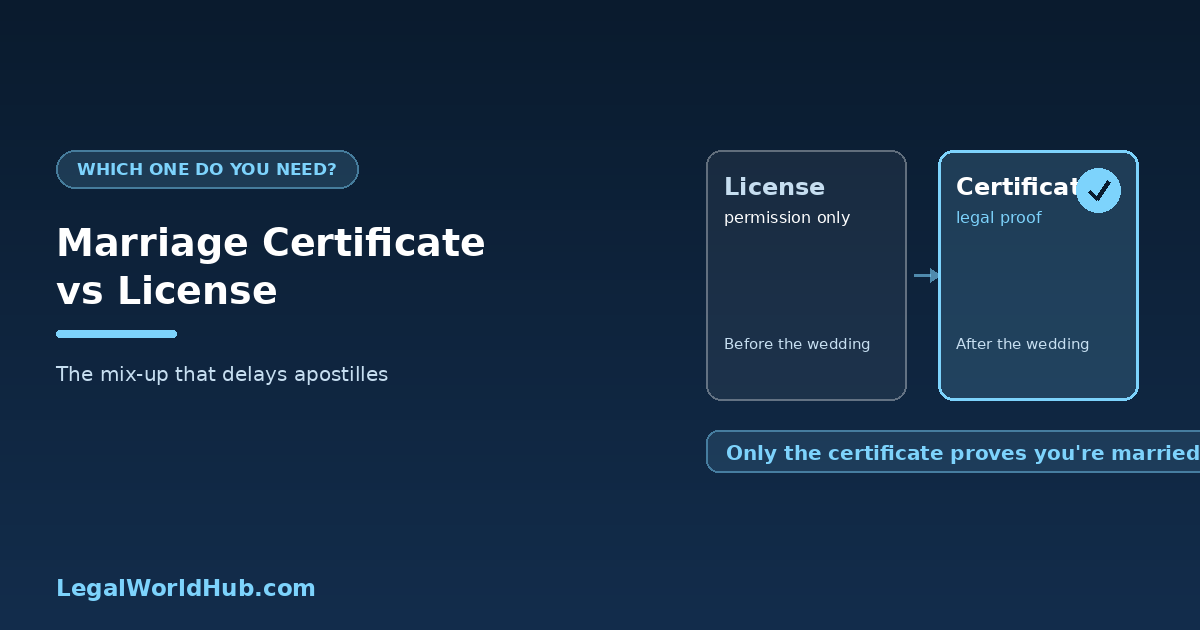
A marriage license gives you permission to marry. A marriage certificate proves you did.
They exist at opposite ends of the same process, and mistaking one for the other is the single most common error people make when a government agency, an insurer, or a foreign authority asks for proof of marriage.
| Marriage license | Marriage certificate | |
|---|---|---|
| When you get it | Before the wedding | After the wedding |
| What it does | Grants legal permission to marry | Proves the marriage happened |
| Who issues it | County clerk, before the ceremony | County or state vital records office, after filing |
| Validity period | Often expires after a set number of days if unused | Permanent record |
| Accepted for official proof of marriage | No | Yes |
| Eligible for apostille | No | Yes |
How one becomes the other
The sequence explains why so much confusion happens in the gap between them.
1. You apply for a marriage license at the county clerk’s office, typically in person, before the wedding. This step usually requires identification, sometimes a waiting period, and a fee. The license grants permission to marry but is not itself proof that a marriage took place.
2. You get married, in a ceremony performed by an authorized officiant.
3. The officiant signs the license and returns it to the county for official filing. This step is easy to overlook, and it is the one that actually creates the legal record. An officiant who forgets to file it, or a couple who assumes the ceremony itself was the final step, can leave a marriage technically unrecorded.
4. Once filed, the county or state issues a marriage certificate. This is the permanent legal record proving the marriage occurred, similar in function to how a birth certificate confirms a birth.
In most places, the certificate is not automatically mailed to you. You typically have to request a certified copy separately, sometimes weeks after the ceremony, once the county has finished processing the filed license.
What actually counts as proof of marriage
A certified copy of the marriage certificate is what institutions require: it carries a raised or official seal and the registrar’s signature, confirming it is a genuine government record rather than a photocopy or a decorative keepsake.
A decorative marriage certificate from your ceremony is not a legal document. Many couples receive an ornate, framed certificate as part of their wedding package, signed by the officiant and witnesses. It looks official and it means something personally, but it is not the government-issued record, and no agency will accept it as legal proof.
If you need proof of marriage for anything official, contact the county clerk or state vital records office where the marriage was recorded and request a certified copy.
Where to actually request the certified copy
Contact the office in the county or state where the marriage took place, not where you currently live. Some states hold marriage records at the county level, others centralize them at a state vital records office, so check which applies before assuming either way.
Most offices allow requests in person, by mail, or online, similar to the process for ordering a birth certificate. Processing times and fees vary by jurisdiction, and expedited service is often available for an additional charge if you need the document quickly.
The apostille trap
If you need your marriage certificate recognized in another country, for a visa, an international name change, or a foreign benefit application, this is where the license and certificate distinction becomes expensive to get wrong.
Only the certified marriage certificate can be apostilled. The license cannot, and neither can a decorative keepsake certificate.
An apostille is an authentication issued under the Hague Apostille Convention that confirms a document is genuine, so it can be legally recognized in another member country. It does not validate your marriage itself. It validates the signature and seal of the official who issued your certified copy.
A few things catch people out here specifically:
Long form versus short form. Where both are available, the long form record, which includes fuller detail such as the officiant and recording information, is generally the safer choice for international use, since foreign authorities handling immigration or citizenship matters often prefer it and request it again if the short form was submitted first.
Marriage records are state documents, not federal ones. An apostille for a marriage certificate is issued by the Secretary of State in the state where the marriage was recorded, not the state where you currently live, and not by any federal office. If you married in one state and moved to another, this is the detail most likely to send your request to the wrong office.
Hague versus non-Hague countries. For a country that is party to the Hague Apostille Convention, the state-issued apostille is generally sufficient on its own. For a country that is not, the document typically needs an additional layer of authentication, sometimes followed by legalization at that country’s embassy or consulate, which adds real time to the process.
Cornell’s Legal Information Institute has a general overview of marriage as a legal status if you want the underlying legal framework rather than the document-ordering process covered here.
Using a marriage certificate for a name change
If you are changing your last name after marriage, the certified marriage certificate is usually the document that unlocks everything else: your Social Security card, your driver’s license, and your passport.
This route is generally simpler than the court process required for other kinds of name changes. Most states let you change your name through the marriage license or certificate process itself, without filing a separate court petition. If your reason for changing your name is unrelated to marriage or divorce, see our guide to legally changing your name, which covers the court petition route instead. If you are updating estate planning documents around the same life event, see our guide to durable power of attorney.
What to do if the record cannot be found
If a county or state search turns up no marriage record, first confirm you are searching the correct jurisdiction, since this is the most common cause. If the record genuinely was never filed, perhaps because the signed license was never returned by the officiant, you may need to contact the officiant or witnesses directly, or in some cases pursue a court process to establish that the marriage occurred, similar in spirit to a delayed birth certificate process. See our guide to how to get a death certificate for how a comparable missing-record situation is handled with that vital record.
Frequently asked questions
What is the difference between a marriage license and a marriage certificate?
A marriage license is obtained before the wedding and grants legal permission to marry. A marriage certificate is issued after the ceremony, once the signed license has been filed, and serves as the official proof that the marriage took place. Only the certificate is accepted as legal proof of marriage.
Can I use my marriage license as proof I am married?
No. A marriage license only shows that you had permission to marry, not that you actually did. Agencies, insurers, and foreign authorities require the certified marriage certificate, issued after the ceremony and filing, as proof of marriage.
Is the decorative certificate from my wedding a legal document?
No. A decorative or keepsake certificate given at the ceremony, however official it looks, is not the government-issued record. You need a certified copy from the county clerk or state vital records office where the marriage was filed for anything requiring legal proof.
How do I get a certified copy of my marriage certificate?
Contact the county clerk or state vital records office in the location where the marriage was recorded, not where you currently live. Most offices allow requests in person, by mail, or online, and you will generally need identification and to pay a fee, similar to ordering a birth certificate.
Can a marriage license be apostilled?
No. Only a certified marriage certificate, issued after the marriage was recorded, is eligible for an apostille. A marriage license, and a decorative wedding-day certificate, are not accepted for this purpose.
Which state issues the apostille for my marriage certificate?
The Secretary of State in the state where the marriage was recorded and the certificate was issued, not the state where you currently live. This distinction catches people out often, particularly if you married in one state and later moved to another.
Do I need to change my name through court if I am taking my spouse’s name?
Usually not. Most states allow a name change as part of the marriage license or certificate process itself, without a separate court petition. If your name change is for a reason unrelated to marriage or divorce, a court petition is generally required instead.
What if the officiant never filed our marriage license?
Contact the county clerk’s office where you applied to check whether the record exists. If it was genuinely never filed, you may need to reach the officiant or witnesses to complete the filing, or in some jurisdictions pursue a specific legal process to establish that the marriage occurred and have it properly recorded.
This article is general information, not legal advice. Marriage licensing, certificate issuance and apostille requirements vary by state and by destination country. Confirm current requirements with the vital records office where the marriage was recorded before requesting a certified copy or an apostille.