How to Find Class Action Settlements You Qualify For
Most people find out about a settlement by accident, or not at all.
A notice arrives at an address you left in 2019. An email lands in spam with a subject line that reads like phishing. Or nobody contacts you, because the company’s records never had you properly in the first place.
You do not need to wait to be told. Notice is an attempt to reach class members, not a condition of being one. If you meet the class definition, you can file whether or not anyone contacted you.
Here is a method for finding what applies to you, working from what you already have rather than from luck.
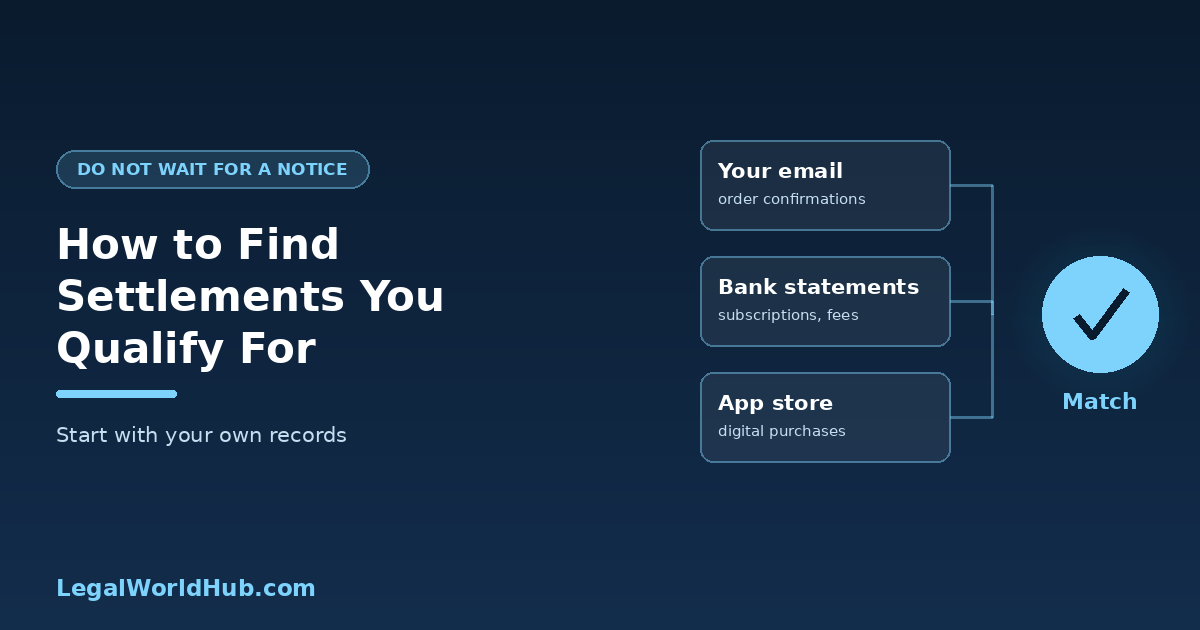
Start with your own records, not a search box
This is the step almost everyone skips, and it is the one that works.
Settlements are defined by what you bought, used or held, and when. So the fastest route is to build a short list of companies you have dealt with in roughly the last decade, then check those names.
Search your email archive. Search for terms like “order confirmation,” “your receipt,” “welcome to,” and “your account.” Include spam, promotions and any old email address you still have access to. A decade of purchases sits in most inboxes.
Scan a year of bank and card statements. Subscriptions and recurring charges are especially productive, because subscription billing, auto-renewal and fee cases are a large share of consumer settlements.
Check your app store purchase history. Apple and Google both retain it, and app and digital purchase settlements are common.
List the accounts you have closed. Old bank accounts, canceled phone contracts, former insurers and lapsed subscriptions all still count if the conduct happened during the class period. Closing an account does not remove you from a class.
Think about the invisible companies. This is the one people miss entirely. Data breach settlements often involve firms you have never heard of, because your information reached them through someone you did deal with. Our guide to the 700Credit data breach settlement covers a case where 5.8 million people got a notice from a company they had never used, because their data passed through it during vehicle financing.
Then search deliberately
With a list of company names, checking is quick.
Search the company name plus “class action settlement.” A genuine case of any size appears in news coverage and on the administrator’s own site.
Check the FTC’s refund distributions. These are government enforcement refunds rather than private class actions, and they often require no filing at all. The FTC publishes what it is currently paying out on its consumer refunds page.
Search your email for the administrators by name. Most settlements are run by a handful of firms: Epiq, Kroll, A.B. Data, Angeion and Simpluris. Searching those names in your inbox surfaces notices you deleted or never opened.
Check the court record if you want certainty. The PACER Case Locator indexes federal cases nationwide, though it charges $0.10 per page, so use it last rather than first.
Our list of open class action settlements tracks live cases with their eligibility rules and deadlines, and is updated weekly.
The categories most people qualify for without realizing
Working through these tends to produce more hits than searching randomly.
Data breaches. The single largest category. If you have ever been notified that your information was involved in an incident, at a retailer, a bank, a hospital, a telecom or a vendor you have never heard of, there is often a settlement behind it.
Bank and card fees. Overdraft fees, insufficient funds fees, foreign transaction charges and interest rate practices generate a steady stream of cases.
Subscriptions and auto-renewal. Enrollment and cancellation practices are heavily litigated. The Amazon Prime FTC settlement is a large recent example.
Privacy and tracking. App and website data sharing cases now cover very large user bases. The Flo period tracker settlement covers anyone who used the app during a three-year window and entered data.
Products and pricing. Mislabeling, defect and antitrust cases. The PlayStation Store settlement covers digital game purchases and pays automatically.
Children’s data. Frequently missed because the class period is long. The Google Play COPPA settlement covers anyone who was under 13 using a Google Play app from April 2015, which means many eligible claimants are now adults filing for themselves.
Reading a class definition properly
Finding a settlement is the easy part. Confirming you are in it is where people get it wrong in both directions.
Read the full definition, not the homepage summary. Settlement sites often say something loose like “if you bought this product you may be eligible.” The actual definition sits in the long-form notice and is precise about dates, states and account types.
The dates are exact. A purchase a month outside the class period does not qualify.
Check the exclusions paragraph. Short, and it usually rules out company employees, their families, the judge, and anyone who opted out.
Watch for state limits. Some classes are nationwide, others cover one state. The SunTrust overdraft settlement requires continuous Georgia citizenship across a seven-year period, which most summaries reduce to “Georgia residents.”
Our guide to checking whether you qualify works through this in detail.
What you will need to file
Two things determine how easy the claim is.
Documentation. Most consumer settlements require none, and let you attest instead. See settlements with no proof required and what counts as proof of purchase.
A claim ID. This is the more common obstacle. Some settlements let you file without one, others require the Unique ID and PIN printed on your mailed notice. If a settlement requires it and you cannot find your notice, contact the administrator early rather than close to the deadline, since reissuing takes time.
Set up a system rather than checking once
Most settlement money goes unclaimed because eligible people never hear about the case in time.
Do a sweep twice a year. Fifteen minutes through your email and statements, checked against open settlement lists.
Do not delete settlement emails. They look like phishing, which is exactly why people bin them. Verify instead, using the checks in our guide to class action settlement scams.
Keep your address current with administrators for any settlement you have already filed in. Payments arrive many months later, and checks to old addresses are a common way people lose money they successfully claimed.
Watch deadlines, not announcements. A settlement being announced does not mean claims are open. Claim windows typically open months later and close on a fixed date.
What to do when you find one
- Verify it is genuine before entering any personal information
- Read the full class definition against your own records
- Note all the deadlines, since claim, opt-out and objection dates frequently differ
- Decide which tier to claim
- File early, not on the deadline
- Watch your email until you are paid, because an unanswered administrator query voids more claims than anything else
Our guide to how to claim settlement money covers the process and the mistakes to avoid.
Frequently asked questions
How do I know if I am part of a class action lawsuit?
By checking the class definition against your own records, not by waiting for a notice. Build a list of companies you have dealt with in the last decade using your email archive, bank statements and app store history, then search each name plus “class action settlement.” If you meet the definition, you are a class member whether or not anyone contacted you.
Can I file a claim if I never received a notice?
Usually yes. Notice is an attempt to reach class members rather than a condition of being one. Most settlement websites let you file without a claim ID, or offer a lookup tool. A minority require the Unique ID and PIN from a mailed notice, in which case contact the administrator to have it reissued.
Is there one website that lists every settlement I qualify for?
No, and be wary of any service claiming otherwise, particularly one charging a fee. Settlements are administered separately by different firms, and no central register matches them to individuals. Tracker sites are useful for discovering that a case exists, but always file on the official administrator’s site.
How far back should I look?
Roughly ten years is a sensible window. Class periods commonly stretch back five to fifteen years, and some run longer. The Google Play COPPA settlement covers conduct from April 2015 to the present, and the SunTrust overdraft case reaches back to 2006.
Do closed accounts still count?
Yes. Class membership is determined by what happened during the class period, so closing an account, canceling a subscription or switching providers afterwards does not remove you. The practical risk is that the company no longer has your current address, which is why you may not have received a notice.
Why would a company I have never used send me a settlement notice?
Because your data reached them through someone you did deal with. Vendors handling payments, credit checks, billing or data processing operate behind the scenes, and a breach at one of them generates notices to millions of people who have never heard the name. These notices are frequently mistaken for scams and deleted.
Are settlement finder services worth paying for?
No. Filing a class action claim is always free, and any service charging a fee or taking a share of your recovery is offering something you can do yourself in minutes. The lawyers who brought the case are already paid from the settlement fund.
What if I find a settlement after the deadline?
Usually nothing can be done, as most settlements do not accept late claims. Worse, in most cases you remain bound by the release whether or not you filed, meaning you gave up the right to sue and received nothing. That is precisely why a periodic sweep is worth the fifteen minutes.
This article is general information, not legal advice. Eligibility is determined by the class definition in each individual settlement. Always verify on the official settlement website before filing.