A letter arrives with a case name, a court, a claim number and several pages of small print. Or an email lands saying you may be entitled to a payment from a company you dealt with years ago.
Most people do one of three things: bin it as junk, assume it is a scam, or set it aside meaning to deal with it later and then forget.
All three cost money, and the third is the most common.
Here is what the notice actually is, how to check it is genuine in about five minutes, and what each of your options really means.
First: what a class action notice is
A class action notice is a court authorised communication telling you that a lawsuit has been brought on behalf of a group of people, that you may be part of that group, and that you have decisions to make.
It is not a bill. It is not a demand. It does not mean you are being sued. It means a court has decided you have a right to know.
You may have received one because the company’s own records identify you, or because notice was published more broadly where the affected people could not all be identified.
Receiving a notice does not automatically mean you qualify. Administrators often send notice to a broad list because it is cheaper and safer than sending it narrowly. The class definition decides eligibility, not the envelope.
The reverse is also true and more important: not receiving a notice does not mean you are excluded. Addresses change, emails bounce, and companies hold incomplete records. Our guide to checking whether you qualify explains how to match a class definition against your own records.
Step one: check that it is real
Do this before you enter any personal information anywhere.
Do not click the link in the message. Open a browser separately.
Search for the case name or the company plus “class action settlement.” A genuine case of any size will appear in news coverage and on the administrator’s own site.
Check what the notice contains. A real notice names the defendant, describes the conduct alleged, gives a court and case number, names the claims administrator, states the class definition with dates, and lists the deadlines. Vagueness is the tell. Scammers avoid specifics because specifics can be checked.
Confirm the settlement website domain matches the one named in the notice, not one that merely resembles it.
If you want certainty on the court record, the PACER Case Locator indexes federal cases nationwide, though it charges $0.10 per page, so use the free checks first.
Check whether it is an FTC refund instead. Government enforcement refunds work differently and often require no filing at all. The FTC publishes what it is currently distributing on its consumer refunds page.
The rule that catches most fakes
Filing a class action claim is always free. The lawyers who brought the case are paid from the settlement fund, and administration costs come out of the fund too.
Any request for a fee identifies a scam on its own, with no further investigation needed. So does any request for your full Social Security number, your bank login, or payment in gift cards or cryptocurrency.
One nuance worth knowing: some legitimate claims, particularly in data breach cases, ask for the last four digits of your Social Security number to match you against company records. That is normal. The full number is not.
Our guide to class action settlement scams covers verification in more detail. If you have already been caught by one, report it at ReportFraud.ftc.gov, and if your data was exposed, IdentityTheft.gov is the FTC’s recovery resource.
Step two: read the class definition, not the summary
The homepage of a settlement site often says something loose like “if you bought this product you may be eligible.” The actual definition sits in the long form notice, and it is precise.
A typical one contains several separate tests, and you must pass all of them: who you are, what you bought or used, how you were affected, when it happened, and sometimes where you lived.
Dates are exact. A purchase a month outside the class period does not qualify. Neither does a business account when the class covers personal accounts.
Read the exclusions paragraph too. It is short and usually rules out company employees, their families, the judge, and anyone who already opted out.
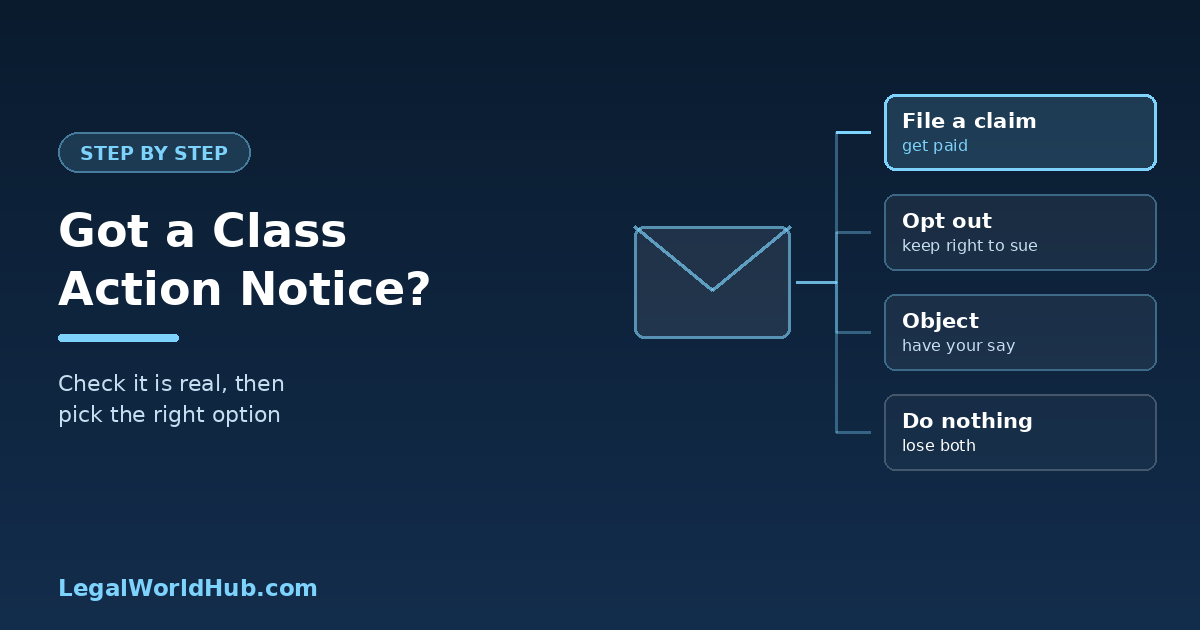
Step three: understand your four options
This is where most people go wrong, because doing nothing feels like a neutral choice. It is not.
| Option | What you get | What you give up |
|---|---|---|
| File a claim | A payment | The right to sue over these claims |
| Opt out | Nothing from the settlement | Nothing. You keep the right to sue |
| Object | A say, but usually stay in the class | Same as filing |
| Do nothing | Nothing | The right to sue, in most settlements |
Doing nothing combines the downside of filing with the downside of opting out. You are bound by the release either way, so you may as well be paid for it.
There are exceptions. A few settlements pay automatically with no claim form, and in those doing nothing is fine. But you have to check rather than assume.
Opting out is a real decision, not a formality
Opting out is the only way to keep your right to sue the company individually over the same issue. You receive nothing from the settlement.
For most people wanting a refund of a small overcharge, this makes no sense. The settlement pays something, individual litigation pays nothing unless you win.
But if your losses are substantial, or if you believe you suffered a genuine injury, it is worth speaking to a licensed attorney before the opt-out deadline. That deadline is often months earlier than the claim deadline, which brings us to the part people most often get wrong.
Step four: note the deadlines, all of them
A notice usually contains three or four dates doing completely different things.
Claim deadline. The last day to file. Miss it and you generally get nothing.
Opt-out or exclusion deadline. The last day to remove yourself from the class.
Objection deadline. The last day to tell the court you think the terms are unfair.
Final approval hearing. The date a judge decides whether to approve the settlement. Payments never go out before this.
These are frequently different dates, and the pattern varies. In some settlements all three fall on the same day. In others, opting out closes weeks or months before claims do. In a few, the opt-out window has already passed by the time most people read about it, leaving filing as the only remaining option.
Read your own notice rather than assuming. And if you see an earlier date and conclude you have missed everything, check again. The claim window is often still open.
Step five: file early, and then watch your email
If you decide to claim, file well before the deadline rather than on it.
Administrators routinely email claimants about deficiencies, meaning something missing, unreadable or inconsistent with company records. Those messages carry short response windows, and an unanswered query voids more claims than anything else after the deadline.
Filing on the last day leaves no room to fix a problem. Our guide to how to claim settlement money covers the full process and the mistakes that most often cost people their payment.
What to expect afterwards
Payment takes far longer than people expect. After the claim deadline, the administrator validates claims, the court holds a final approval hearing, and any appeal must resolve before money moves. Nine to eighteen months from filing to payment is normal, and two years is not unusual where there is an appeal.
The amount will probably be modest. Most consumer settlements divide a fund pro rata among everyone who files, after attorneys’ fees and administration costs. Our guide to how payouts are calculated explains why the headline figure is never what reaches claimants.
You may owe tax on it. It depends on what the payment replaces. Refunds of money you overpaid generally are not taxable. Statutory damages, interest and lost wages generally are. See whether settlement money is taxable.
If the notice arrived for someone else
Two situations worth covering.
The person has died. Many settlements allow an estate or legal representative to file. The administrator’s FAQ usually addresses this directly.
It is addressed to a former occupant or the wrong person. You cannot file on their behalf. If it looks genuine and you know the person, pass it on. If not, the administrator can be told the address is wrong.
What to do right now
- Verify it is real using the checks above, without clicking any link in the message
- Read the full class definition, not the summary
- Write down all the deadlines and which is which
- Decide whether to claim or opt out, and take advice if your losses are substantial
- File early and keep your confirmation
- Watch your email until you are paid
If you want to see what else is currently open, our list of open class action settlements is updated weekly, and our guide to settlements with no proof required covers the ones that take a few minutes to claim.
Frequently asked questions
Is a class action notice a scam?
Usually not. Genuine notices are court authorised and contain a named defendant, a court and case number, a named administrator, a class definition with dates, and deadlines. The reliable test is that filing a legitimate claim is always free. Any request for a fee, your full Social Security number, or banking credentials identifies a scam regardless of how official the message looks.
What happens if I ignore a class action notice?
In most settlements you remain a class member, you give up the right to sue over the claims covered, and you receive no payment. Ignoring it is not neutral. It is the option that combines the downside of participating with the downside of opting out.
Do I have to do anything if I get a class action notice?
Legally, no. Practically, yes if you want to be paid. Some settlements pay automatically with no claim form, but most require you to file. Read the notice to see which applies rather than assuming.
Why did I receive a notice for a company I do not remember using?
Class definitions can be broader than they appear, covering a subsidiary, a former brand name, or a service bundled into something else you bought. It can also mean the administrator sent notice to a broad list. Check the class definition against your own records before deciding either way.
Can I file a claim if I lost the notice?
Usually yes. Most settlement websites let you file without a claim ID, or offer a lookup tool that retrieves it from your name and address. A few require the ID from the mailed notice, in which case contact the administrator to have it reissued.
What is the difference between the claim deadline and the opt-out deadline?
The claim deadline is the last day to file for a payment. The opt-out deadline is the last day to remove yourself from the class so you can sue separately. They are frequently different dates, and opting out often closes first. Missing the opt-out date does not stop you filing a claim.
Should I get a lawyer?
Not to file a claim, and you should not pay anyone to file one for you. The lawyers who brought the case are already paid from the settlement fund. The exception is if you are considering opting out to sue individually, which is a genuine legal decision worth advice before the deadline.
How long until I get paid?
Nine to eighteen months from filing is normal, and longer where there is an appeal. Payment cannot happen before the court grants final approval and any appeal period closes. A check that has not arrived after six months almost never means fraud, it means the process is still running.
This article is general information, not legal or tax advice. The terms of your own notice govern. Always verify on the official settlement website before filing, opting out, or letting a deadline pass.